
 Modern wars are no longer fought only with fighter jets, missiles and drones. They are also fought with words, images and rumours. Often, the second battle lasts longer than the first. That is exactly what happened after Operation Sindoor in May 2025. India won the military engagement in the skies, but the narrative battle dragged on—until facts finally caught up.
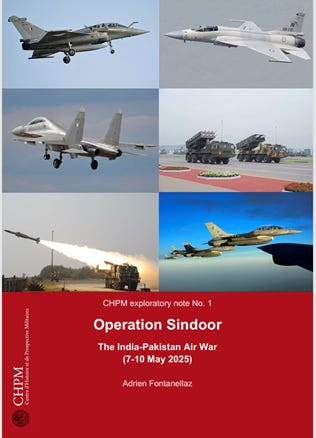
An independent report by the Swiss Centre for Military History and Perspective Studies (CHPM) has now brought much-needed clarity. Based on operational analysis rather than political positioning, the Swiss study concludes that India achieved air superiority and Pakistan sought a ceasefire because its military position had become untenable. The report is available here:
https://chpm.ch/wp-content/uploads/Operation-SIndoor-15-January-2026.pdf
This finding matters because the immediate post-war environment was thick with misinformation. Pakistan claimed dramatic successes. Anonymous accounts circulated exaggerated losses. Some international voices rushed to suggest that India had stopped under pressure. More dangerous—and frankly appalling—was the indigenously created narrative driven by murky domestic politics. Although evidence for these claims was weak, repetition gave them temporary life. In the digital age, rumours often travel faster than verification.
The Swiss report quietly dismantles these narratives.
It acknowledges that the opening night of the conflict was intense and contested. Pakistan did manage some early tactical successes. But wars are not decided in the first few hours. Over the following days, India systematically degraded Pakistan’s radar network, air defence systems and command coordination. As these systems weakened, Pakistan’s ability to operate safely even in its own airspace diminished. By the early hours of May 10, continuing the conflict carried unacceptable risks.

That is when Pakistan requested a ceasefire. I had written this on 17 May itself:
https://gpsmann.substack.com/p/pakistans-sudden-2025-ceasefire-with?r=3598n2
Not because of persuasion. Not because of goodwill. But because military conditions had shifted decisively, and Pakistan was facing its own internal pressures as well.
This directly contradicts claims made by former US President Donald Trump, who later suggested that he had “forced” India and Pakistan to stop fighting. The Swiss report offers no support for this claim. It does not credit any foreign mediation as decisive. Instead, it places the ceasefire squarely in the context of battlefield realities. In simple terms, the war ended because one side lost escalation space.
Operation Sindoor was not a symbolic strike or a short-lived retaliation. It was a carefully calibrated air, missile and drone campaign designed to destroy terror infrastructure and degrade enabling military assets. Moreover, it was executed with restraint. Objectives were clearly defined, escalation was controlled, and operations stopped once those objectives were achieved. That combination—force with discipline—is the mark of a mature power.
Yet despite this, doubt lingered.
Why?
Because India still struggles with narrative confidence. It often allows others to describe its actions first, and sometimes louder. Moreover, misinformation ecosystems thrive on uncertainty. They do not require proof—only momentum. In such an environment, silence or hesitation becomes costly.
India today is not a hesitant or emerging actor unsure of its place. Economically, diplomatically and militarily, it has crossed a threshold. Operation Sindoor demonstrated that India can conduct complex, high-technology operations, impose real costs on an adversary, and step back without losing advantage. That is not weakness. That is control.
What remains unfinished is the information battle.
India does not need propaganda. It needs digital warriors—citizens, analysts and professionals who can read reports, understand context, and calmly counter lies. This is not about shouting back. It is about consistency, clarity and patience. Moreover, it is about trusting facts to do their work. I had highlighted this need earlier as well:
https://gpsmann.substack.com/p/indias-war-on-lies-needs-digital?r=3598n2
The Swiss report has now done what weeks of noise could not. It has secured the story with evidence. It has exposed inflated claims, self-serving myths and false political narratives. In fact, the political narrative became so vicious that it deliberately blurred the thin line between being anti-party and being anti-India.
After winning the air war, missile war and drone war, India has finally won the war of narratives too.
Although the truth arrived late, it arrived firmly.
And once facts are established, they have a habit of outrunning rumours—no matter how loud those rumours once sounded.