
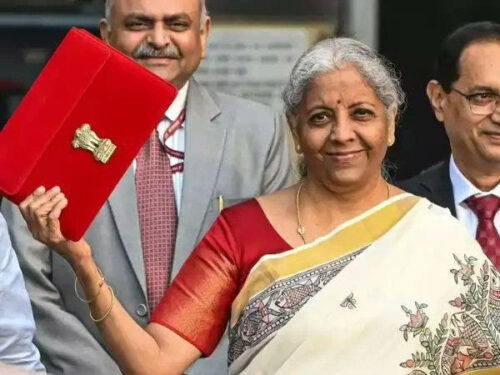
 Union Budget 2026–27, presented by Finance Minister Nirmala Sitharaman in her ninth successive budget, must be read less as a routine fiscal exercise and more as a political economy statement of India’s evolving growth model. It is a Budget that speaks confidently of macroeconomic stability, capital formation, services exports and technological leadership, yet remains notably restrained in its engagement with the uneven geography of Indian development. In doing so, it reinforces a central paradox of contemporary Indian federalism: growth is national, but adjustment is regional.
There is also a popular perception, reinforced over successive budget cycles, that selective incentives are often discreetly embedded for States approaching electoral contests. Against this backdrop, the absence of any explicit Punjab-specific announcement inevitably generated disappointment within the State. Some, however, continued to nurse the hope that a compensatory gesture might still be forthcoming—perhaps through an announcement by Prime Minister Narendra Modi during his visit to Dera Ballan in Jalandhar. Such expectations were always misplaced. By long-established convention, no substantive policy announcements are ordinarily made while Parliament is in session, least of all on the very day the Union Budget is presented.
At the aggregate level, Budget 2026–27 is orthodox and reassuring. Fiscal consolidation continues, the debt-to-GDP trajectory is brought under control, and public capital expenditure remains the principal lever for sustaining growth amid global uncertainty. Inflation moderation, resilient financial markets and a stable currency are presented as outcomes of deliberate policy discipline. Yet political economy is not merely about fiscal arithmetic. It is about who benefits from growth strategies, which regions are structurally positioned to gain, and which States are left to manage the social and political consequences of transition.
Centralised Growth, Constrained Federalism
Despite formally accepting the 16th Finance Commission’s recommendation of 41 per cent vertical devolution, Budget 2026–27 continues to hollow out the operational space of States. Economic transformation is increasingly channelled through centrally designed missions, challenge-mode funding, and national digital architectures, leaving States as implementing agencies rather than co-authors of growth strategy.
For fiscally stressed States like Punjab, this model presents a structural dilemma. With high committed expenditures, limited borrowing headroom and shrinking discretionary space, Punjab is expected to align with centrally framed priorities while absorbing the political risks of reform locally. The Centre retains agenda-setting power; the States retain accountability.
Cesses, Surcharges and the Hollowing of Fiscal Federalism
A deeper and more structural fault-line in Union–State fiscal relations, left unaddressed in Budget 2026–27, is the continued and expanding reliance on cesses and surcharges, which today hover in the vicinity of ₹4.5 to ₹5 lakh crore annually. These levies, though collected under laws passed by Parliament, are kept entirely outside the divisible pool and are therefore retained 100 per cent by the Union. In effect, they represent a systematic bypassing of constitutional devolution. This is difficult to justify either economically or constitutionally. At the end of the day, these are still taxes imposed on citizens under parliamentary authority, and there is no persuasive rationale for their permanent sequestration at the Centre. Even where such levies are justified for specific purposes—be it health, infrastructure or energy transition—the objectives could be achieved far more effectively by devolving both funds and functions to State governments, who are better placed to make informed, context-sensitive choices. Retaining cesses and surcharges centrally not only weakens State finances but also corrodes the spirit of cooperative federalism, reducing States to implementers of centrally determined priorities rather than autonomous fiscal actors.
Punjab’s Structural Drift
Punjab’s relative invisibility in Budget 2026–27 is emblematic of a deeper malaise. Once the backbone of India’s food security and a robust contributor to national growth, Punjab now finds itself in structural limbo—its agrarian engine exhausted, its industrial base weakened, and its services sector underdeveloped.
The Budget’s agricultural narrative is expansive but generic. It emphasises diversification, fisheries, horticulture, high-value crops and technology-driven advisory platforms. These initiatives may be meaningful for many States, but they skirt Punjab’s central crisis: an economy locked into wheat–paddy monoculture through MSP-backed procurement, without a credible exit framework.
For Punjab, agriculture is not merely a sector; it is a socio-political ecosystem involving landholding patterns, rural employment, credit networks and electoral mobilisation. Any transition away from MSP-centric procurement requires carefully sequenced reform, compensatory mechanisms and federal negotiation. Budget 2026–27 avoids this terrain altogether. There is neither a roadmap for procurement reform nor a fiscal framework to support early-transition States. The result is reform by silence, which merely postpones adjustment while compounding uncertainty.
Agriculture without Federal Dialogue
The Centre’s reluctance to confront procurement reform reflects political caution, but the costs of this caution are borne disproportionately by States like Punjab. Procurement operations, storage inefficiencies and rural credit stress are effectively decentralised burdens, even as procurement policy remains centralised.
Technological interventions—AI-enabled agristacks, digital advisory platforms and integrated databases—may improve efficiency at the margins, but they cannot substitute for political consensus on restructuring incentives. Punjab’s farmers remain locked into a system whose fiscal sustainability is increasingly questioned, yet whose reform is politically deferred. This is not cooperative federalism; it is managed ambiguity.
MSMEs: National Vision, Regional Blind Spots
The Budget is most persuasive in its articulation of MSMEs as engines of growth and employment. The ₹10,000 crore SME Growth Fund, enhanced liquidity through TReDS, expanded credit guarantees and equity support are well-designed instruments. However, the absence of regional anchoring limits their transformative potential.
Punjab’s MSME landscape—textiles, sports goods, light engineering, machine tools and food processing—has steadily lost competitiveness due to rising input costs, environmental compliance pressures, power tariffs and outdated technology. Budget 2026–27 announces schemes for capital goods, container manufacturing and textiles, yet fails to address why traditional industrial clusters such as Ludhiana and Jalandhar continue to stagnate.
The challenge-mode allocation of funds further disadvantages States with weaker fiscal capacity and administrative agility. Punjab, burdened by debt and constrained capital expenditure, may struggle to compete with States that already enjoy stronger industrial ecosystems. National MSME policy thus risks amplifying regional divergence rather than correcting it.
Services: Growth without Spatial Strategy
Services dominate India’s growth narrative, and the Budget reflects this through initiatives in logistics, tourism, healthcare, education and digital exports. Yet Punjab remains peripheral to this vision, not due to lack of potential, but due to lack of spatial imagination.
Tourism development focuses on iconic destinations, eco-trails and Buddhist circuits, with little attention to border States whose cultural, religious and diasporic capital is substantial. Punjab’s religious tourism, cultural industries, education services and healthcare potential find no dedicated policy articulation. Similarly, while global capability centres and services exports are encouraged, non-metro service hubs receive scant attention. The Chandigarh–Mohali–Panchkula region could have been positioned as a northern services node; it remains an afterthought.
Data Centres and the Geography of Services Growth
The Budget’s generous tax incentives for data centres and cloud-based services deserve particular scrutiny from a federal perspective. These investments promise stable, long-term revenues and high-value employment, and the Budget actively courts them through income tax exemptions and facilitative policies. However, the geography of data infrastructure is not neutral.
Data centres require enormous and uninterrupted power supply, sophisticated cooling systems, proximity to undersea cable landing stations, and access to abundant water or coastal cooling options. Consequently, such investments gravitate towards coastal States or regions with surplus power and maritime connectivity. For a landlocked State like Punjab—already facing power constraints, rising energy costs and water stress—the probability of attracting large-scale data centre investments is inherently limited.
In effect, while the Union offers uniform fiscal incentives, natural endowments and infrastructure asymmetries determine outcomes. Punjab cannot realistically compete for these investments, yet the Budget does not compensate for this structural disadvantage by proposing alternative service-sector pathways tailored to inland States. This underscores a broader issue: services-led growth without regional differentiation risks becoming geographically exclusionary.
Federalism Reduced to Compliance
Budget 2026–27 reflects a steady transformation of Indian federalism from partnership to compliance. States are expected to align with national priorities, adopt centrally designed platforms and compete for limited discretionary funds, all while managing local social and political fallout.
Punjab’s predicament is illustrative. It is urged to modernise agriculture without procurement reform, revive MSMEs without fiscal space, and participate in services growth without locational advantages. Meanwhile, debt servicing crowds out developmental expenditure, constraining the State’s ability to invest in future growth.

The Politics of Omission
Perhaps the most revealing feature of Budget 2026–27 is not what it promises, but what it avoids. There is no candid engagement with regional economic fatigue, no acknowledgement of States trapped between legacy growth models and uncertain futures, and no framework for differentiated transition strategies.
This silence is political. It reflects an implicit belief that national growth will eventually resolve regional stagnation, that markets can substitute for federal dialogue, and that States must adapt rather than negotiate. For Punjab, this is a precarious wager.
Conclusion: Growth Needs Geography
Budget 2026–27 is fiscally prudent and macroeconomically coherent. Yet political economy demands more than coherence; it demands contextual sensitivity. Growth strategies that ignore geography risk producing national success alongside regional decline.
Punjab does not seek exceptionalism. It seeks recognition of its structural constraints, a credible transition framework for agriculture, regionally anchored MSME revival, and service-sector strategies that account for inland realities. Without a renewed federal compact that differentiates rather than homogenises, Punjab risks remaining suspended between nostalgia and neglect.
A Viksit Bharat cannot be built on uniform incentives applied to unequal terrain. It requires a federalism that listens, negotiates and adapts. Budget 2026–27, for all its ambition, still speaks primarily in the language of the Centre—and too rarely in the voice of the States.
·
Jan 24