
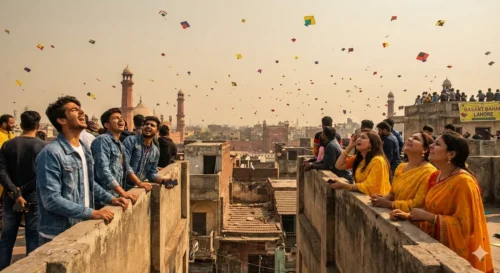
 A yellow sky over Lahore is never just about kites. It is about a city insisting, against clerics and courts, against bans and blackouts, that spring must arrive, that rooftops must be reclaimed, that joy is a public good. This Basant, nearly two decades after the last state-sanctioned kite took off in Lahore, young men in jeans and women in bright saris leaned over parapets, shouting “Bo-kaata!” into the February air, as if to slice through not just rival strings but the long, dour season of Pakistan’s Islamisation (video clip).
If you only watched India’s television debates, you might think this is a civilisational victory, proof that “Indic” culture has finally seeped back through the Radcliffe Line, turning “their” youth into “our” kite-flying Punjabis. That is a comforting story—and a dangerously shallow one. What is happening on Lahore’s rooftops is not a plebiscite in favour of Akhand Bharat. It is something more complicated and more revealing: a state-managed re-appropriation of Punjabi culture to shore up a fraying federation, launder the image of Pakistan Punjab, and quietly signal to Sikhs across the border that this Punjab, too, remembers mustard fields and Basant.
1. A spring that refused to die
Long before Pakistan, Basant Panchami marked the loosening of winter’s grip across North India. In Lahore, the kite-flying Basant under Maharaja Ranjit Singh transformed a seasonal observance into a spectacular urban festival: turbans in basanti shades, yellow rice, fairs around the city’s shrines, and, above all, a riot of paper triangles in the sky. Lahore’s pride in Basant was not devotional; it was civic.
That sensibility survived Partition. Through the 1960s to the early 2000s, Basant in Lahore became an anchor of a shared Punjabi urban culture: landlords and labourers on the same skyline, rooftop bands, late-night “Basant nights” in hotels, and a city branding itself as bohemian and welcoming in an otherwise anxious republic. Crucially, it never belonged to one community. The festival sat on the seam of many identities—Punjabi, Lahori, vaguely Sufi—but never resolved into Hindu, Muslim or Sikh.
This is precisely why it could be turned into a battleground. As Pakistan’s public space narrowed from the Zia era onwards, anything visibly exuberant, syncretic, or pre-Islamic became suspect. Basant—loud, mixed-gender, rooted in the soil rather than scripture—was an obvious target.
2. How a safety ban became an ideological veto
On paper, the death of Basant was about safety. By the early 2000s, kite-flying in Lahore had mutated into a deadly sport. Glass-coated manjha and metallic string slit throats of children on motorbikes, high-tension lines tripped, celebratory gunfire became the macho soundtrack of spring. Hospitals and power utilities had the numbers to prove that kites were killing. The Lahore High Court and, later, the Supreme Court leaned heavily on these statistics to demand restrictions. The West Punjab administration responded with blanket bans on kite-making and flying, interspersed with a brief, failed experiment in “regulated Basant” around 2008.
But public policy is never just about the text of a court order. Around the same time, a discursive shift was underway. Conservative activists and lawyers began describing Basant explicitly as a “Hindu festival” and linking it to polemical episodes like Haqiqat Rai. Official statements in 2018 went so far as to refuse revival on the ground that this was “the Hindu spring festival of Basant Panchami”, as if the kite in a Lahori child’s hand were smuggling polytheism into an Islamic republic.

The safety narrative provided the legal fig leaf; the religious narrative supplied the emotional and ideological charge. Together, they froze a living festival in time. An entire generation of urban Punjabis grew up with only nostalgic stories—parents recalling rooftop romances, tourists remembering “Basant nights”, but no lived experience of that collective, sensory excess.
And yet, Basant never quite died. Kites flew discreetly in back lanes. Underground kite-makers kept their craft alive. Social media filled with sepia-tinted photos of pre-ban Basants. The sky over Lahore became, paradoxically, more present in memory for having been emptied.
3. The state rediscovers Basant
The decision of the Pakistan Punjab Government under Maryam Nawaz to bring back Basant in Lahore is therefore not an impulsive populist gesture but a carefully calibrated political act. The festival has been tightly corralled: a three-day window, essentially confined to Lahore; licensing of kite-makers; mandatory cotton string; bans on large kites; heavy policing; and, tellingly, a sweeping prohibition on religious or political imagery on kites under Section 144.
This is not the spontaneous Basant of the 1990s. It is Basant as a controlled release valve. The language from Lahore’s rulers is revealing: talk of “heritage”, “cultural revival”, “youth entertainment”, “tourism”, “economic activity”. Basant is recast as a heritage commodity and a governance deliverable, something a modern, competent provincial administration gives its people—alongside metro lines and IT parks—to prove that life is still liveable in Pakistan.
At the same time, the religious sting is painstakingly pulled. By insisting on Basant as a Punjabi, not Hindu, festival, and by banning all religious and political symbols from the sky, the state is telling both Islamists and hyper-nationalists: this is not your arena. You may denounce or celebrate from the sidelines, but the festival will be curated from the Chief Minister’s Secretariat in Lahore, not the pulpit.
In that sense, the revival is less a defeat of Islamisation than its domestication. The state does not concede that it was wrong to ban a “Hindu” festival; it simply rewrites Basant as something else and sells that rebranded product back to the public.
4. Lahore’s rooftops and the crisis of Pakistani federalism
You cannot read this move in isolation from Pakistan’s larger crisis of cohesion. Balochistan is scarred by insurgency and repression; Khyber Pakhtunkhwa and the tribal districts are under the shadow of new-wave Taliban militancy; Pakistan-occupied Kashmir, which Islamabad officially styles as “Azad Kashmir”, simmers; Karachi’s ethnic balance and MQM politics remain fragile; Sindh’s elite chafe at what they see as Punjabi domination. The only truly national institution that works with cold efficiency is the army.
In such a setting, Lahore’s Basant serves several overlapping functions.
First, it re-centres Punjab—again—as the cultural heart of Pakistan. When global media show laughing Lahoris on multicoloured rooftops, they are not looking at Quetta or Gwadar, Peshawar or Miranshah. They are looking at the city that already dominates the state’s political imagination. A sky full of kites becomes an image of national normalcy, but it is a very specific part of the nation that is allowed to look normal.
Second, it offers a relatively cheap way of buying consent from a frustrated, job-starved urban youth. When you cannot guarantee employment or reliable electricity, you can at least give people a weekend of legally sanctioned joy. The message is clear: this government, this province, is not just about raids and IMF conditionalities; it can also restore the “good old days”.
Third, it gives the Pakistan establishment a softer vocabulary to speak about nationhood. Instead of only flags, martyrs, and nuclear deterrence, it can talk of “heritage”, “festivals”, “culture”. In a federation where most cultural symbols are contested along ethnic lines, Punjabi cultural markers, when sanitised of explicit religion, can be projected as national without provoking secessionist anxieties—precisely because Punjab already holds the whip-hand.
None of this means that the return of Basant is a sinister conspiracy drawn up in GHQ. It does mean that the winds filling those kites are not just meteorological. Power always rides the breeze.
5. A quiet message to Sikhs—and a caution to India
There is also, in our humble opinion, a clever eastward gaze in this story. Over the last few years, Pakistan has invested substantially in soft Sikh religious diplomacy: the Kartarpur corridor, refurbished gurdwaras, and a flood of slick reels that emphasise Guru Nanak’s birth in Nankana Sahib, Rai Bular’s generosity, and the care with which Pakistani authorities tend to Sikh shrines. The unspoken message to Sikhs and Punjabis in India is: the physical memory of your gurus lives more fully on our side.
Basant’s revival complements this narrative. For Sikhs in the Indian Punjab, Basant Panchami is not a central religious date, but the imagery—mustard fields, basanti turbans, the verse “aayi basant, pala udant”—is deeply familiar. When Lahore markets its Basant as a Punjabi, not Islamic, festival, and when those images leak across borders, it is not hard for a Sikh or Hindu Punjabi viewer in Amritsar or Jalandhar to feel a pang of recognition. This is not yet a call to political unity; it is a call to emotional contiguity.
From Islamabad and Lahore’s perspective, such soft cultural convergence is low-cost and high-yield. It does not challenge Pakistan’s Islamic identity, because the festival is framed as heritage, not worship. It does not concede any Indian claim, because the state insists this is Pakistani Punjab’s own legacy. But it does create a thin membrane of shared feeling that can be activated when needed—whether for tourism, diaspora donations, or diplomatic messaging.
For India, especially for those invested in an RSS-style civilisational narrative, there is a temptation to read Lahore’s Basant as capitulation: they banned “our” festival, and now, under pressure of history, they must revive it. This is analytically lazy. What we are seeing is not Pakistan being absorbed into an Indic civilisational space, but Pakistan—specifically Pakistan Punjab—curating which fragments of that older civilisational space it will admit, under what names, and under whose control.
6. Kites, not coronations
An honest reading of Basant’s revival therefore requires holding three truths together.
First, at the level of lived experience, this is genuinely about joy and memory. For the young in Lahore, it is the first real Basant of their lives. For their parents, it is the recovery of a lost soundscape—the whistle of falling kites, the surging cheer of “Bo-kaata!”, the smell of basmati and gunpowder. Any analysis that does not start from this human register risks becoming bloodless.
Second, at the level of provincial politics, it is a carefully stage-managed show of confidence by a Punjab desperate to reclaim some moral authority in a battered federation. The festival is not just happening; it is being administered, policed, branded, and sold. The same apparatus that banned kites now leases out the sky by the hour.
Third, at the level of India–Pakistan and Sikh–Muslim relations, it is a subtle gesture of cultural outreach wrapped in a thick layer of deniability. Lahore can always say: we are simply celebrating our spring. Delhi can always claim: they are returning to their Indic roots. The real work is done in the domain of emotion, not ideology.
In other words, what is taking off from Lahore’s rooftops this February is not the coronation of Indic civilisation, nor the betrayal of Pakistan’s ideological foundations. It is a set of small, brightly coloured, tightly supervised experiments in how far an Islamic state can loosen its grip on culture without losing control. The kites are light. The questions they raise about power, identity and memory are anything but.