
 The same logic applies to red sorghum for animal feed, which is essentially jowar in Indian terms. Here the political language risks running ahead of agronomic reality. Jowar is not a major crop in Punjab or Haryana. Its cultivation is limited and region-specific, far more relevant to parts of central and southern India than to the north-western plains.
To claim that red sorghum imports will destabilise Punjab agriculture is to confuse a trade category with a lived cropping pattern. If anything, the real question for Punjab and Haryana is not whether jowar imports will upend them, but whether feed innovations—domestic or imported—can help stabilise livestock economics without harming local producers.
Processing and Value Addition: Where the Real Opportunity Lies
Where there could be impact is in the processing ecosystem: feed manufacturing, oilseed crushing, and food processing. But that is precisely where Punjab and Haryana should be positioning themselves for the future. If trade integration nudges India away from raw commodity dependence and towards processing, branding, and export-oriented value chains, that is not inherently a threat—it is an opportunity.
Large cooperatives such as MARKFED and Punjab Milkfed should not be defensive spectators. They should be at the forefront—scaling up processing, improving quality control, investing in brands, exploring overseas markets, and even undertaking joint ventures abroad where feasible. Punjab’s long-term problem is not “lack of protection”; it is lack of diversification and weak value-add per unit of land and water.
The Big Picture: Dairy Matters More Than We Admit
It is also worth placing the debate in its macroeconomic context. Crops and horticulture account for roughly 15–16 per cent of GDP, while dairy and animal husbandry contribute close to 10 per cent and serve as the most widespread, inclusive “cash-flow stabiliser” for rural households. The interim framework appears to leave dairy market access untouched. In other words, the most socially broad-based component of rural income remains insulated.
Alarmism that suggests systemic rural collapse does not align with the economic structure of the countryside.
The Missing Debate: Export Curbs Hurt More Than Trade Jargon
However, there is one area where Punjab and Haryana farmers have a legitimate, immediate and under-discussed grievance—and it does not begin and end with the MSP narrative.
Export policy—especially for rice, and most of all for basmati—matters far more to farm incomes than many of the slogans currently dominating the airwaves. Basmati is not merely a crop; it is a premium export brand, a value chain involving growers, millers, exporters, and rural labour. When export restrictions are imposed—formally through bans, minimum export prices, quotas, or informally through bureaucratic signalling and delayed clearances—the price transmission is swift and direct. Farmers do not feel the impact in abstract terms; they feel it in the mandi that week.
If farmer unions want a cause that affects incomes immediately and demonstrably, they should be ready to press—calmly and forcefully—whenever export restrictions are introduced without a credible, time-bound rationale. A mature farm politics should demand transparency and predictability in export policy, not only statutory slogans around MSP.

Transparency Is the Antidote to Propaganda
This is where the debate on the interim framework should land: not in a reflexive rejection of trade vocabulary, but in a clear-eyed demand for transparency—product lists, quotas, standards, and safeguards. Interim agreements are, by definition, incomplete. The real details lie in annexes, schedules, and implementation rules. If the Government of India believes the impact on Punjab and Haryana is minimal, it should demonstrate that with published schedules, clear caps, and enforceable standards—so that misinformation cannot fill the vacuum.
Not All Regions Are Equal: J&K and Ladakh Face Sharper Exposure
It is also important to recognise that all regions are not similarly placed. Jammu & Kashmir and Ladakh face a different exposure. Almonds, apples, and walnuts—often tucked inside broad trade terms such as “tree nuts” and “fresh and processed fruit”—are central to their rural economies. Import competition there can have sharper consequences, not only for farmers but for employment across the entire horticulture chain. Their concerns merit targeted safeguards and—if adjustment costs arise—credible compensation.
Conclusion: Engage, Don’t Agitate Blindly
Punjab and Haryana must avoid becoming collateral participants in someone else’s grievance. Farmer unions play an essential role in safeguarding rural interests. But they also carry a responsibility: not to mobilise on partial readings, unfamiliar terminology, or propaganda, especially when the direct exposure appears limited.
The interim framework does not dismantle Punjab’s procurement economy. Nor does it open dairy. Nor does it meaningfully attack the core cereal backbone of the two states. The wider reality is unavoidable: Indian agriculture cannot remain frozen in a procurement-driven, cereal-heavy model indefinitely. If farmers are to secure rising incomes, they must move up the value chain—into processing, branding, exports, better farmgate aggregation, and market-led diversification. Trade agreements, handled wisely, can be instruments in that transition.
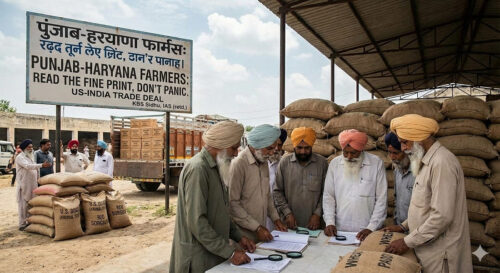
For Punjab and Haryana farmers, the message is simple: read carefully, ask hard questions, insist on transparency—but don’t panic. And if there is one policy arena that deserves sharper, sustained pressure, it is the one that hits farm incomes immediately: export policy—especially for basmati. That is where farm politics can become both informed and effective.