
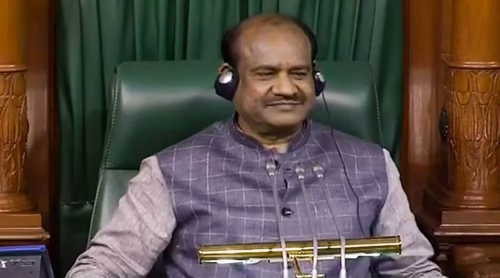
The recent calls for a no-confidence motion against the Lok Sabha Speaker represent a dangerous precedent that threatens to undermine the very institutional framework that sustains Indian democracy. While Opposition voices have raised concerns about House proceedings, a closer examination reveals why removing the Speaker would be counterproductive to the democratic process itself. The Speaker’s primary responsibility is to maintain order and decorum in the House. Critics claim the Opposition is being “silenced,” but this conflates orderly debate with unlimited disruption.
The Speaker must balance multiple competing demands. Time allocation requires careful management, as with 543 MPs and limited parliamentary sessions, strict scheduling becomes essential. Procedural compliance ensures members cannot speak out of turn or without proper recognition. Maintaining decorum means that disruptions preventing legislative business must be appropriately controlled. Without these guardrails, Parliament would descend into chaos where the loudest voices dominate rather than reasoned debate prevailing.
The Opposition has ample opportunities to raise issues through established parliamentary mechanisms. Question Hour allows direct interrogation of ministers. Zero Hour provides time for matters of urgent public importance. Adjournment motions can halt business for critical discussions. Parliamentary committees offer a detailed examination of policies and bills.
If the Opposition chooses to boycott proceedings or create disruptions that prevent the House from functioning, the Speaker must act to restore order. Parliamentary privilege is not a license for chaos. It is a protection for substantive debate, not a shield for obstruction.The accusation of silencing rings hollow when examining the actual record of opportunities provided versus opportunities utilised constructively.
Trade policy debates belong in substantive discussions, not no-confidence motions against the Speaker. The government has provided multiple opportunities for debate on economic matters through budget sessions, standing committees, and dedicated discussion time. Disagreement with policy outcomes doesn’t justify attacking the institution’s leadership. The Speaker facilitates debate; they do not determine trade policy. Conflating these roles distorts the constitutional separation of powers between the legislative chair and the executive government.If the Opposition believes the country has been misled, the appropriate response is to present evidence, demand debates, and build public pressure through legitimate parliamentary channels.
Agricultural policy requires serious legislative discussion, which the Speaker actively facilitates. Parliamentary committees on agriculture regularly examine farming issues. Budget sessions allocate time for rural development discussions. Dedicated debates on agricultural bills provide forums for these concerns.
The Speaker cannot be held responsible for policy decisions made by the executive branch. Farmers’ welfare depends on good governance and sound policy, not on removing the parliamentary referee who ensures fair play in debates.
Blaming the Speaker for agricultural distress misdirects legitimate grievances away from those who actually formulate and implement farm policy. Removing a Speaker through a no-confidence would politicize a neutral office that must rise above party politics. The Speaker’s authority depends on being seen as an impartial arbiter, not as a political target to be removed when one side feels disadvantaged. This move encourages instability by creating a template for future disruptions. Every time an Opposition feels frustrated, they could threaten the Speaker rather than engaging with actual policy debates. Parliament would become mired in endless procedural battles.
It undermines institutional authority at a fundamental level. If the Speaker can be removed for enforcing rules, those rules become meaningless. Parliament’s ability to function depends on a respected, stable leadership that can make tough calls without fear of political retaliation.Perhaps most critically, it distracts from governance. Time spent on confidence motions is time not spent legislating, debating policy, or addressing constituent needs. Political theater replaces substantive work.
Yes, the people’s money funds Parliament—which is precisely why it must function efficiently. Unlimited speech time and tolerance for disruption would bring legislative work to a halt, wasting the very public resources the Opposition claims to protect.The Speaker enforces rules that all members agreed to uphold when they took their oaths of office. These rules exist to ensure everyone gets heard, not just those willing to shout the loudest or disrupt the longest.Democracy is not merely about the freedom to speak; it is about the discipline to listen, the structure to enable productive debate, and the institutions that balance competing voices into coherent governance.
Critics argue that the Speaker has shown partisanship in allowing government business while curtailing Opposition interventions. They point to specific instances where ruling party members received extended time while Opposition MPs were cut short or denied recognition.They contend that legitimate concerns about trade agreements affecting farmers deserve more floor time, especially when government policies may have far-reaching economic consequences. The Opposition argues that procedural rules are being weaponized to avoid accountability.
These critics maintain that the current approach reflects a concerning concentration of power that stifles democratic debate. They argue that when the Speaker consistently favors one side, the neutral arbiter role has already been compromised.Finally, they contend that accountability mechanisms, including no-confidence motions, are essential checks on any office-holder who appears to favor the ruling party over institutional neutrality. Without such checks, they argue, the Speaker’s office becomes an instrument of majority dominance rather than parliamentary fairness.