
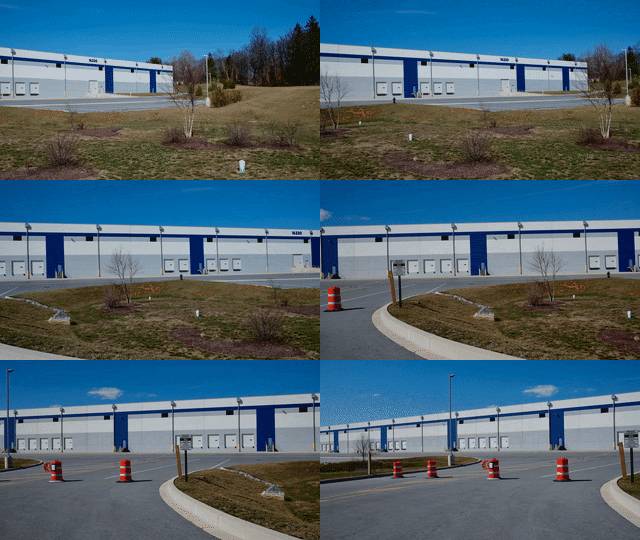
 I drove out to the site of one of the most controversial new ICE facilities in the country this afternoon, an 825,000 square foot warehouse built with the hopes of being used or sold to a logistics company like Amazon but which was recently purchased by Immigration and Customs and Enforcement for a million dollars to hold people instead of boxes.Although often described as the “Hagerstown facility”, the building is actually in the much smaller town of Williamsport, home to 2,000 people. If ICE uses this facility at (or over) its stated initial capacity of 1,500 people, the population of the town will effectively double in size.
The building currently has four toilets and two water fountains. It was designed as a logistics hub, allocated just six Equivalent Dwelling Units of water by the city of Hagerstown, a measure meant for a warehouse where trucks come and go, not a facility where 1,500 human beings are supposed to live. Given the size of the facility, I can’t imagine they will stop at 1,500 if they actually manage to open this facility.
Hagerstown has said it doesn’t have the water capacity for a project like this. County commissioners have floated the idea of drilling wells or trucking water in, but even the volunteer researchers tracking this project have pointed out that trucking water for a facility of this size would be, to put it mildly, quite a task.
The federal government has now spent at least $215 million on the site. The $102.4 million purchase in January was followed last week by a $113 million build-out and operations contract awarded to KVG LLC, a firm based in Gettysburg, Pennsylvania. That contract has options to grow to $642 million over three years.
The whole thing is being run through a Navy contracting vehicle called WEXMAC, originally created for overseas military deployments and quietly amended in 2025 to cover the domestic United States. The ceiling on that contract was recently raised from $10 billion to $55 billion.
Before KVG got the job, a $29.9 million design contract had already collapsed when the Citizen Potawatomi Nation, a Native American nation tied to the design work, announced it had exited the agreement, leaving the facility’s design in what one tracking group called “legal and administrative limbo.”

Career ICE officials have reportedly warned that the expansion is unworkable. A federal procurement specialist with 25 years of experience told the volunteer research group Project Salt Box that experienced civil servants’ concerns are being “systematically overruled by political leadership.” ERO staff, the source said, continue to state that this is not a viable option.
Maryland’s attorney general has filed a 28-page lawsuit to halt construction, alleging DHS violated the National Environmental Policy Act by purchasing the facility without an environmental review. The state’s governor sent a 10-page letter raising concerns about sewer capacity, heating, traffic, and backup generators. According to the state’s own filings, ICE is planning to have the facility operational by September.
Standing in front of the building, what strikes you is how enormous and barren the facility is. It’s a massive metal and concrete box set back from the road, with bay doors built for loading and unloading tractor trailers—not people. Across the street up a small rise, several single family houses overlook the facility. I wonder what they will witness from their living room and dining room windows by the end of the year. The conversion that ICE is attempting, from warehouse to human storage, is not a renovation so much as a statement about what this administration believes immigrants are.
I took the photos below and the video above (they are functional, not artistic), and I am making them all available for public use by anyone for any purpose, including any editing and manipulation—just please provide attribution back to this post. Thank you.