
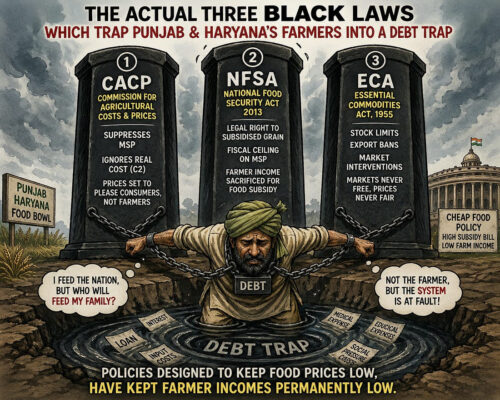
 Were the repealed “three farm laws” truly the ‘kale kanoon’ or do the real ‘kale kanoon’ lie deeper within India’s policy architecture, unaddressed and largely ignored? This column attempts to examine that question.Parliament’s data presented in February 2026 reveals an uncomfortable truth about India’s agricultural economy. The average farm household debt in Punjab stands at ₹2.03 lakh and in Haryana at ₹1.83 lakh, among the highest in the country, against a national average of about ₹74,000. Nearly 89 percent of farm households in Punjab are indebted, and total institutional debt in Punjab and Haryana exceeds ₹2 lakh crore.
Punjab and Haryana have delivered near-100 percent procurement of wheat and rice at MSP for decades, feeding the Public Distribution System and filling government granaries. Yet they continue to sink deeper into debt.This paradox is not market failure. It is the outcome of a policy architecture that systematically suppresses farm-gate prices, anchored in three institutions: the Commission for Agricultural Costs and Prices (CACP), the National Food Security Act (NFSA) 2013, Essential Commodities Act (ECA) 1955.
Agriculture: The Largest Livelihood Sector Without a National Policy
India remains fundamentally agrarian. About 46 percent of the population — roughly 65 crore people — directly depend on agriculture, while over 80 crore Indians depend on it directly or indirectly. Yet agriculture contributes only 15–16 percent to GDP.Despite this, India still lacks a comprehensive national agriculture policy. Policy has evolved largely to ensure cheap food and low inflation, not sustainable farm incomes. That is the reason that the structural and policy architecture is anti farmer and let me explain the three unspoken policies which are slowly squeezing the farmers.
1. CACP’s Terms of Reference: A Structure Designed to Balance, Not Reward
The CACP, established in 1965 and governed by Terms of Reference last revised in 2009, continues to guide MSP recommendations under a framework shaped for an earlier era — when the priority was food scarcity and inflation control, not farmer income security.The Commission’s mandate itself reveals the inherent contradiction. It must recommend MSP:

“…with a view to evolving a balanced and integrated price structure and with due regard to the interests of the producer and the consumer.”Its mandate requires MSP to ensure a “balanced and integrated price structure” with due regard to both producers and consumers. This “balance” is the core problem.MSP is not determined solely by farm costs but by inflation, cost of living, wages and broader economic considerations. It is a tool of macroeconomic management. The methodology reinforces this bias. MSP is based on A2+FL costs, not the more comprehensive C2 cost including land and capital. This systematically understates the real cost of farming.
The outcome is clear. According to the OECD, India’s agricultural policies generate negative price support of about –14 to –15 percent of farm receipts effectively an implicit tax on farmers.As Sharad Joshi observed, “Bharat subsidises India” rural producers transfer value to urban consumers through suppressed prices. Dr S.S. Johl similarly warned that MSP-led procurement has locked Punjab into an unsustainable wheat–paddy cycle.
2. NFSA 2013: The Fiscal Ceiling on MSP
If CACP moderates MSP from below, the NFSA 2013 caps it from above.
The Act legally entitles 67 percent of India’s population to subsidised grain. To sustain this, the government procures 60–70 million tonnes annually, largely from Punjab and Haryana.
The economic cost now exceeds ₹2,200–2,500 per quintal, while grain is issued at ₹1–3 per kg. The gap forms the food subsidy, now over ₹2 lakh crore annually. Because this entitlement is legally enforceable, MSP increases must remain fiscally manageable. Thus MSP becomes tied not to farm economics but to budget constraints.
Schemes like PM-Kisan, though well-intentioned, remain marginal almost like returning a dime after taking away a pound.
As Ashok Gulati notes, nearly 80 percent of agricultural subsidies benefit consumers, as equity is pursued through price suppression rather than income support.
3. ECA 1955: The Market That Never Fully Functions
The Essential Commodities Act (1955) completes the framework. Through stock limits, export bans and market interventions, it creates persistent uncertainty. Private investment in storage and value chains remains constrained. Whenever prices rise, intervention brings them down. Farmers rarely benefit fully from favourable markets. It is no coincidence that non-MSP sectors like dairy and horticulture grow at 5–8 percent, while MSP-dependent cereals stagnate at 2–3 percent.
The Mirage of a Legal MSP
The demand for a legal MSP guarantee has gained traction. But if the methodology itself understates real costs and is faulty, what exactly will be guaranteed?
A legal MSP based on A2+FL would simply legalise a suppressed price, leaving the distortions of CACP, NFSA and ECA intact. As Ashok Gulati warns, such a move could distort markets, crowd out private trade and impose heavy fiscal burdens. Dr. S.S. Johl has repeatedly argued that universal MSP procurement is impractical.
The demand risks becoming a mirage something farmers are made to chase while structural problems remain untouched.
Punjab’s Experience: Food Security Without Farmer Prosperity
Punjab offers the clearest evidence. Four decades of near-total procurement on MSP have ensured national food security but not farmer prosperity. Instead, the state faces high indebtedness, ecological stress and a narrow wheat–paddy cycle; precisely the outcome policy failed to prevent.
Beyond Slogans: Need for Structural Reform
For decades, voices like Sharad Joshi, S.S. Johl, Bhupinder Singh Mann, and Ashok Gulati have warned that India’s agricultural policy suppresses farm prices to serve urban consumers. What we are witnessing is a structural transfer of income from agriculture to the rest of the economy. The real challenge is not expanding MSP, but restructuring the policy framework itself. As long as agriculture is treated as an instrument of food subsidy and inflation control, farmer distress will persist.
For nearly eight decades, the Indian farmer has fed the nation often at personal ruin. The question now is stark:
Can India’s food security continue to rest on the economic insecurity of its farmers?