
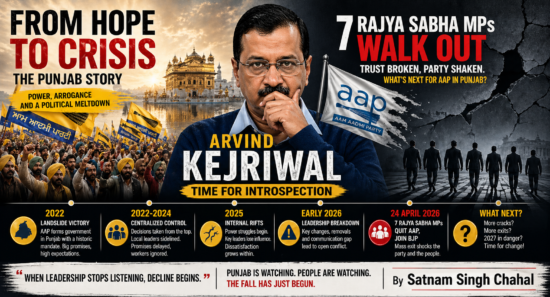
After the historic 2022 mandate in Punjab, Arvind Kejriwal and the Aam Aadmi Party leadership were seen as symbols of a new political revolution. The people of Punjab voted with hope—hope for clean governance, strong leadership, and a system that would listen to the common man. But within a short span of time, that hope began to fade. What started as confidence soon turned into arrogance, and instead of strengthening grassroots democracy, decision-making became increasingly centralised. Punjab’s voice, many believe, was slowly replaced by remote control politics.
In the initial phase after 2022, several key decisions raised serious questions. Leaders who were not deeply connected to Punjab’s realities were elevated to powerful positions, including Rajya Sabha seats. Local party workers and regional leadership felt ignored, as if the mandate of Punjab was being managed from outside rather than respected from within. The gap between leadership and ground workers widened, but these concerns were either dismissed or overlooked.
Between 2022 and 2024, the focus appeared to shift away from delivering on major promises toward consolidating political control. Instead of strengthening governance, there was growing criticism that authority mattered more than accountability. This period saw increasing dissatisfaction not just among observers, but within the party itself. Voices of disagreement were not encouraged, and internal democracy appeared to weaken.
By 2025, the internal cracks had become too visible to ignore. Senior leaders and strategists who once played a key role in the party’s success began to lose influence. Confusion over leadership roles, lack of clear direction, and growing mistrust created an unstable environment within the party. The very individuals who were once celebrated as the “brains” behind Punjab’s victory were now feeling sidelined.
Then came 2026 the turning point. The exit of seven Rajya Sabha MPs shocked the political landscape. These were not ordinary members; they were carefully selected and trusted by the leadership. Their departure has raised a fundamental question: if the leadership itself chose them, what went wrong? Why did those insiders decide to walk away? This is not just defection—it reflects a deeper crisis of confidence within the party.
Today, the situation in Punjab has become a serious political concern. Supporters feel confused, critics feel vindicated, and neutral observers see it as a lesson in leadership failure. Blaming those who left may not be enough, because the root issue lies deeper.
The truth is simple: when leadership stops listening, when humility is replaced by arrogance, and when decisions are imposed rather than discussed, the foundation begins to crack. Punjab is witnessing that reality today. And this may not be the end more political instability, more dissent, and more damage could follow.
The people of Punjab are watching closely. They gave a historic mandate with trust and expectation, and now they expect accountability. This is the time for introspection.
Power is temporary, but public trust is everything. Once that trust breaks, the fall is inevitable and in Punjab, that fall may have just begun.
— By Satnam Singh Chahal