
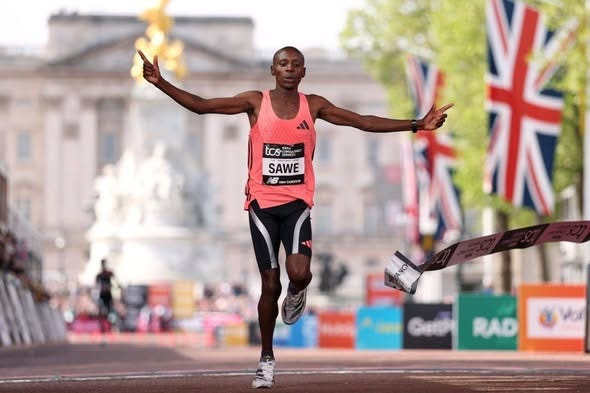
A Bannister Moment for the Marathon:Kenya’s Sebastian Sawe crosses the line at the London Marathon in 1:59:30, officially bringing down the two-hour barrier and redefining the limits of human endurance.
Citius, Altius, Fortius
On 6 May 1954, at the Iffley Road Track in Oxford, during a meeting between the Amateur Athletic Association and Oxford University, the British athlete Roger Bannister ran the mile in 3 minutes 59.4 seconds and gave sport one of its most enduring metaphors. In front of a modest crowd on a windy English evening, paced by Chris Brasher and Chris Chataway, he showed that a barrier widely treated as natural, final and almost sacred could, in fact, be broken. Ever since, a “Roger Bannister moment” has meant that rare instant when the impossible suddenly becomes possible.
The Olympic motto — Citius, Altius, Fortius, faster, higher, stronger — captures precisely this spirit. It is not merely a slogan for medals and podiums. It is a philosophy of human striving: the disciplined belief that inherited limits are not final walls but thresholds waiting for courage, imagination and perseverance.
The Marathon: Myth, Distance and Endurance
The marathon has carried a similar aura for generations. For more than a century, it has fused myth, physiology, suffering and romance: 26 miles and 385 yards of patience, pain, pacing and willpower. That exact distance, now taken for granted, was fixed only in the early twentieth century, when the Olympic marathon from Windsor Castle to the stadium in London set the template that was later standardised worldwide.
Its emotional power, however, reaches much further back. The race takes its name from Marathon, the plain where the Athenians defeated the Persians in 490 BC. According to an old Greek legend, a messenger named Pheidippides ran from Marathon to Athens, cried out “Nenikēkamen” — “We have won” — and then collapsed and died. Whether history or legend, the story has endured because it captures something elemental: the human being spending himself completely in the service of a cause larger than himself. His body may have fallen on that ancient road, but his spirit lives on in every marathon run across the world, whenever men and women choose to test the outer limits of endurance.
Roger Bannister: Breaking the 4-minute barrier in 1954
When the Two-Hour Wall Fell
That is why what happened at the London Marathon today feels so immense. Sabastian Sawe of Kenya ran the course in 1 hour 59 minutes and 30 seconds, becoming the first athlete to break two hours in an official marathon and cutting more than a minute from the existing world record, subject of course to the usual ratification process. This was not merely an outstanding athletic performance. It was the destruction of one of sport’s most famous psychological and physiological frontiers.
And Sawe was not alone in redefining the event. Ethiopia’s Yomif Kejelcha finished in 1:59:41 on his marathon debut, while Uganda’s Jacob Kiplimo ran 2:00:28, also faster than the previous world record. That clustering of astonishing performances around a once-mythic threshold is what gives the moment its true Bannister quality: once the barrier yields, others immediately begin to push through the opening.
From Bannister’s Mile to the Metric Age
Bannister’s own record did not remain untouched for long. The mile, once the glamour distance of middle-distance running, kept falling by fragments of human possibility — from 3:59.4 in 1954 to Hicham El Guerrouj’s 3:43.13 in 1999. In other words, the world’s best milers eventually carved more than sixteen seconds from Bannister’s immortal mark. Yet the mile never came close to three minutes; instead, as athletics became increasingly metric, the 1500 metres took centre stage at the Olympics and major championships, while the mile slowly faded from the front rank of global competition into the annals of sporting history. Its romance survived, but its centrality diminished.
That, too, is part of sport’s deeper rhythm. Some records do not merely fall; some events themselves change shape. The mile gave way to the 1500 metres. The standing certainties of technique yielded to new methods. The impossible was not always defeated by brute strength. Sometimes it was defeated by imagination.
When Imagination Changes Technique
High jump offers one of the most vivid examples. Before Dick Fosbury, jumpers largely attacked the bar face down or sideways. At the 1968 Mexico City Olympics, Fosbury approached the bar with what looked at first like eccentricity, even defiance. He turned his back to the bar and cleared it head first, using the technique that came to be known as the Fosbury Flop. What seemed odd, even ungainly, soon revolutionised the event. Today, almost every elite high jumper is, in some sense, Fosbury’s descendant.
Gymnastics had its own equivalent moment at Montreal in 1976. Nadia Comăneci, only fourteen years old, received the first perfect 10 in Olympic gymnastics. The scoreboard, famously, was not even prepared to display such perfection properly. The achievement was not only numerical. It enlarged the imagination of what grace, discipline and composure under pressure could mean in sport.
Records That Tumble, Records That Endure
Records, therefore, do not all behave in the same way. Some, once broken, quickly begin to tumble; others endure for years and even decades. Pole vault has often followed the first pattern, from Sergey Bubka’s patient centimetre-by-centimetre progress to Armand Duplantis lifting the world record to dizzying new heights. Long jump offers the opposite example. At the 1968 Mexico Olympics, Bob Beamon soared so far beyond the previous world record that his 8.90-metre leap stood for nearly 23 years and still feels like a visitation from another era.
The marathon may now have entered the first category. Once Bannister ran the first sub-four-minute mile, the feat lost its mystical isolation and became a target for others. Sawe’s London run may have the same effect on marathon running. Coaches will recalibrate training. Competitors will believe more daringly. Race organisers will think afresh about pacing, course design and conditions. What was yesterday a fantasy will now be pursued as tomorrow’s standard.
Not Genius Alone, but Civilisation in Motion
Yet it would be a mistake to see such moments as the work of isolated genius alone. Sawe’s run is the product of accumulated advances in training, nutrition, biomechanics, race organisation, recovery science and footwear, as well as the extraordinary depth of East African distance running. But that does not diminish the grandeur of the achievement. A Bannister moment is never only personal. It is civilisational in miniature: the point at which many streams of effort, science, discipline and imagination converge in one unforgettable act.
The Punjabi Resonance: Fauja Singh and the Moral Marathon
For Indian, and especially Punjabi, readers, the London Marathon has an additional resonance. It is also part of the legend of Fauja Singh, who began serious running astonishingly late in life and became a global symbol of endurance, dignity and the refusal to accept easy limits. He was not chasing world records in the elite sense. He was enlarging the moral imagination of the marathon itself. In his own way, he too reminded the world that human limits are often more elastic than they first appear.
The Wall Becomes a Doorway
That is the deeper meaning of today’s race. The sub-two-hour marathon had hovered for years between science and myth, much as the four-minute mile once did. At the London Marathon, that ambiguity ended. The barrier fell, and with it a whole way of thinking about the limits of human endurance.
Records will continue to fall; that is their nature. But every so often, one does more than fall. It changes the horizon. Bannister’s mile, Fosbury’s leap, Comăneci’s perfect 10 and Sawe’s marathon all belong to that rare category. They tell us that the human spirit does not advance by accepting the finality of limits. It advances by approaching them, again and again, until the wall becomes a doorway.
Sabastian Sawe’s 1:59:30 was such a moment — not merely a triumph of speed, but a celebration of resilience, imagination and the unconquered human spirit.