
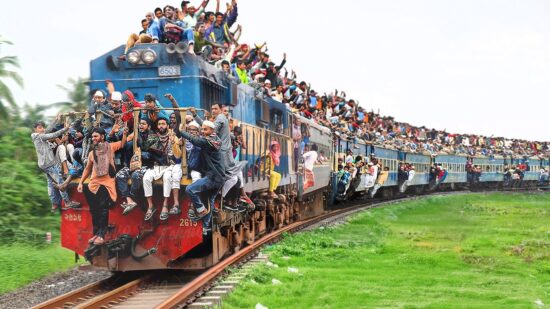
Over the last several weeks, social media platforms have been flooded with videos showing overcrowded trains allegedly carrying Rohingya Muslims or migrants from Bangladesh toward northern Indian states. Many posts claim that large numbers of these people will eventually settle in Punjab. The videos are being circulated with dramatic music, alarming captions, and emotional commentary, creating fear and anger among many Punjabis already worried about unemployment, crime, demographic change, and pressure on public resources. However, the situation demands careful research, verification, and responsible discussion instead of panic-driven conclusions.
One important fact is that viral videos on social media often travel faster than verified information. A single train video recorded at a railway station can be reposted hundreds of times with different captions. In many cases across India, old videos, unrelated footage, or clips from labour migration movements have been falsely presented as evidence of illegal infiltration. Crowded trains are common during seasonal migration, festival travel, recruitment drives, construction labour movement, or relocation of workers between states. Without official confirmation from railway authorities, border agencies, or intelligence departments, it becomes difficult to accurately identify who exactly is travelling in such videos.
At the same time, public concern cannot simply be dismissed. Punjab has experienced enormous demographic and economic changes over the past two decades. Large numbers of Punjabi youth have migrated abroad to countries like Canada, Australia, the United Kingdom, Italy, and the United States. As local labour shortages emerged in agriculture, factories, construction, transport, and small industries, workers from Bihar, Uttar Pradesh, Jharkhand, West Bengal, and other regions increasingly came to Punjab for employment. Today, migrant labour forms an important part of Punjab’s economy. However, alongside this economic dependence, social tension has also grown in some areas due to rising competition for jobs, housing pressure, language differences, and fears regarding law and order.
The Rohingya issue itself is internationally sensitive and politically explosive. The Rohingyas are a Muslim minority community originally from Myanmar’s Rakhine State. Over the years, large numbers fled violence and persecution, moving toward Bangladesh refugee camps and later attempting migration to other countries, including India. Indian governments at different times have treated the issue mainly as a national security and immigration concern. Security agencies have occasionally detained undocumented migrants in different states. However, every poor migrant visible in a train video cannot automatically be labelled as Rohingya or Bangladeshi without evidence. Such assumptions risk turning social anxiety into communal suspicion.
Punjab’s geographical and political position also explains why rumours spread quickly. Border-state psychology plays a major role in public reactions. Punjabis already live with memories of militancy, drug trafficking, cross-border tensions, and economic uncertainty. Social media algorithms amplify emotionally charged content because fear generates clicks, shares, and political engagement. As a result, videos showing crowded trains easily become symbols of “invasion” or “demographic threat,” even when no official data supports those claims.
There is also a political dimension behind such narratives. Across India, migration has become deeply linked with electoral politics. Different political groups use migration fears to mobilize support. Some parties portray migrants as economic burdens or security risks, while others emphasize humanitarian responsibility and labour needs. Punjab too has entered this national debate. Certain organizations argue that unchecked migration could alter the state’s cultural and linguistic identity, while others point out that Punjab’s economy itself depends heavily on migrant workers due to the massive outflow of local youth abroad.
The larger issue for Punjab is not merely rumours about trains, but the absence of a clear migration policy and transparent public communication. Citizens naturally become anxious when governments fail to provide timely information. If authorities openly shared verified data regarding undocumented migration, labour registration, border monitoring, and settlement patterns, rumours would lose much of their power. Silence often creates a vacuum filled by conspiracy theories and emotionally charged speculation.
Another serious concern is the danger of collective blame. History shows that when societies begin identifying entire communities through rumours, innocent people suffer first. Poor labourers, daily-wage workers, and vulnerable migrants often become targets of hostility even when they have no connection to illegal activities. Punjab itself has a long history of migration and displacement. Punjabis who settled abroad also faced suspicion, racism, and stereotyping in foreign countries during different periods. This historical experience should encourage balanced thinking rather than uncontrolled hatred.
At the same time, citizens do have the right to demand proper border control, legal immigration systems, verification mechanisms, and law enforcement. A democratic society can discuss security concerns without spreading unverified communal narratives. The challenge is to separate legitimate policy debate from misinformation campaigns designed to provoke fear and division.
The train videos circulating online therefore reveal something larger than migration itself. They expose Punjab’s growing insecurity about identity, employment, crime, political instability, and the future direction of the state. Social media may amplify the noise, but the deeper anxieties already exist within society. Punjab needs facts, transparency, and responsible leadership not panic based entirely on viral clips whose origins and claims often remain unverified.