
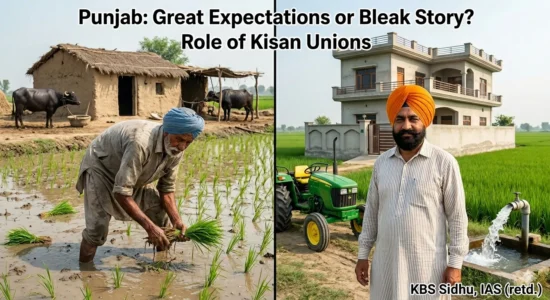
 Balbir Singh Rajewal has spent five decades at the barricades of Punjab’s agrarian struggles, and that record — including his central role in compelling the Union government to repeal the three farm laws — deserves its due acknowledgement. What follows is not an attack on the man, but an examination of the politics he and similar leaders spearhead. And that examination is overdue, because Punjab is running out of water, out of fiscal space, and out of time — and the politics of the Samyukt Kisan Morcha (SKM), whatever the personal integrity of its leaders, is not equipped to save it.
The hard truth is this: SKM’s concrete demands, and its equally significant silences, serve a narrow elite among landowners and their arhatiya credit-marketing partners. The movement borrows the moral vocabulary of “kisan-mazdoor” solidarity to give this a broader legitimacy it does not possess. Small and marginal farmers, tenants, bataidars, and Dalit farm labour receive slogans where they needed structural change. That is not a conspiracy. It is a class position. And it is time to name it as such.
The Coalition Behind the Cause
Any honest analysis must begin with who actually benefits from SKM’s flagship demands. The movement’s political base is, structurally, medium-to-large Jat Sikh landowners. The arhatiya is not their adversary; he is their credit partner and frequently their caste ally. Farm labour — predominantly Dalit, landless, semi-landless — is their workforce, not their constituency. This structural reality shapes every demand that SKM makes loudly and every injustice it chooses not to see.
When MSP and statutory procurement are demanded, it is the large farmer with marketable surpluses — not the small or marginal cultivator who consumes most of what he grows — who captures the bulk of the benefit. When free electricity for agriculture is defended as sacred, it is the medium and large landholder with multiple high-horsepower pumpsets who walks away with the lion’s share. When loan waivers are demanded, it is the institutional borrower with significant formal credit — again, the larger farmer — whose balance sheet benefits most visibly. The landless labourer, the tenant, the small farmer borrowing from the arhatiya at opaque rates: these figures appear in SKM’s speeches as rhetorical furniture. They are absent from its actual programme.
This is the foundational double standard from which all the others flow.
MSP Without Water: Defending the Trap
SKM’s most resonant demand is a statutory guarantee of MSP for the existing rice-wheat procurement regime. It is also, ecologically, the most irresponsible position on offer in Punjab’s public discourse.
Assured MSP and guaranteed procurement for paddy, combined with free or heavily subsidised power, have locked Punjab into a cropping pattern that is depleting groundwater at an alarming rate in the central districts and generating severe waterlogging and salinity in the south-west. Every individual farmer is acting rationally when he plants paddy and runs a tubewell on free electricity; collectively, the agrarian leadership that reinforces these incentives is sawing off the very branch on which Punjab sits.
To demand a statutory MSP for paddy without simultaneously insisting that procurement and incentives shift towards less water-intensive crops — pulses, oilseeds, millets, diversified fodder — is to defend yesterday’s comfort against tomorrow’s desert. Dr S.S. Johal, one of Punjab’s most eminent agricultural economists, former Vice-Chancellor of Punjab Agricultural University, Ludhiana, and the architect of the landmark Johl Plan on crop diversification, has noted that he is frequently asked by farmers and policymakers alike: what shall we grow, if not paddy? His answer is terse and unanswerable: “What will you grow when you run out of water?” What, precisely, will Punjab’s farmers do with their statutory MSP once the aquifers have run dry? This is not an abstract question. In the most over-exploited blocks of Ludhiana, Sangrur, and Fatehgarh Sahib, it is already a near-term operational reality.
A water-aware MSP politics would demand the opposite: gradually cap paddy procurement in the most depleted blocks; expand assured procurement, crop insurance, and marketing infrastructure for alternative crops; and design direct-income transfers that are not tied to groundwater over-extraction. On all of this, SKM is largely silent. The silence is not accidental; defending the paddy-wheat-MSP architecture is in the direct financial interest of the large landowners who anchor the movement.
Free Power: The Most Regressive Subsidy in Punjab
Free electricity for agriculture is defended, loudly and at every platform, in the name of the annadata. The data tells a different story.
Punjab’s farm-power subsidy amounts to roughly ₹10,000 crore annually — nearly 10 per cent of the state’s total developmental budget. The distribution of this benefit is strikingly skewed: the bulk flows to medium and large farmers with multiple high-horsepower connections, while small farmers with modest single connections receive a fraction of the transfer, and thousands of rural applicants continue to wait for basic connections altogether.
Blanket free power does four things simultaneously: it entrenches a landed elite whose competitive advantage rests on subsidised extraction; it incentivises the most water-guzzling crops and the deepest borewells; it starves the distribution system of revenues needed to modernise infrastructure, clear arrears to generation companies, and extend connections to those still off-grid — driving those without connections to run diesel pumpsets at disproportionate cost, burning money and carbon in the absence of the very electricity that the subsidy claims to democratise; and it crowds out the fiscal space needed for health, education, and urban services that benefit the non-agricultural majority.
Who Actually Benefits: The Numbers Behind the Slogan
The numbers make the injustice precise. Punjab currently has approximately 13.94 lakh agricultural tubewell connections receiving free power, at a subsidy cost of roughly ₹10,000 crore for the farm sector alone. Against this, Punjab’s active PM-Kisan beneficiaries — farmers verified as sufficiently small and marginal to qualify for the Centre’s income support of ₹6,000 per year, or a mere ₹500 a month — number only in the range of 4 to 5 lakh after successive rounds of eKYC verification and de-duplication have removed ineligible registrations. The contrast is stark: the PM-Kisan list, for all its imperfections, at least attempts to identify and target the genuinely needy; the free-power regime makes no such distinction whatsoever — every connection, regardless of the landholding behind it, draws the same subsidy from the public exchequer.
PSPCL data lays bare the internal architecture of this inequity: of 14.50 lakh tubewell connections in the state, 10,128 farmers hold between four and nine connections each, 29,322 hold three, and 1.42 lakh hold two — while only 1.83 lakh farmers have a single connection. A former Leader of the Opposition, according to PSPCL officials, holds six subsidised connections; a senior officer with five connections saw nothing wrong in accepting what the government freely offered. Many farmers with multiple connections will not figure on the PM-Kisan list at all — their landholdings and incomes placing them well above the scheme’s intended beneficiary profile. Many who do qualify for PM-Kisan — the genuinely small and marginal — may not have a single electric tubewell connection, and are consequently running diesel pumpsets at their own cost, burning money and carbon alike, while their wealthier neighbours draw free electricity through multiple motors charged to the state.
The subsidy that SKM defends most loudly is, in its actual distribution, a fiscal transfer from Punjab’s strained exchequer to the most comfortable segment of its own political constituency. That this is done in the name of the annadata — the giver of food, the symbol of agrarian sacrifice — is not merely ironic. It is a measure of how thoroughly the language of solidarity has been captured by the interests it was meant to challenge.
A rational policy would limit free power to one modest connection per agricultural household — protecting the genuinely small farmer — and meter larger pumpsets at a subsidised but measurable tariff. Any such proposal is immediately denounced by SKM as “anti-kisan.” It is easier to maintain the slogan than to acknowledge that the current regime is both ecologically and socially indefensible.
Punjab as FCI’s Unpaid Banker
There is a structural injustice in Punjab’s relationship with Union food procurement that virtually no one in the organised kisan leadership has chosen to make a central campaign issue, even though it costs the state hundreds of crores annually.
Every grain of paddy and wheat purchased in Punjab for the central pool ultimately belongs to the Union government and the Food Corporation of India. Yet it is the Punjab government and its agencies that must approach the Reserve Bank and bank consortia each season for massive cash credit limits — ₹40,000 crore and more in recent years — to pay farmers on time at the procurement centres. The principal is eventually reimbursed, but the state bears substantial additional interest costs because banks lend to state governments at rates higher than they charge the Centre. By conservative estimates, this differential costs Punjab upwards of ₹500 crore annually, on top of storage leakage, administrative overhead, contested FCI claims, and the political risk of credit-limit disputes with banks.
If the Union government wishes to claim the political dividend of feeding 80 crore Indians through a subsidised food security programme, it should carry the financing burden in its own name and on its own balance sheet. Punjab should not be left paying interest on money borrowed to procure grain that the Centre will claim, store, and distribute, while simultaneously being lectured about fiscal profligacy.
This is a genuinely federal grievance, and a potentially unifying one — it affects the state’s finances regardless of which party is in power. SKM could make it a campaign that builds bridges with non-agrarian constituents who also suffer from Punjab’s fiscal compression. It has not done so, because the issue requires engaging with budgets, banking, and inter-governmental finance rather than marching to Delhi with demands for higher MSP. The harder analytical work does not lend itself to the rally format.
The Arhatiya: Protected Monopolist, Not Ally of the Small Farmer
Perhaps the most glaring double standard in SKM’s politics is its posture on the arhatiya.
The movement that mounted the most sustained resistance in independent India’s history against “corporate entry” into agricultural markets has nothing to say about the commission agent’s unregulated stranglehold on rural credit and marketing. Field studies consistently show that small farmers borrow heavily from arhatiyas at effective interest rates that bear no relationship to any regulated rate, with credit bundled into marketing arrangements that make the borrower entirely dependent on the lender for the sale of his crop. In law, the arhatiya is a commission agent; in practice, he is an informal banker, moneylender, and monopoly buyer, operating without the transparency, mioney-lending licensing, or audit obligations that any registered financial intermediary must meet.
SKM opposed the three farm laws partly on the ground that they would enable corporate players to bypass the regulated mandi system and exploit farmers through private purchase. The argument had merit. But the corporate threat, at least in theory, was subject to contract law, consumer protection, and the Competition Commission of India. The arhatiya operates in a space of near-total informality, and the debt relationships he sustains are beyond the reach of any of these protections. The movement that resisted corporate entry has no quarrel whatsoever with an unregulated intermediary who has exercised a local monopoly over credit and marketing for generations.
A genuinely farmer-first movement would insist that every arhatiya who extends credit be licensed under the relevant moneylending legislation, with mandatory written disclosure of interest rate, method of calculation, and all fees, in language accessible to the borrower. It would demand that arhatiya accounts be subject to audit and that creditor-borrower disputes be adjudicated by independent, farmer-accessible forums. It has done none of this. The arhatiya is embedded in the social and economic networks of the same landed class that anchors SKM’s base; his interests and theirs are deeply intertwined, and that entwinement is the silence that SKM will not break.
The 2016 Debt Act: A Monument to Cosmetic Reform
The Punjab Settlement of Agricultural Indebtedness Act, 2016 was enacted with considerable fanfare as a farmers’ relief measure. It deserves scrutiny rather than applause.
The Act created divisional-level settlement forums with narrow jurisdiction, creditor-friendly composition, and interest relief benchmarked at rates that represented only marginal concession to distressed borrowers. The number of cases actually resolved through the mechanism has been trivial relative to the scale of rural indebtedness. There is no robust authority to write down genuinely unpayable loans, no adequate shield for small borrowers’ assets against seizure and auction, and no mechanism to restructure viable farm enterprises rather than liquidate them.
The law functions more effectively as a tidy recovery channel for institutional lenders than as genuine relief for marginal farmers and agricultural labourers. Yet SKM leaders have never subjected the 2016 Act to sustained public critique, clause by clause. Criticism is safely directed at Delhi. The state law — enacted under the Parkash Singh Badal government, and reflecting the limits of what even ostensibly farmer-friendly state politics will actually deliver — is left largely unexamined.
For a movement that spends considerable energy invoking the tragedies of karza and atmahatya, this silence is not incidental. It reflects the structural reality that the primary beneficiaries of genuine debt reform — small borrowers, landless labourers, tenants who borrow informally — are not the constituency whose interests drive the movement’s agenda.
The Invisible Tenant: Procurement, Relief, and Legal Non-Existence
At the centre of Punjab’s agrarian economy sits a figure who is largely invisible in both law and politics: the tenant cultivator, the bataidar, the informal sharecropper who farms land he does not own and whose name appears in no jamabandi that the state formally recognises.
This invisibility has concrete consequences across every major instrument of agrarian policy. In procurement, it is the person who physically delivers grain to the mandi who receives payment — typically the recorded owner, or whoever has the transport, storage, and marketing relationship to move the crop. The tenant who grew it negotiates his share privately, outside any formal protection.
In disaster relief, the consequences are more immediately unjust. When floods, hailstorms, or unseasonal rain destroy standing crops, the state conducts a special girdawari, assesses damage by area, and disburses compensation based on revenue records. The person recorded in official land documents — the owner — receives the compensation cheque. Whether any portion of that cheque reaches the tenant who actually lost his season’s labour and often his borrowed capital depends entirely on private arrangements and the power balance between owner and cultivator. The state considers its relief obligation discharged; the actual victim has no legal entitlement.
SKM’s public campaign on disaster compensation focuses, legitimately, on the quantum — demanding higher per-acre rates and lower damage thresholds for eligibility. But it never attacks the structural flaw: the fact that entitlement is based on ownership rather than cultivation. A genuinely tenant-inclusive movement would demand mandatory seasonal recording of the actual cultivator’s name for every leased plot, and statutory routing of all calamity relief in that name, with the owner’s share — if any — explicitly defined in the relief notification rather than left to private negotiation.
This is not a peripheral demand. In a state where an enormous proportion of cultivated area is under informal tenancy — the phenomenon is pervasive in every district — the silence on tenant rights is not an oversight. It is a structural preference, reflecting the fact that the landowner constituency driving SKM’s agenda has no interest in legally empowering the tenants who work its land.
The Mazdoor Who Appears Only in the Slogan
The most telling omission in SKM’s programme concerns agricultural labour. The language of “kisan-mazdoor” is deployed at every platform; the concrete demands for mazdoor welfare are, by any honest assessment, negligible.
Punjab’s statutory minimum wage for unskilled workers, following the 15 per cent hike announced by Chief Minister Bhagwant Mann at the special Vidhan Sabha session convened on May 1, 2026 — the first revision of the base rate since 2013, a gap of thirteen years — now stands at ₹13,486 per month, or ₹518.69 per day. Spread over those thirteen years, the 15 per cent increase translates into a compound annual growth rate of barely 1.1 per cent. Even at the revised rate, ₹518 a day is a figure difficult to reconcile with any reasonable conception of dignified living in rural Punjab, given the cost of food, housing, health, and education. The comparison with Haryana — which has notified a minimum wage for unskilled workers of approximately ₹15,220 per month effective April 2026 — is instructive and unflattering. SKM mounted no sustained campaign for a meaningful revision of this figure across those thirteen years of official indifference, no mass mobilisation to demand enforcement of whatever minimum existed, and no organised pressure to extend social security, health coverage, or pension entitlements to the landless and semi-landless who constitute the most economically precarious segment of rural Punjab.
When Punjab enacted the State Farmers and Farm Workers Commission Act, 2017, it formally recognised farm workers as a distinct constituency deserving of policy attention and established a corpus fund in their name. The promise has remained largely on paper. There has been no sustained pressure from the major unions to operationalise it: no agitation demanding that the Commission prioritise labour welfare, that the corpus fund be deployed for health, housing, or off-season employment support, or that minimum wages be topped up from available resources. The lobbying energy that SKM deploys with great effectiveness for MSP arrears, power subsidy continuance, and procurement finance is almost entirely absent when it comes to funds and entitlements meant for the workers who actually till the fields.
A politics that invokes “kisan-mazdoor” as its moral foundation but declines to fight seriously for higher minimum wages, meaningful enforcement, or direct material benefits for landless farm workers is not a class-bridging movement. It is a lobby for the landed, wearing the moral vocabulary of labour as a costume.
Federalism Selectively Applied
Rajewal and SKM are vigorous defenders of Punjab’s federal prerogatives against central encroachment — on water, on agricultural legislation, on the Dam Safety Act. The defence is legitimate and deserves support. But this federal consciousness is applied selectively.
The same leaders who challenge Delhi’s overreach have little to say about Punjab’s own agrarian laws and administrative practices that perpetuate injustice within the state: the 2016 Settlement Act that protects creditors; the absence of moneylending regulation for arhatiyas; the land record system that renders tenants invisible; the welfare corpus that sits undeployed while farm workers go without basic protections. Central laws are scrutinised fiercely; state structures that serve the same landed constituency are left intact.
Real federalism is about accountable governance at every level, not merely about resisting central authority when it inconveniences the dominant agrarian class. Punjab’s kisan leadership has mastered the first half of that argument. It has conspicuously avoided the second.
What the Politics of Honest Advocacy Would Look Like
None of this is an argument against organised agrarian politics or against demanding better terms from the Union government. It is an argument against a politics that has stopped asking hard questions of itself.
A kisan leadership that genuinely represented Punjab’s agricultural majority — small and marginal farmers, tenants, farm labourers, as well as medium landowners — would look very different from SKM as currently constituted. It would demand water-aware reform of MSP and procurement, with diversification incentives that are real and adequately funded. It would insist on mandatory licensing and disclosure obligations for arhatiyas who extend credit. It would tear up the 2016 Settlement Act and replace it with accessible, farmer-controlled debt restructuring forums with statutory authority to reduce usurious obligations. It would cap free power for large farmers and redirect the saving towards small farmers, grid modernisation, and off-grid connectivity. It would bring the actual cultivator — tenant, bataidar, sharecropper — into legal visibility for procurement, credit, and disaster relief. It would fight for meaningful minimum wages and the deployment of welfare funds for farm labour. And it would renegotiate the procurement-finance architecture so that Punjab is not continuously underwriting FCI’s balance sheet at its own fiscal cost.
Each of these demands would require confronting, at some level, the interests of the dominant constituency within SKM’s own coalition. That is precisely why none of them is on the agenda.
Great Expectations or Bleak Story?
Punjab is not simply running out of patience with Delhi. It is running out of water in its central districts, running out of productive land in its south-west, and running out of fiscal room to maintain subsidies that have long since ceased to be pro-poor even by the most generous interpretation.
The politics that Rajewal and his contemporaries have built served Punjab in a particular historical moment — one that has now passed. The repeal of the three farm laws was a genuine achievement, and it will be remembered as such. But the electoral verdict that followed was equally instructive, and considerably more sobering. Riding the momentum of that victory, 22 of the 32 Punjab farm unions broke away from SKM, floated the Sanyukt Samaj Morcha, and presented Rajewal as its declared Chief Ministerial candidate for the February 2022 Vidhan Sabha elections. The Punjab voter’s response was unambiguous and merciless. The SSM contested 94 seats and lost every single one; barring one solitary exception, every candidate forfeited their deposit. Rajewal himself, contesting from Samrala in Ludhiana district — his own home constituency — finished a distant sixth, secured barely 3.5 per cent of the vote, and lost his deposit. As one senior BKU leader observed at the time, the masses had supported these leaders when they stood against the three farm laws, but the assumption that the same masses would follow them into electoral politics was precisely where they went wrong. The farmers — and indeed the people of Punjab at large — knew the difference between a pressure group and a political party, even when their leaders did not. A movement that commands the streets around a single, clear adversary does not automatically carry that authority into the broader contest for governance, where the preferences and priorities of many other stakeholders and sections of society inevitably come to the fore. The zero-seat verdict was Punjab’s way of saying so, plainly and without appeal.
A movement that can win tactical victories while entrenching the structural conditions that are destroying the state’s ecological and economic foundations is not Punjab’s saviour. It is indistinguishable, in its consequences, from the forces it claims to oppose.
Safe Silence or Risky Discourse?
Respect for veterans is appropriate. Exempting their politics from rigorous scrutiny is not. Punjab’s majority — the small farmer, the tenant, the farm worker, the young person contemplating migration because the land can no longer support them — deserves an advocacy that actually speaks for them, not one that merely claims to.
The author is under no illusion about what this essay will invite. The labels are predictable and will arrive on cue: agent of the Centre, RSS decoy, anti-farmer, armchair bureaucrat who has never felt the weight of a plough or the anxiety of a failed crop. In a public discourse where the loudest voice is too often mistaken for the most legitimate one, intellectual honesty carries a price — and putting inconvenient questions into print about those whom many regard as untouchable carries a higher one still. So be it. The alternative — watching Punjab’s water table sink, its farm labour go unprotected, its tenants remain legally invisible, and its kisan leadership escape accountability behind a shield of borrowed solidarity — carries a far greater cost than any accusation of bad faith.
There is an old principle in public life worth restating: if you are not part of the solution, you are part of the problem. It applies to agrarian leaders as much as to those who write about them. The courage that Rajewal and his colleagues showed on the highways outside Delhi deserves acknowledgement. But Punjab now needs a different kind of courage from them — not the courage of confrontation with an external adversary, which they have amply demonstrated, but the courage of honest reckoning with their own record and their own silences, which remains conspicuously absent. It also requires, on the part of those who write and comment on public affairs, the intellectual honesty to say so plainly — regardless of which way the wind of popular sentiment happens to be blowing.
Let the trolls do their work. The questions will outlast them. And Punjab is running out of time.