
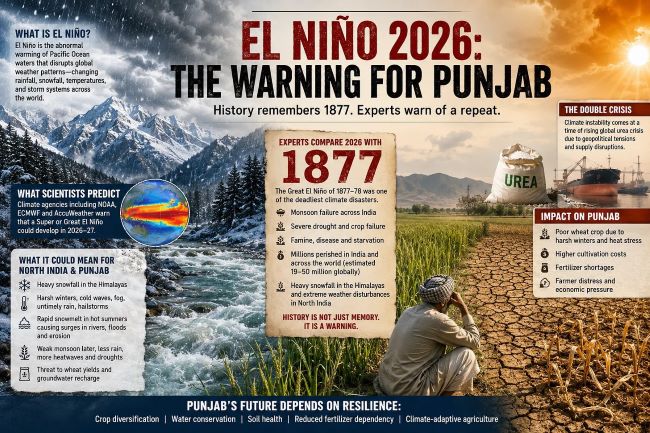
 El Niño is a climatic phenomenon caused by abnormal warming of surface waters in the Pacific Ocean near the equator. Though it originates thousands of kilometres away from India, its effects spread across the globe by disturbing atmospheric circulation, monsoons, jet streams, rainfall, snowfall, temperatures, and storm systems.In simple terms, El Niño disturbs the earth’s climate balance.A normal El Niño appears every few years. But sometimes the warming becomes exceptionally strong. Then scientists call it a “Super El Niño” or “Great El Niño.” Such events are rare and far more destructive because they trigger extreme weather patterns across continents.For India, a strong El Niño has historically been associated with:
· weak monsoons,
· drought conditions,
· extreme heatwaves,
· erratic rainfall,
· and agricultural stress.
But under modern climate change, the effects are becoming even more unpredictable. A Great El Niño can now produce simultaneous extremes:
· drought in some regions,
· excessive snowfall in others,
· harsh winters,
· floods,
· heatwaves,
· and unstable seasonal patterns.
That is why climate scientists across the world are now closely watching 2026.Several international agencies and climate researchers have warned that the Pacific Ocean is showing conditions that could evolve into a major or even “Super” El Niño during 2026–27. Forecast discussions by NOAA, ECMWF, AccuWeather, and other climate institutions increasingly describe the possibility of one of the strongest El Niño events in decades.What is especially striking is that many experts are now comparing the emerging climatic patterns with the Great El Niño of 1877–78 — one of the deadliest climate disasters in recorded history.
The comparison is not casual.
The Great El Niño of 1877 triggered catastrophic climatic disruption across Asia, Africa, China, and South America. India suffered one of the worst famines of the colonial era after repeated monsoon failures devastated agriculture. Historical studies estimate that millions perished globally because of famine, disease, and crop collapse linked to the climatic event.North India too witnessed extraordinary weather abnormalities during that period.

Historical accounts from the late nineteenth century describe severe climatic disturbances across the Himalayan region and adjoining northern plains. The winter of 1877–78 saw exceptionally heavy snowfall in parts of the western Himalayas, especially Kashmir and adjoining mountain regions. Snowfall continued for months. Villages were cut off. Livestock perished. Transport routes collapsed. Entire regions faced food shortages and economic paralysis.
Punjab, though situated in the plains, remained deeply connected to this Himalayan climate system. The rivers that shaped Punjab’s civilization — the Sutlej River, Beas River, and Ravi River — depend heavily upon Himalayan snow accumulation.Historically, gradual snowmelt acted as a natural reservoir, sustaining irrigation, groundwater recharge, and agriculture through summer.
But climate change is now disturbing that rhythm itself.Scientists fear that if 2026 develops into a Great El Niño, North India may witness:
· unstable western disturbances,
· harsh winters,
· heavy Himalayan snowfall,
· prolonged fog,
· erratic rainfall,
· followed by sudden heatwaves and extremely hot summers.
This creates a dangerous chain reaction.
Heavy snowfall in the hills may initially increase water in Punjab’s rivers. But if extremely hot summers follow, snow may melt too rapidly. Instead of gradual seasonal recharge, rivers could witness sudden surges, unstable flows, flash floods, erosion, and irregular groundwater replenishment.At the same time, harsh winters themselves can damage Punjab’s wheat crop. Wheat requires balanced winter chill followed by gradual warming. Severe cold waves, prolonged fog, hailstorms, or sudden March heat spikes can sharply reduce yields.
And this climatic stress is arriving precisely when fertilizer insecurity is rising globally.The ongoing Iran–US tensions and instability around the Strait of Hormuz threaten fertilizer and natural gas supply chains. Punjab’s agriculture, heavily dependent on urea and chemical fertilizers, remains especially vulnerable.
This creates a dangerous combination:
climate instability plus fertilizer insecurity.
Punjab today may appear technologically stronger than the Punjab of 1877. Yet ecologically it may actually be more fragile because agriculture has become heavily dependent upon groundwater extraction, monoculture, chemical inputs, electricity, and stable weather behaviour.The Great El Niño of 1877 is therefore not merely a historical episode.
It is a warning from history itself:
when climate systems become unstable, societies built upon ecological imbalance become extremely vulnerable.