
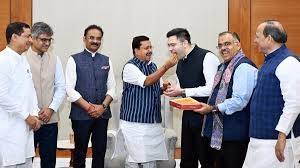
 Punjab today stands at a निर्णायक moment in its history, burdened with several unresolved issues that have lingered for decades. These are not minor administrative matters, but deeply rooted political and constitutional questions that shape the state’s future. Among them, the status of Chandigarh, control over river waters through the Bhakra Beas Management Board, and the long-standing dispute of the Sutlej-Yamuna Link Canal stand out as symbols of unfinished justice. At such a critical time, the role of Members of Parliament becomes vital. Yet, a growing sentiment across Punjab is that some of these leaders—particularly a group of seven MPs have failed to rise to the occasion.
The issue of Chandigarh is not merely about territory; it represents Punjab’s identity and the emotional aftermath of its reorganisation in 1966. Chandigarh was built to serve as Punjab’s capital, yet it continues to function as a Union Territory and a shared capital with Haryana. Over the years, Punjab has repeatedly asserted its rightful claim through legislative resolutions and political demands. However, despite these efforts, the issue remains unresolved. The silence or inconsistency of MPs on such a critical matter raises serious concerns about their commitment to Punjab’s cause at the national level.
Equally significant is the matter of water control under the Bhakra Beas Management Board. For an agrarian state like Punjab, water is not just a resourceit is the backbone of its economy and survival. Concerns have been raised repeatedly about the dilution of Punjab’s authority over its own river waters, with increasing central intervention and administrative changes. In such circumstances, Punjab’s MPs are expected to act as strong advocates, ensuring that the state’s rights are protected. However, when their voices are not forceful or unified, it creates the impression that Punjab’s interests are being compromised.
The Sutlej-Yamuna Link Canal dispute adds another layer of complexity and emotional intensity. This issue has been a flashpoint for decades, involving legal battles, political standoffs, and widespread public resistance. Punjab has consistently argued that it does not have surplus water to share, especially in the face of a rapidly depleting groundwater table. In such a sensitive matter, the responsibility of MPs is immense. They are expected to present Punjab’s case firmly at the national stage. Any sign of weakness, division, or political hesitation only weakens the state’s position further.
Beyond these major disputes, Punjab is also grappling with a broader set of challenges, including economic stagnation, agrarian distress, unemployment, drug abuse, and industrial decline. These issues require strong representation and consistent advocacy at the central level. However, a perception has taken root among the people that some leaders have prioritized personal growth over public service. Having built their careers, wealth, and influence through Punjab, they are now seen as disconnected from the ground realities and unwilling to take bold stands when it matters most.
This growing perception has led to a strong and emotional accusation that these MPs have “stabbed Punjab in the back.” While such language reflects public frustration, it also highlights a deeper crisis of trust. People feel that leaders who once praised Punjab and sought its support are now quick to change their stance when it suits their political ambitions. The same voices that once defended certain policies or parties are now criticizing them after switching sides, raising questions about their sincerity and integrity.
It is important, however, to consider the role of political compulsions. National politics often requires leaders to align with party strategies and central leadership. Balancing state interests with party loyalty can be challenging. Yet, true leadership is tested in such moments. Standing up for one’s state, even at personal or political cost, is what distinguishes genuine representatives from opportunists. When this balance consistently tilts away from Punjab, it becomes difficult to justify such actions as mere compulsion.
The road ahead demands accountability. Punjab’s people are increasingly aware and politically conscious. They are watching closely, questioning more, and expecting better. The coming years will test whether these MPs can regain the trust of the people by taking clear, consistent, and courageous stands on the state’s core issues. Words and promises will no longer suffice; only decisive action will.
In conclusion, Punjab’s pending issues are not just political debatesthey are matters of identity, rights, and survival. The responsibility to address them lies heavily on those elected to represent the state at the national level. If these leaders fail to act with integrity and determination, the sense of betrayal will only deepen. The ultimate judgment, however, will come from the people of Punjab, who will decide whether these MPs stood with their state or turned away when it needed them the most.