
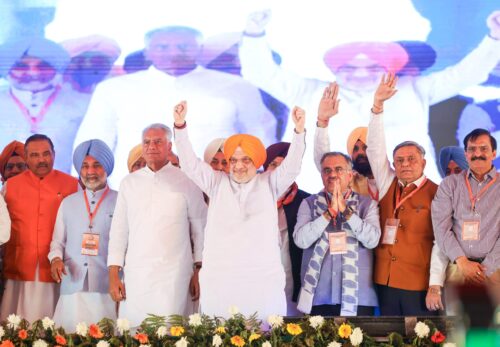
 In Punjab, rallies are often noisy, colourful and quickly forgotten. Amit Shah’s “Badlaav Rally” in Moga was designed not to be forgotten. It was not merely another stop on a crowded political calendar, nor just another exercise in headline management. It was a carefully mounted declaration that the Bharatiya Janata Party now sees itself not as an adjunct to someone else’s politics in Punjab, but as a serious, standalone claimant to power.
On the outskirts of Moga, near Killi Chahlan village, acres of open land had been transformed into an imposing rally site, complete with a waterproof pandal, a towering stage and giant LED screens carrying Shah’s image to the farthest edges of the crowd. The arrangements spoke of planning, money and method. This was not a casual walk-in gathering. It was a mobilised event, built through fleets of buses, village-wise coordination and the familiar political instruction to local leaders to “deliver” numbers from each Assembly segment. Yet once the speeches began, the audience did not appear merely transported; it seemed engaged. The slogans rose in rhythm, the responses came on cue, and the silences at key moments were the silences of attention, not indifference.
A Rally Meant to Expand the Frame
What gave the rally its deeper significance was not just its scale, but its social composition. The BJP plainly wanted Punjab — and, indeed, the rest of India — to notice that this was not the old template of a limited urban-Hindu gathering. Under the pandal were Sikh men in turbans, rural youth from the Malwa belt, small traders, women mobilised through mandal networks, and an assortment of local notables. The optics were deliberate and unmistakable.
Shah himself wore a saffron turban, and photographs of him greeting local leaders in that attire circulated widely, underscoring the party’s chosen visual message: that Hindu-Sikh unity lies at the heart of the BJP’s Punjab project. No seasoned observer would describe such a rally as spontaneous in any romantic sense. Major political events in India are now too carefully managed for that. But spontaneity was beside the point. What mattered was that the BJP demonstrated organisational reach in the heart of Punjab and showed that it could gather not only a substantial crowd, but also a socially varied one willing to hear it out.
Drugs, Disorder, Identity — and Memory
From the stage, Shah constructed his appeal around three anxieties that cut across Punjabi households: drugs, law and order, and identity. He accused the AAP government of allowing Punjab to drift deeper into a swamp of narcotics, gangsterism, corruption and insecurity. He promised that if the BJP were in power in both Delhi and Chandigarh, the drug networks could be dismantled within a defined period. He also raised the issue of religious conversion, warning against conversions allegedly driven by inducement or pressure and signalling a hard legal response.
But Shah’s intervention did not stop with criticism of AAP. He also made sure not to let Congress escape moral and historical scrutiny. In reminding the audience of Congress’s record, he invoked one of the deepest wounds in Sikh memory: Operation Blue Star. He recalled the Congress government’s decision in June 1984 to send tanks and the Army into the Darbar Sahib complex, an action that culminated in the destruction of the Sri Akal Takht Sahib building and left an enduring scar on Punjab’s political and religious consciousness. That reference was not incidental. It was meant to ensure that Congress was not allowed the luxury of appearing merely as an ineffective opposition party of today, but as the bearer of a historical burden that still resonates in Sikh political memory.
Running through Shah’s speech was another recurring theme: Hindu-Sikh unity as Punjab’s civilisational anchor. Invoking the legacy of the Gurus, he urged both communities to support the BJP’s call for “badlaav”. The slogan — “Aao miljul ke badliye Punjab; sukhi rahe saada Punjab” — encapsulated the pitch neatly: change, but change rooted in Punjab’s own social and cultural grammar.
The Long Game, Not the Lightning Strike
The real significance of Moga lies in what it reveals about the BJP’s strategic thinking. The party does not appear to believe that Punjab can be captured in one dramatic sweep. Its approach is more patient, more incremental and arguably more realistic. What it seems to be seeking is a durable vote base in the mid-twenties. In Punjab’s fragmented electoral landscape, that is not a minor aspiration; it is a strategic threshold.
In a state increasingly defined by three- and four-cornered contests, 25 per cent of the vote can have consequences that far exceed the number itself. With the right regional concentration, such a vote share can convert into a disproportionately large number of seats. A party that crosses that threshold is no longer peripheral. It becomes either the pivot in a hung Assembly or the principal pole around which a government may be formed.
Why Moga Could Matter Disproportionately
Seen this way, the Moga rally was more than a show of strength. It was evidence that the BJP is putting in place the hard political infrastructure required for that threshold: booth-level workers, local convenors, district units capable of mobilising thousands, and an emerging ability to reach beyond its traditional urban pockets into parts of Malwa where it once barely mattered outside select municipal wards.
But organisational capacity, however necessary, is only the first layer of political expansion. The real test between now and February 2027 is whether the BJP can transform logistical reach into emotional and electoral commitment. It is one thing to bring voters to a rally by bus. It is quite another to persuade them, months later and of their own accord, to walk to the polling booth and press the lotus symbol.
Alliance Ambiguity, Strategic Certainty
On alliances, Shah and the BJP were careful to remain open-ended without seeming uncertain. Every serious political conversation in Punjab eventually turns to the same question: whom might the BJP align with in 2027? Yet nothing in Moga suggested that the party was preparing to return to its old position as a junior partner leaning on a larger regional force for relevance in rural Punjab.
That older formula — with the BJP managing a modest cluster of urban seats while depending on an ally for the countryside — no longer suits the party’s national self-image. If an alliance does eventually take shape, it is likely to be negotiated on the basis of fresh arithmetic and demonstrable strength, not inherited habit or nostalgia. For now, the BJP’s priority is obvious: project self-sufficiency, expand its footprint, and raise its bargaining power should alliance talks become unavoidable closer to the election.
AAP as the Immediate Rival, Congress as the Historical Burden
If the BJP’s stance on alliances remains deliberately elastic, its choice of principal target is much clearer. In the party’s current reading, AAP — not Congress — is the main political adversary in Punjab today. AAP runs the government, controls the administrative machinery, and occupies the central space in contemporary political debate. It therefore bears the full burden of anti-incumbency on issues such as drugs, policing, public finances and the delivery of promises.
Congress, by contrast, is no longer treated by the BJP as the principal competitor for present power in Punjab. It is seen as diminished by factionalism, weakened by indecision, and unable to craft a compelling political narrative in a state where the old Akali-Congress duopoly has already fractured. Yet Shah did not permit that relative present weakness to convert into political innocence. By invoking Operation Blue Star and the assault on the Darbar Sahib complex, he reminded listeners that Congress carries not just the baggage of organisational decline, but also the weight of a profoundly damaging historical legacy. In that sense, AAP may be the BJP’s immediate rival, but Congress remains, in BJP rhetoric, the party of an unforgiven past.
The 25 Per Cent Doctrine
This is why the figure of 25 per cent matters so much. It is not merely a target; it is the central organising doctrine of the BJP’s Punjab strategy. If the party can move from low double digits into that band, it will alter the geometry of Punjab politics. Potential allies will have to treat it more seriously. Fence-sitting leaders and local power-brokers will begin to view it as a viable destination. Defectors from other parties will recalculate. The BJP itself will gain the option either to sit in opposition as a long-term builder or to enter government from a position far closer to parity than ever before in the state.
If, however, it remains below that threshold, rallies like Moga will in retrospect look like impressive theatre that generated attention without fundamentally altering the balance of power.
Punjab Is Not Easy Ground
That is the challenge before the party. Punjab is not a state where national narratives alone can deliver durable success. It has its own political memory, its own injuries, and its own non-negotiable sensitivities. Any party hoping to expand here must tread carefully around questions of federalism, agrarian distress, religious identity and civil liberties.
The BJP’s chosen themes — drugs, law and order, religious conversion, and civilisational unity — undoubtedly touch real nerves. But their political effect will depend heavily on tone, phrasing and local adaptation. A message that reassures one section can unsettle another. A slogan that lands well in Moga may sound different in Majha or Doaba. The BJP’s Punjab leadership will therefore have to do more than simply echo Delhi’s script; it will have to translate that script into a distinctly Punjabi idiom that does not stumble over the state’s layered realities.
A State of Parallel Experiments
Over the coming months, Punjab will become a theatre of parallel political experiments. AAP will try to convince voters that it can still govern better than the traditional parties and contain public anger over drugs, debt and delivery failures. Congress will attempt to stitch together its internal factions and recover credibility. The Akali space will continue its uneasy search for reinvention.
The BJP, meanwhile, will test whether the momentum generated by rallies like Moga can travel beyond organised pandals into the deeper grain of Punjab’s public life — into villages, dhabas, mandi towns and gurdwara-adjacent conversations where political decisions often begin forming long before campaign slogans reach their loudest pitch.
The Real Meaning of Moga
As Punjab moves towards the February 2027 Assembly election, little is settled. Alliances remain fluid, vote shares uncertain, and even the identity of the eventual front-runner is not yet fixed. But Moga has sharpened one emerging possibility with unusual clarity: if the BJP can touch and hold the 25 per cent mark, the arithmetic of a fragmented contest may hand it a much larger Assembly presence than its raw vote share would ordinarily suggest.
That is why the rally matters. Not because it proved that the BJP has already arrived, but because it suggested that the party is building, patiently and methodically, for arrival. Whether that long game succeeds will depend not on stagecraft alone, but on the quieter verdicts formed over the next year and a half in homes, fields, bazaars and village addas across Punjab. Those conversations, far removed from the glare of LED screens, will decide whether Moga was merely a spectacle — or the first unmistakable drumbeat of a political realignment.
P