
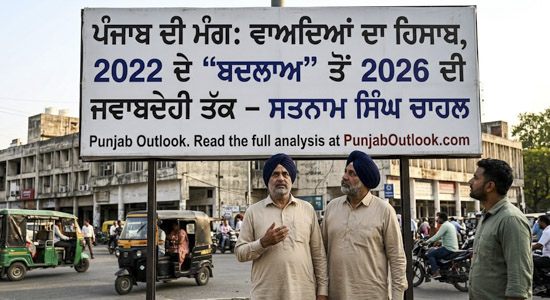
The 2022 Punjab Assembly election was fought on promises of a new political beginning. The Aam Aadmi Party presented itself as an alternative to the traditional political establishment and made a long list of commitments to the people of Punjab. Free electricity, financial assistance for women, jobs for youth, better schools and hospitals, action against drugs and corruption, justice in sacrilege cases, relief for farmers and cleaner governance were among the issues that featured prominently in its campaign.
The message was simple: give AAP a chance and Punjab will see a different kind of government.The people gave that chance decisively. AAP won 92 of 117 Assembly seats and Bhagwant Mann became Chief Minister. Such a massive mandate represented not merely electoral success but enormous public expectations.Four years later, however, the political question has changed.It is no longer simply “What will AAP do for Punjab?”
It is:
“What happened to the promises made to Punjab?”That question should not be dismissed as opposition politics. Nor should every government achievement be dismissed simply because it comes from AAP. A democratic society must examine both sides through evidence.The government says it has fulfilled its major pre-election guarantees and points to free electricity, recruitment, health services, education initiatives and other programmes. Critics, however, continue to point to commitments they say remain delayed, modified or incomplete.This disagreement should not be settled through television shouting matches, social-media abuse or political slogans.
Punjab needs a public audit of promises.
Every major 2022 commitment should be placed on one page: the original promise, the date it was made, the government’s subsequent decision, budget allocation, implementation status, number of beneficiaries and present position.Then the people can decide for themselves.The ₹1,000 monthly assistance promise for women is one obvious example of why such transparency matters. It was a prominent election commitment, and its implementation has remained a subject of political debate. Similar questions have been raised around other campaign commitments.The people have a right to ask: If a promise was fulfilled, show us the evidence. If it was partially fulfilled, explain what remains. If it was changed, tell us why. If it was delayed, tell us the reason.That is not anti-government behaviour.That is democracy.
From voter to watchdog
Punjab’s voters must also change the way they evaluate political parties.Too often, political loyalty becomes personal loyalty. A leader is defended regardless of performance, while an opponent is criticised regardless of facts.That culture has to end.A voter should be able to say: “I supported this party, but I still want answers.”That is not betrayal.It is responsible citizenship.The same standard must apply to AAP, Congress, SAD, BJP and every other political organisation seeking the people’s mandate.
How should people respond?
The answer is peaceful democratic pressure not violence or intimidation.If citizens believe an election promise has not been honoured, they can ask questions publicly, organise peaceful protests, seek government records through RTI, approach competent authorities, raise the issue with elected representatives and, where a genuine legal issue exists, seek appropriate judicial remedies.But threatening politicians, physically confronting them, vandalising property, spreading unverified accusations or harassing their families is neither democratic accountability nor a legitimate substitute for evidence.Punjab’s anger should become documentation.Its frustration should become questions.Its questions should become public accountability.And its final constitutional instrument remains the vote.
The “promise file” Punjab needs
Imagine every Punjabi household maintaining a simple political record.Promise made.Date announced.Video saved.Manifesto preserved.Government order checked.Budget allocation recorded.Implementation verified.Result noted.Five years later, the record—not political emotion can speak.That would fundamentally change Punjab’s political culture.No leader could easily say, “I never promised that,” when thousands of citizens had preserved the original evidence.
The real lesson of 2022
AAP’s 2022 victory demonstrated the power of public expectations. The electorate was willing to move away from established political parties when it believed another political alternative could deliver change.That lesson should be remembered by every political party.A vote is not a permanent contract of loyalty.It is a mandate accompanied by accountability.The government deserves credit for whatever it has demonstrably achieved. At the same time, citizens deserve answers about whatever remains pending or disputed.Both things can be true at the same time.The people of Punjab should therefore neither worship political leaders nor hate them.
They should question them.They should verify their claims.They should compare promises with performance.And when the time comes, they should make their own democratic decision.Because ultimately, the most powerful citizen is not the person shouting the loudest at a politician.It is the voter who remembers what was promised.And asks what was delivered.
Disclaimer: This article and accompanying images are for informational and illustrative purposes only. Some visuals may be AI-generated or digitally enhanced and may not depict actual events or persons.Views expressed are based on publicly available information and analysis