
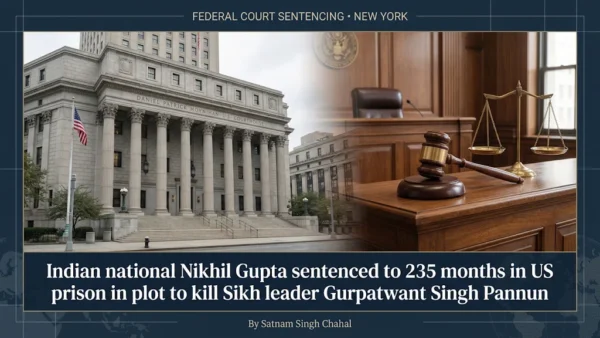
 Indian national Nikhil Gupta has been sentenced to 235 months (19 years and seven months) in federal prison by a US court for his role in a murder-for-hire conspiracy targeting Sikh leader and US citizen Gurpatwant Singh Pannun in New York. The sentence was imposed on November 20, 2026, by US District Judge Victor Marrero in the Southern District of New York. The 235-month term is at the lower end of the advisory sentencing range of 235 to 293 months presented in the case.
May 2023: According to US court documents, the alleged conspiracy began taking shape. Prosecutors said Gupta worked with an individual identified as a co-conspirator, later named in court documents as Vikash Yadav, to arrange the killing of Gurpatwant Singh Pannun, a US-based Sikh activist and American citizen. The alleged plan involved recruiting a contract killer.
June 9, 2023: US prosecutors alleged that Gupta and his co-conspirators arranged for an associate to deliver $15,000 in cash as an advance payment to the person they believed could arrange the killing. That person was, in fact, a confidential source working with the US Drug Enforcement Administration (DEA).
June 18–20, 2023: Hardeep Singh Nijjar, a Sikh activist, was shot dead in British Columbia, Canada, on June 18. US court documents state that Gupta subsequently referred to Nijjar’s killing in communications with the undercover source and indicated that there was no need to delay the proposed attack on Pannun. These details formed part of the US prosecution’s account of the alleged conspiracy.
June 30, 2023: Gupta was arrested by Czech authorities after travelling to the Czech Republic, following a US request.
November 2023–May 2024: The extradition process proceeded through the Czech judicial system. After legal challenges, the Czech Constitutional Court rejected Gupta’s challenge in May 2024, clearing the way for extradition.
June 14, 2024: Gupta was extradited from the Czech Republic to the United States. He appeared before a federal court in New York and faced charges connected with the alleged murder-for-hire conspiracy.
February 13, 2026: Gupta pleaded guilty in a US federal court to all three charges: murder-for-hire, conspiracy to commit murder-for-hire and conspiracy to commit money laundering. The US Department of Justice announced the guilty plea. His admission of guilt marked a major development in the criminal case.
August 12, 2026: The court rescheduled his sentencing to November 20. The hearing had earlier been scheduled for September 25, but was postponed after the intended victim sought an opportunity to participate in the sentencing proceedings.
November 13, 2026: US prosecutors sought a sentence of 293 months, approximately 24 years and five months, arguing that the conspiracy was a serious attempt to kill an American citizen on US soil. Gupta’s defence sought a substantially reduced sentence of 144 months, or 12 years, citing his lack of a previous criminal record, untreated alcohol dependence and acceptance of responsibility.
November 20, 2026: US District Judge Victor Marrero sentenced Nikhil Gupta to 235 months, equivalent to 19 years and seven months, in federal prison. The sentence is at the lower end of the advisory sentencing range of 235 to 293 months.
Indian national Nikhil Gupta has been sentenced to 235 months in a US federal prison for his role in a murder-for-hire conspiracy targeting Gurpatwant Singh Pannun, a Sikh activist based in the United States. The sentence, announced on November 20 by US District Judge Victor Marrero in the Southern District of New York, amounts to 19 years and seven months of imprisonment.
The case relates to an alleged 2023 conspiracy to assassinate Pannun in New York. US prosecutors said Gupta worked with others, including an individual identified in court documents as Vikash Yadav, to arrange the killing. Prosecutors alleged that Gupta approached a person he believed to be connected with criminal networks to find a contract killer. However, that person was actually a confidential source working with the US Drug Enforcement Administration.
According to the prosecution’s account, a payment of $100,000 was discussed for carrying out the murder. An advance payment of $15,000 was allegedly delivered in cash in June 2023. The planned killing was foiled through the US investigation, and Pannun was not harmed.
Gupta’s guilty plea on February 13, 2026, was a decisive turning point. He admitted guilt to three federal offences: murder-for-hire, conspiracy to commit murder-for-hire and conspiracy to commit money laundering. The US Department of Justice said he had worked at the direction of an Indian government employee to arrange the murder of a US-based leader of the Sikh separatist movement.
During the sentencing proceedings, prosecutors argued that Gupta played a crucial role in a foreign conspiracy to kill an American citizen on American soil. They requested 293 months in prison, saying a strong sentence was necessary to reflect the seriousness of the crime and deter attempts to use violence to silence people in the United States.
Gupta’s defence, meanwhile, asked for a substantially shorter sentence of 144 months. His lawyers referred to his lack of a previous criminal record, his untreated alcohol dependence at the time of the offence and his acceptance of responsibility. Gupta also expressed remorse in a letter to the court, saying he wished he could return to 2023 and undo his actions. He stated that he was grateful the plot had not resulted in anyone’s death or injury.
The judge ultimately imposed a 235-month sentence, the lower end of the advisory range cited in the case, but considerably longer than the term requested by Gupta’s defence.
The case has significance beyond the conviction of one individual. It has brought renewed international attention to the security of Sikh activists and political advocates living in North America. Pannun, who holds American and Canadian citizenship and advocates for an independent Sikh state, was the intended target of the conspiracy described by US prosecutors.
The prosecution’s allegations concerning the involvement of an Indian government employee have also placed the case within the wider debate over alleged transnational repression and the safety of political dissidents abroad. India has rejected allegations of official involvement in such plots and has maintained that actions against individuals outside the law are not part of government policy. The allegations against other individuals must be assessed separately, and Gupta’s conviction should not automatically be treated as a judicial finding against every person named or discussed in the wider investigation.
The case also carries a wider message about the responsibilities of governments and the protection of citizens under the law. Political disagreements, ideological differences or advocacy for a cause cannot justify violence or an attempt to arrange someone’s murder. The US court proceedings have demonstrated that a conspiracy targeting a person on American soil can lead to serious criminal consequences even when the alleged arrangements are made across international borders.
For Sikh communities in the United States, Canada and elsewhere, the case is particularly important because it concerns the safety of a Sikh activist and the broader question of whether individuals can express political opinions without fear of violence. The sentencing is a major development, although questions surrounding the alleged involvement of other individuals and the wider circumstances remain subjects of continuing scrutiny.
Sources: US Department of Justice, February 13, 2026; US Department of Justice extradition announcement, June 17, 2024; The Indian Express; Hindustan Times; PTI reports published November 20, 2026.
Reporting note: The 235-month sentence is confirmed in reports published on November 20. The $100,000 figure refers to the alleged payment discussed for the killing, while $15,000 was the alleged cash advance. The guilty plea and sentence apply to Gupta; they do not establish the guilt of every other person mentioned in the case