
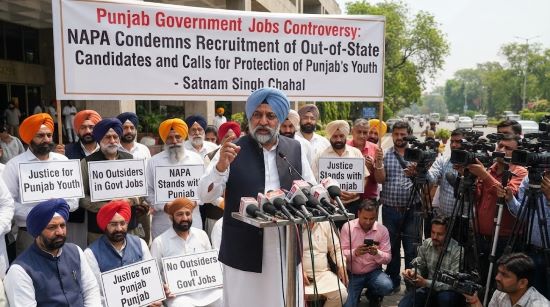
CHANDIGARH — The North American Punjabi Association (NAPA) has strongly condemned the recruitment of candidates from outside Punjab for government jobs, saying the practice is deepening unemployment concerns and unfairly affecting the state’s young people.
NAPA Executive Director Satnam Singh Chahal said Punjab’s government employment opportunities should first serve eligible residents of Punjab, particularly at a time when thousands of educated young people are struggling to find stable jobs and many are being forced to leave the state in search of work.
“Punjab’s youth should not be pushed out of their own state while government jobs are offered to people from outside Punjab,” Chahal said. “We strongly condemn any recruitment policy or process that ignores the interests of eligible Punjab residents. The Punjab government must stand with the people of Punjab and protect their rightful employment opportunities.”
The controversy has raised questions over domicile rules, Punjabi-language requirements, recruitment transparency and the legal basis for allowing out-of-state candidates to compete for positions in Punjab government departments.
Timeline of the Controversy
Recruitment Rules and Eligibility Conditions
Punjab government departments and recruiting agencies issue advertisements for different posts under separate service rules. Some positions may require Punjab domicile, knowledge of Punjabi or residence within the state, while others may be open to applicants from across India.
The eligibility conditions generally depend on the department, the nature of the post, reservation rules and the recruitment notification.
Chahal said the government must not use general legal explanations to avoid addressing the concerns of Punjab residents.
“Every recruitment notification must clearly explain whether a post is intended for Punjab residents, whether Punjabi-language knowledge is required and why candidates from other states are being permitted to apply,” he said. “There should be no ambiguity, no hidden conditions and no changes after young people have invested their time and money in the recruitment process.”
Concerns Raised by Punjab Residents
As recruitment examinations and selection lists were announced, complaints began emerging from applicants who claimed that candidates from outside Punjab had secured positions in state government departments.
Some candidates and organizations alleged that Punjab residents were being disadvantaged in their own state, particularly in competitive examinations where applicants from larger states could significantly increase the number of candidates.
They demanded greater transparency regarding domicile requirements, merit lists, reservation categories and the number of selected candidates from outside Punjab.
NAPA said these concerns should not be dismissed as political complaints.
“Punjab’s young people have spent years preparing for these examinations,” Chahal said. “They pay application fees, coaching expenses, travel costs and other expenses. They deserve to know whether the rules were designed and applied fairly.”
NAPA Calls for Priority for Punjab’s Youth
NAPA called on the Punjab government to adopt a clear and legally sustainable policy that gives eligible Punjab residents priority in state government employment wherever permitted by law.
Chahal said the government should review recruitment rules for all departments and identify positions where domicile, Punjabi-language knowledge or other local eligibility conditions can lawfully be required.
“Punjab is facing a serious employment crisis,” he said. “If the state cannot protect opportunities for its own qualified youth, the government must explain what future it is offering them.”
He also urged the government to consult student organizations, unemployed graduates, legal experts, recruitment agencies and community representatives before finalizing any new policy.
Political Parties Enter the Debate
The issue subsequently became a political controversy, with opposition parties accusing the Punjab government of failing to protect the interests of local youth.
Political leaders called for a review of recruitment policies and demanded that Punjab residents receive preference in government employment wherever legally permissible.
The government, however, has maintained that recruitment must be conducted according to notified rules and applicable law. Officials have also indicated that not every government post can legally be restricted exclusively to state residents.
NAPA said constitutional requirements must be respected, but they should not be used as a reason to avoid transparency or abandon Punjab’s youth.
“Respecting constitutional rights does not prevent the government from creating lawful, clearly announced and properly administered protections for local residents,” Chahal said. “The first responsibility of the Punjab government is to the people of Punjab.”
Questions Over Domicile and Punjabi-Language Requirements
A major point of dispute is whether candidates from outside Punjab satisfy the language and domicile requirements attached to particular posts.
For some positions, knowledge of Punjabi may be mandatory. In other cases, candidates may be required to pass a Punjabi language examination after appointment or within a specified period.
Critics say such requirements must be clearly stated before the recruitment process begins and applied consistently to every candidate.
They also argue that vague or changing conditions can create confusion and lead to litigation after examinations and selection lists are completed.
NAPA said Punjabi-language requirements should be meaningful rather than symbolic.
“If Punjabi is required for a post, that requirement must be clearly stated and genuinely enforced,” Chahal said. “Punjab government employees should be able to communicate effectively with the people they serve.”
Legal and Constitutional Complications
The demand to reserve all Punjab government jobs exclusively for Punjab residents faces constitutional and legal limitations.
India’s Constitution protects the right of citizens to seek employment across the country, although Parliament and state governments may impose certain lawful conditions for specific categories of employment.
Any state policy giving preference to local residents must therefore be carefully drafted and supported by applicable law. A blanket exclusion of candidates from other states may face legal challenges if it conflicts with constitutional guarantees or judicial decisions.
This is why the legality of each recruitment process depends on the exact notification, service rules, reservation provisions and eligibility conditions involved.
NAPA said it supports a policy that is both legally valid and protective of Punjab’s residents.
“We are not asking the government to violate the Constitution,” Chahal said. “We are asking the government to use every lawful option available to protect Punjab’s youth and ensure that recruitment policies reflect the needs of the state.”
Selection Lists and Calls for Review
After selection lists were released for certain posts, concerns intensified among unsuccessful applicants who claimed that a significant number of selected candidates were from outside Punjab.
Applicants and community organizations called for the publication of detailed data, including:
* The number of applicants from Punjab and other states
* The number of selected candidates by state
* The application of domicile rules
* Compliance with Punjabi-language requirements
* Category-wise merit and reservation details
* The legal basis for allowing out-of-state candidates to apply
* The number of vacancies filled by Punjab residents
* Any post-wise or department-wise preference rules
They also demanded that any complaint mechanism be independent, time-bound and accessible to affected candidates.
NAPA urged the government to release this information without delay.
“Transparency is the only way to restore public confidence,” Chahal said. “If the process was fair, the government should publish the records. If mistakes were made, the government should correct them.”
Government Response
The Punjab government has emphasized that recruitment should be based on merit, eligibility and the rules notified for each post.
Officials have rejected the suggestion that candidates are being selected unlawfully merely because they come from another state. At the same time, the government faces pressure to explain whether local-language and domicile conditions were properly enforced.
The administration may also face questions about whether recruitment advertisements were sufficiently clear and whether candidates were given equal information before applying.
NAPA called on the government to respond directly to the concerns of Punjab residents rather than relying only on general statements about merit.
“Merit must be measured under rules that are clear, lawful and appropriate for Punjab,” Chahal said. “A recruitment process cannot be called fair if eligible Punjab residents do not know why they were excluded or how out-of-state candidates were allowed to compete.”
Broader Employment Concerns
The controversy reflects a larger crisis facing Punjab’s youth.
With limited private-sector opportunities in many parts of the state, government employment remains highly sought after. Thousands of candidates spend years preparing for competitive examinations, often paying substantial fees for coaching, travel and applications.
When candidates believe that recruitment rules are unclear or that local applicants are being overlooked, public confidence in the process can decline quickly.
The issue is also connected to Punjab’s continuing migration trend. Many young people leave the state for education and employment, while families that remain behind often view government jobs as one of the few stable career options available locally.
Chahal said the government must address the conditions that are driving Punjab’s youth abroad.
“Punjab is losing its young people because they do not see enough opportunities at home,” he said. “Offering government jobs to out-of-state candidates while Punjab’s own qualified youth remain unemployed sends the wrong message and may accelerate migration.”
What Should Happen Next?
To address the controversy, the Punjab government and recruiting agencies should consider publishing complete recruitment data and clarifying the legal basis for eligibility conditions.
A transparent review should examine whether:
1. Recruitment advertisements clearly stated domicile and language requirements.
2. All candidates were assessed under the same rules.
3. Punjabi-language conditions were properly applied.
4. Reservation and merit lists were prepared according to law.
5. Candidates from outside Punjab were eligible for the specific posts.
6. Any changes to eligibility rules were made before applications were submitted.
7. The number and state of origin of selected candidates were disclosed.
8. Complaints were investigated by an independent authority.
9. Eligible Punjab residents received all lawful preferences available under the rules.
10. Recruitment agencies provided complete records to affected applicants.
If irregularities are found, the government should take corrective action. If the recruitment process complied with the law, officials should publish the relevant data and rules to remove uncertainty.
NAPA also called for a special review of recruitment processes that have already been completed where large numbers of Punjab residents have alleged that they were unfairly excluded.
A Balance Between Local Opportunity and Constitutional Rights
The debate requires a careful balance.
Punjab residents have a legitimate interest in ensuring that state government employment is accessible and fairly administered. At the same time, recruitment policies must respect constitutional rights and cannot be changed arbitrarily after an examination or selection process has begun.
The most effective solution may be a clearly defined policy that identifies which posts can lawfully include domicile or Punjabi-language requirements, while ensuring that all conditions are announced in advance and applied uniformly.
NAPA said the policy should be designed around the economic realities facing Punjab.
“Punjab’s government must support the people of Punjab,” Chahal said. “That means creating more jobs, improving recruitment transparency, strengthening Punjabi-language requirements where appropriate and ensuring that qualified local candidates are not pushed aside.”
The controversy should not be resolved through political statements alone. It requires official records, legal analysis and a transparent examination of the recruitment process.
For Punjab’s unemployed youth, the central demand is straightforward: government jobs should be filled through a fair, transparent and legally valid process that protects the interests of eligible Punjab residents.
NAPA strongly condemned the offering of Punjab government jobs to out-of-state candidates where such recruitment disadvantages qualified Punjab residents or fails to reflect the state’s employment needs.
Until the government releases complete information about the recruitment rules and the backgrounds of selected candidates, questions over the appointment of out-of-state candidates are likely to continue.
Source: Recruitment notifications, applicable Punjab government service rules, official selection lists and statements issued by government departments, political representatives and the North American Punjabi Association.