
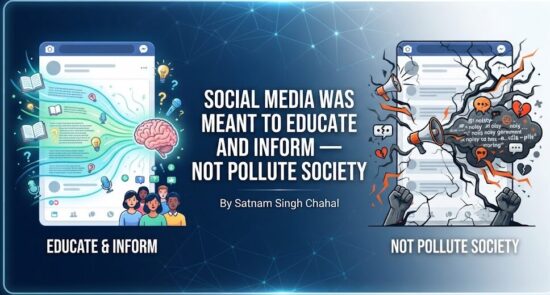
 We have turned one of the greatest communication tools ever created into, at times, a marketplace of vulgarity, outrage and attention-seeking. A platform that could educate millions, expose social evils, challenge government failures and give a voice to the voiceless is increasingly being flooded with content that informs nobody, improves nothing and often leaves society wondering: Why was this posted in the first place?
Social media was meant to bring people closer to knowledge, information and meaningful public discussion. It was supposed to give ordinary citizens an opportunity to express their views, raise questions, highlight injustice and draw attention to problems that traditional institutions sometimes overlook. Instead, a disturbing amount of online activity is now driven by the pursuit of likes, followers, views and instant popularity.
There is nothing wrong with wanting an audience. The problem begins when attention becomes more important than responsibility. When people deliberately create controversy because they know it will generate reactions, society gradually begins to reward the loudest voice rather than the most responsible one.
Social media should be a place where people learn something, discover something, question something or become aware of something. It should help us understand our communities and the world around us. It should encourage citizens to discuss government policies, public spending, corruption, education, healthcare, unemployment, drugs, crime, environmental problems and countless other issues that affect everyday life.
Strong criticism has an important place in any democratic society. Governments are not above questioning, and public officials should be accountable to the people. Journalists, activists and citizens must have the freedom to raise difficult questions. But there is a difference between criticism and character assassination; between accountability and humiliation; between exposing wrongdoing and deliberately attacking someone’s dignity.
Unfortunately, that distinction is sometimes disappearing online. Personal insults, vulgar language, obscene material, rumours, manipulated photographs and unverified accusations can spread within minutes. A person may post something simply to gain attention without considering the consequences for another individual’s family, career, reputation or mental well-being.
Once something is published online, it can travel far beyond the original audience. A post intended for a few hundred people can potentially reach thousands or millions. A careless comment can be copied, forwarded and preserved indefinitely. The internet has a long memory, even when the person who posted something has forgotten it.
This is particularly important when we consider children and young people. Young users are growing up in an environment where they are exposed to enormous amounts of information every day. They learn not only from schools and families but also from what they repeatedly see online. If vulgarity, bullying, hatred and humiliation receive more attention than knowledge, kindness and achievement, what kind of social culture are we teaching the next generation?
Parents therefore have an important role, but responsibility cannot be placed entirely on parents. Schools, communities, social-media companies, content creators, journalists, public figures and ordinary users all have a role to play. Every adult who posts publicly should remember that young people may be watching.
Content creators and influencers have an especially important responsibility because they can reach large audiences. With a large following comes greater influence. A person with thousands or millions of followers should understand that every statement can shape attitudes, behaviour and public conversation. Popularity should come with greater responsibility—not fewer boundaries.
The same principle applies to political leaders and public officials. Social media can be an excellent way for governments and elected representatives to communicate directly with citizens. But public platforms should not become places for personal abuse, political revenge or deliberate misinformation. People deserve facts, explanations and accountability not endless online fights.
Journalists and media organizations also have a responsibility to maintain standards. Speed is important in the digital age, but accuracy is more important than being first. A headline may attract thousands of clicks, but if the information is misleading or unverified, the damage can be much greater than the temporary benefit of increased traffic.
Ordinary social-media users also have enormous power. We often blame the person who creates offensive or misleading content, but the audience also determines what succeeds. Every like, comment, share and forward is a form of endorsement or amplification. If responsible content receives no attention while offensive content receives millions of views, the message to content creators is obvious: controversy sells.
We therefore need to change our own habits. Before forwarding a message, we should ask whether it is verified. Before sharing a photograph, we should consider its context. Before accusing someone, we should ask whether we actually know the facts. Before writing an angry comment, we should pause and consider whether the same words would be acceptable if spoken face-to-face.Most importantly, we should ask ourselves a simple question: Does this post make society more informed, more aware or more responsible or does it simply make society more angry, divided and disrespectful?
Social media does not force anyone to post vulgarity. It does not force anyone to spread rumours. It does not force anyone to humiliate another person for entertainment. These are choices made by individuals and choices have consequences.We should not misunderstand this argument as a demand to silence disagreement. A healthy society needs disagreement. Different opinions are normal. Debate is healthy. Criticism is necessary. But disagreement does not require hatred, and freedom of expression does not require abandoning basic decency.
Perhaps the simplest responsibility checklist is also the most powerful: Is it true? Is it necessary? Is it respectful? Is it verified? Could it unnecessarily hurt someone? Does it educate or inform? Would I be comfortable if my children saw it? Would I say the same thing face-to-face? And, years from now, will I still be proud that I posted it?If we cannot answer these questions responsibly, perhaps the most powerful thing we can do is not press the “post” button.
Social media has given every individual a microphone. That is an extraordinary privilege. But a microphone can educate a community or create unnecessary noise. It can expose injustice or spread hatred. It can bring people together or push them further apart.The technology is not the problem. What we choose to do with it is the real test.
We should demand better standards from social-media platforms, but we should also demand better standards from ourselves. We cannot complain about the quality of public conversation while contributing to its decline.The choice ultimately belongs to every one of us.Use social media to educate, not degrade. Inform, don’t mislead. Criticize, don’t humiliate. Question power, don’t abuse people. Create awareness, don’t create unnecessary hatred.Because at the end of the day, social media is not only a reflection of the society we have—it is helping create the society we will have tomorrow.
Disclaimer: This article and accompanying images are for informational and illustrative purposes only. Some visuals may be AI-generated or digitally enhanced and may not depict actual events or persons.Views expressed are based on publicly available information and analysis