
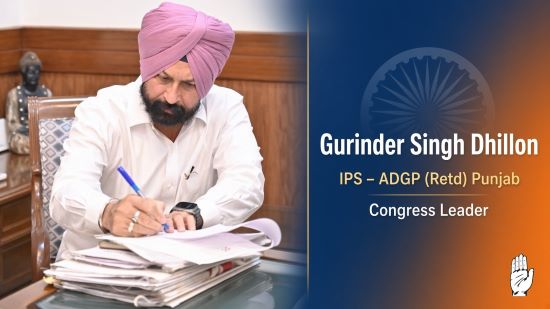
 CHANDIGARH: Former Punjab IPS officer Gurinder Singh Dhillon has called for clear, uniform and practical security guidance for every member of the Punjab Police, arguing that protecting police personnel during extraordinary security circumstances must be treated as a core responsibility of the police command rather than as a matter of political controversy.
In a strongly worded public message addressed to the Punjab Police leadership, Dhillon said every member of the state police should be properly advised and guided by supervisory officers and the head of the force about precautions required to ensure their safety and security when there are credible threat inputs or unusual security circumstances.
Dhillon specifically tagged the Punjab DGP while making the point that security advisories should be based on intelligence inputs and professional assessment rather than political considerations.
According to Dhillon, the traditional functioning of the police force also provides an important context for discussing the issue. He recalled that police personnel traditionally reported at their police stations, marked attendance, received their duty assignments and left for duty after the prescribed Daily Diary entry. He said a substantial proportion of the force traditionally lived in police-station barracks, thereby reducing unnecessary exposure while travelling between duty locations and their residences.
He further argued that wearing police uniform should primarily be linked to official duty and that, wherever security circumstances warrant it, police personnel should be advised about appropriate precautions, including the possibility of civilian clothing or concealment of police identity while commuting. He pointed out that police organisations in different parts of the world use operational discretion concerning uniforms and visibility when particular security threats exist.
The central question raised by Dhillon is not whether police personnel are afraid of criminals or terrorists, but whether the police leadership has a duty to minimise avoidable risks to its own personnel.
“Protecting the police force is a command responsibility,” Dhillon argued, stressing that prudence should not be confused with fear.
He questioned whether political criticism should prevent the police leadership from issuing a security advisory when intelligence inputs or circumstances indicate a potential threat. In his view, even if an advisory becomes politically controversial after being issued, the professional responsibility of the police command should remain focused on protecting its personnel.
Dhillon also raised a difficult accountability question: If another police officer is killed because adequate precautions were not communicated or followed, who will ultimately be responsible?
His argument is that preventive instructions should not be delayed simply because they could attract criticism. Intelligence inputs, he maintained, should be assessed professionally, and reasonable precautions should be communicated clearly to the entire force.
At the same time, Dhillon emphasised that such precautions should not be interpreted as weakness. He described the Punjab Police as a brave force and said its personnel have repeatedly demonstrated courage in confronting organised criminal networks and other security challenges.
The former IPS officer also referred to the controversy surrounding an audio recording of a woman police officer that has circulated publicly. Rather than focusing exclusively on the language used in the recording, Dhillon said authorities should examine the officer’s underlying intent and whether she was attempting to communicate a genuine concern about the safety of police personnel.
He suggested that an officer acting with an honest intention to protect colleagues should not automatically become the subject of criticism merely because her words or manner of expression became controversial.
The broader issue, according to Dhillon, is the need for a strong internal security communication system within the Punjab Police. Every police employee—from constabulary to senior officers—should know what precautions are required when a credible threat emerges. Supervisory officers should ensure that instructions are not merely issued but actually understood and implemented.
This becomes particularly important in an environment where police personnel can themselves become targets because of their professional identity. A uniform, official vehicle, police station or predictable routine can potentially make personnel easier to identify. Dhillon’s argument is therefore centred on risk reduction: when circumstances change, operational practices should also be adjusted.
The responsibility, he said, cannot be left to individual police personnel. The DGP’s office, range officers, commissioners, district police chiefs and other supervisory authorities must collectively ensure that security instructions reach the last police station and the last member of the force.
The question is ultimately one of institutional responsibility. If intelligence agencies or police units identify a credible threat, the information must be translated into practical instructions. If the threat changes, the instructions must change. And if personnel are required to adopt additional precautions, those measures must be explained without creating confusion.
Dhillon has therefore urged the Punjab Police leadership and the state government to place professional security considerations above political compulsions. His message is essentially that precautionary advice should be judged by the threat assessment and the safety of police personnel not by the political reaction it may generate.
The debate also raises a wider question about policing in Punjab: Is enough attention being given to the security of those who are expected to protect everyone else?
Police personnel are routinely expected to confront criminals, respond to emergencies, maintain public order and deal with serious threats. Their own safety cannot be treated as an afterthought.
Dhillon’s position is that providing timely guidance is not an admission of weakness. It is part of responsible command.
“Prudence is leadership, not fear,” is the central message of his intervention.
For Punjab Police, the challenge now is to ensure that security advisories whenever required—are based on credible intelligence, professionally assessed risks and clearly communicated operational procedures. Political debate may continue, but the fundamental responsibility remains unchanged: police personnel must be given every reasonable opportunity to return safely from duty to their families.
The question raised by Dhillon deserves a straightforward institutional answer: if a credible threat exists, what precaution is being taken today to prevent the next police casualty tomorrow?