
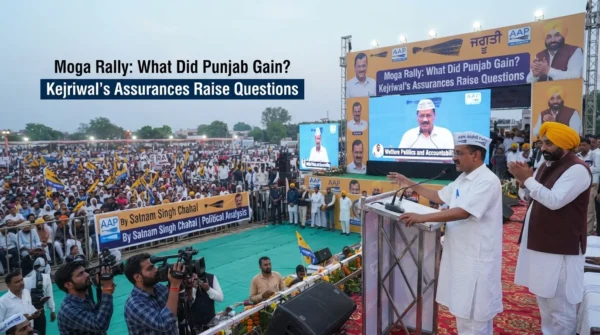
The Aam Aadmi Party’s rally in Moga has raised an important question that deserves to be asked by every citizen of Punjab: What exactly did Punjab gain from this rally, apart from political speeches, election-oriented promises and assurances aimed at securing another term in power? A political rally organised in the name of a prosperous Punjab should have been an opportunity for the ruling party to present a detailed account of its government’s achievements, explain its failures and announce a practical roadmap for the state’s economic recovery. Punjab needed answers on unemployment, agricultural distress, drug trafficking, industrial investment, government debt, education, healthcare and the declining financial condition of the state. Instead, the central political message appeared to be focused on persuading voters to bring AAP back to power in 2027.
Arvind Kejriwal’s assurances that the benefits being provided by the government would continue if people voted for AAP raise serious questions about the nature of the party’s election campaign. Government welfare benefits are not personal gifts from a political party. They are public programmes financed through taxpayers’ money and the state’s resources. Citizens are entitled to legitimate welfare assistance regardless of which political party they support or vote for. By linking the continuation of welfare benefits with electoral support, Kejriwal created the impression that public assistance was being presented as an inducement to secure votes. This is a disturbing approach to democratic politics.
The most controversial aspect of Kejriwal’s political messaging was his appeal to women voters to persuade their husbands, fathers, brothers and other family members to vote for AAP. He linked the continuation of several welfare programmes, including the proposed Mawan-Dhiyan Satkar Yojana, free electricity, ₹10 lakh health insurance and pilgrimage facilities, to the return of the Mann government in 2027. Such assurances may be politically attractive, but they also raise an uncomfortable question: Are voters being encouraged to evaluate the government’s performance, or are they being told that their existing benefits could depend on their willingness to support the ruling party? The impression was that the government was offering a political bargain—vote for AAP and continue receiving benefits. Public welfare must never be treated as a reward for political loyalty.
Punjab’s people are not beneficiaries of any political party’s personal generosity. They are taxpayers and citizens whose money finances government programmes. Any eligible woman, farmer, labourer, unemployed youth or economically weaker family has the right to receive benefits under government policies, irrespective of voting preference. AAP cannot claim ownership of public welfare schemes, just as no future government should be allowed to withdraw legitimate benefits simply because a citizen supported another political party.
Another important question concerns the nature of the Moga event. Although presented as a government Smart Ration Card Distribution Function, it also became a platform for AAP’s 2027 Assembly election campaign. The distribution of smart ration cards and ration kits was combined with political speeches, criticism of opposition parties and appeals for another term for AAP. The government must explain the distinction between official functions and party campaigning. Public money, government machinery, official facilities and administrative resources must not become instruments for strengthening a ruling party’s electoral prospects. The government should disclose the total expenditure on the rally, including transportation, publicity, security, arrangements and other facilities, and clarify which departments or agencies paid the bills.
The biggest disappointment is that Punjab is facing serious financial challenges, yet the Moga rally did not provide the kind of comprehensive economic roadmap that the state urgently needs. Punjab is struggling with mounting public debt, unemployment, agricultural difficulties, industrial challenges and the continuing drug crisis. The state cannot become prosperous merely through slogans, large gatherings and welfare announcements. Kejriwal and Chief Minister Bhagwant Mann should have presented a detailed financial and economic report explaining how the government intends to strengthen Punjab’s economy, generate employment, attract investment, improve agriculture and reduce its dependence on borrowing.
The government must answer how much additional debt Punjab has accumulated during the AAP government’s tenure, what concrete steps have been taken to increase the state’s own revenue and how many new industries have actually started production. How many unemployed young people have secured sustainable employment? How many villages, towns and urban colonies have become genuinely drug-free under the Yudh Nashian Virudh campaign? What measurable results have been achieved against drug trafficking networks? What is the government’s strategy to strengthen agriculture and increase farmers’ incomes? These are the questions that matter to ordinary Punjabis, but they cannot be answered through election slogans.
The proposed financial assistance to women has also become an important part of AAP’s electoral messaging. Financial support for women can certainly be a legitimate welfare measure, particularly for economically weaker households. However, the public deserves clarity about eligibility, implementation, the total annual financial burden and the source of funding. If Punjab is already struggling with debt and limited financial resources, where will the additional money come from? Will the government generate new revenue, reduce unnecessary expenditure, attract investment or borrow more money? Women of Punjab deserve economic independence, employment opportunities, education, healthcare and financial security. They should not be reduced to a vote bank whose political loyalty is sought through monthly financial assistance.
Arvind Kejriwal is the national convenor of AAP, but Punjab is not a political laboratory for experimenting with election strategies. The people elected Bhagwant Mann as Chief Minister and entrusted his government with the responsibility of running the state. The people have every right to ask why Kejriwal is making the continuation of welfare schemes such a central condition in his appeal for another term. If the government has genuinely fulfilled its promises and established a strong system of governance, it should be able to seek votes on its performance rather than create apprehension about what might happen if another political party comes to power. The Chief Minister must also take responsibility for presenting an independent and transparent account of his government’s five-year performance.
A rally can demonstrate a political party’s organisational strength, mobilise supporters and launch an election campaign, but it cannot, by itself, improve the economic condition of a state. AAP may have gained political visibility, an early start to its 2027 election campaign and an opportunity to project its welfare programmes before voters. The distribution of smart ration cards may benefit eligible households, and existing welfare schemes may provide important support to families. However, Punjab needs to know what additional, measurable development outcomes emerged from the Moga gathering. Where is the employment roadmap? Where is the industrial investment strategy? Where is the debt-reduction plan? Where is the independent assessment of the government’s anti-drug campaign?
The ruling party must understand that free electricity, healthcare, education, ration assistance and financial support for women are public responsibilities, not political favours. A government must never create the impression that public benefits are rewards for political loyalty. If Kejriwal and Bhagwant Mann believe that their government has transformed Punjab, they should publish a comprehensive five-year performance report supported by verifiable figures. Let the people examine the employment figures, debt position, industrial investment, drug-control results, education standards and healthcare outcomes. The 2027 Assembly election should be decided on performance, accountability and the future of Punjab, not on the fear that welfare benefits might disappear if voters exercise their democratic choice.
Punjab has witnessed successive governments making promises of development, employment, prosperity and an end to corruption. Yet the fundamental problems of the state remain unresolved. The people are struggling with rising living costs, unemployment, migration, agricultural uncertainty and the growing financial burden on future generations. At this critical moment, Punjab needs political leadership that can explain how it will rebuild the state’s economy rather than simply promise that existing benefits will continue if the ruling party receives another mandate.
The ultimate question is simple: Did the Moga rally offer a genuine vision for a prosperous Punjab, or was the prosperity slogan primarily a vehicle for launching AAP’s campaign to retain power in 2027? Punjab needs jobs, investment, financial stability, freedom from drugs and accountable governance. Its people deserve development, dignity and economic security—not electoral assurances that make public welfare appear to be a favour offered in exchange for votes.
Punjab Outlook Editorial Perspective: Public welfare is a right of eligible citizens, not an electoral favour of any political party.