
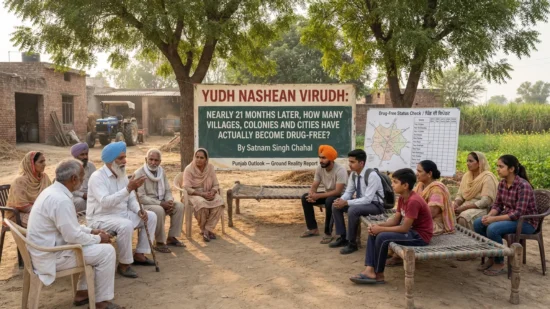
 By Satnam Singh Chahal | Punjab Outlook — Political Analysis-The Punjab Government launched its ambitious anti-drug campaign, Yudh Nashean Virudh, on March 1, 2025, with the promise of eliminating the drug menace from the state. Chief Minister Bhagwant Mann described the campaign as a decisive battle against drug trafficking and addiction, promising strict action against smugglers, dismantling of drug networks, public participation and rehabilitation of drug addicts. Nearly 21 months have passed since the launch of this campaign, but an important question remains unanswered: what has actually been achieved on the ground, and how many villages, residential colonies, towns and cities in Punjab are now genuinely free from illegal drugs?
The government has repeatedly highlighted the number of arrests, FIRs registered, drug seizures and awareness programmes conducted under the campaign. According to government announcements, approximately 29,980 NDPS cases were registered during the first phase, while thousands of alleged drug traffickers were arrested. The government also reported the identification and rehabilitation of around 90,000 people affected by drug addiction and highlighted its conviction rate in cases decided by courts. These figures indicate considerable enforcement activity, but they do not necessarily establish that the drug menace has been eliminated from Punjab’s villages and cities.
On August 2, 2026, Chief Minister Bhagwant Mann announced that approximately 70,000 alleged drug smugglers had been arrested during the campaign’s first 500 days. He also highlighted the participation of nearly 1.25 lakh volunteers across approximately 13,000 villages. In September 2026, government figures reportedly indicated that arrests had crossed 76,000. While these numbers are significant, the government must explain how many of these arrests resulted in convictions, how many major drug networks were dismantled and whether the availability of illegal drugs has actually declined in the state.
The most important question concerns Punjab’s villages. The government has promoted Village Defence Committees under the initiative known as Pind De Pehredaar, involving local residents in identifying drug-related activities, informing police authorities and creating awareness among young people. However, establishing a Village Defence Committee does not automatically make a village drug-free. The government should disclose how many villages have completely eliminated illegal drug sales, how many have dismantled local drug distribution networks and how many have remained free from drug trafficking for at least six months or one year. The number of villages covered by the campaign and the number of villages that have genuinely become drug-free are two entirely different measurements.
The situation in Punjab’s cities and urban colonies also deserves serious attention. Drug addiction and trafficking are not restricted to rural areas. Cities such as Amritsar, Jalandhar, Ludhiana, Patiala, Bathinda and Moga also face the challenge of illegal drug distribution. The government should provide separate information about municipal wards, residential colonies, slum settlements and commercial neighbourhoods. How many urban wards have become drug-free? How many colonies have been cleared of drug-peddling networks? How many towns and cities can officially claim that illegal drugs are no longer being sold in their neighbourhoods? These questions require clear and verifiable answers.
Another important issue is the difference between arrests and the actual elimination of drug trafficking. Arresting a person involved in drug distribution does not necessarily mean that the supply network has been destroyed. In many cases, another person may take over the same business, while the availability of narcotics continues. Similarly, large drug seizures can indicate effective police action, but they can also demonstrate that illegal narcotics continue to enter and circulate within the state. The government must therefore publish information about changes in the availability of heroin and other narcotics, the number of active drug distribution locations and the progress made in dismantling major trafficking networks.
Rehabilitation is equally important. A successful anti-drug campaign cannot depend entirely on police action and arrests. People suffering from addiction require medical treatment, counselling, family support and long-term rehabilitation. The government should disclose how many people were identified as drug users, how many received treatment, how many completed rehabilitation programmes and how many successfully returned to normal family and working lives. It should also provide information about relapse rates and drug-related deaths. Merely identifying or admitting a person to a de-addiction centre cannot be considered permanent recovery.
Punjab needs a comprehensive and publicly accessible district-wise report card on Yudh Nashean Virudh. The report should cover all 23 districts and identify the villages, towns, cities, municipal wards and residential colonies where the campaign has produced measurable results. It should also provide details of drug-related arrests, court convictions, dismantled trafficking networks, drug seizures, rehabilitation outcomes and areas where illegal drug distribution continues. Independent verification involving local residents, elected representatives, civil society organisations and health professionals would make such a report more credible.
The Bhagwant Mann Government has made the anti-drug campaign an important part of its political and administrative agenda. However, the people of Punjab are entitled to assess its success through actual improvements in their daily lives. Parents want their children protected from drugs, young people need education and employment opportunities, and families want to live without the fear of drug trafficking in their neighbourhoods. The ultimate success of the campaign must be measured by whether drug availability has declined and whether fewer young people are becoming addicted.
The central question for Chief Minister Bhagwant Mann is simple: Out of approximately 13,000 villages and the numerous towns, cities, municipal wards and residential colonies in Punjab, how many have actually become drug-free since March 1, 2025? If the government has achieved success, it should publish the names of these areas along with independently verified evidence. If the target has not been achieved, the government should honestly explain the remaining challenges and present a time-bound action plan.
Punjab does not need another slogan or another publicity campaign. It needs measurable results. The real report card of Yudh Nashean Virudh should be the number of drug-free villages and colonies, the number of lives saved, the number of drug networks permanently dismantled and the number of young people rescued from addiction. Arrests and FIRs may demonstrate police activity, but only a reduction in drug availability and the creation of genuinely drug-free communities can demonstrate lasting success.
Punjab Outlook — Independent Political Analysis