
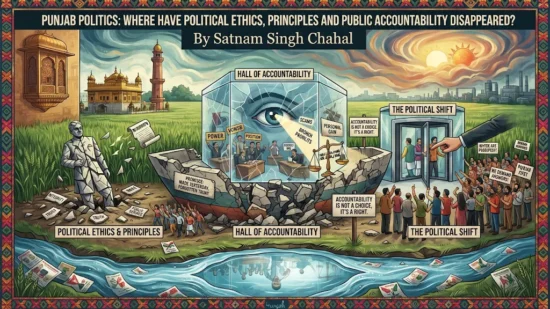
 When political statements change overnight, alliances shift with convenience, and yesterday’s opponents become today’s friends, the biggest casualty is public trust.Punjab has a long history of political movements, ideological struggles and leaders who built their identities around principles, public service and commitment to the people. Politics was once expected to be guided by ideology, political discipline and a sense of responsibility towards society. However, the changing political environment in Punjab raises an important question: Are political parties still guided by principles, or have principles become negotiable according to political convenience?
One of the most visible features of present-day Punjab politics is the contradiction between what political leaders say today and what they say tomorrow. A leader who strongly criticises another party in the morning may join hands with the same party in the evening. Someone who describes a political opponent as unsuitable for public life may later share a platform with that very person. Yesterday’s accusations are forgotten, yesterday’s promises are abandoned, and yesterday’s political enemies suddenly become respectable partners.
Political differences are natural in a democracy. Parties can change their positions when circumstances, evidence or public needs change. But there is a difference between a genuine change of opinion and a convenient change of political stand. When leaders change their positions without explaining why, people are left wondering whether their earlier statements were sincere or merely political performances.Another troubling trend is the growing importance of political power over public issues. Farmers,
unemployed youth, drug addiction, education, healthcare, industrial development, government debt and the future of Punjab deserve continuous attention. Unfortunately, political discussions frequently revolve around personalities, party defections, accusations, counter-accusations and the distribution of political positions. The problems of ordinary people often become secondaryto the struggle for power.
The culture of political defection has also raised serious questions about the relationship between elected representatives and voters. People vote for candidates because of their party affiliation, manifesto, political ideology and promises. But what happens when an elected representative changes parties after winning an election? Does the representative ever consider the expectations of the voters who supported them? Political freedom and individual choice are important, but democratic responsibility must also be respected.The same standards should apply to every political party. No party should claim moral superiority simply because it is in opposition, and no ruling party should assume that winning an election gives it unlimited political authority. Opposition parties must offer constructive alternatives instead of limiting themselves to criticism. Governments must answer questions about their decisions, promises, expenditure and performance.
Punjab needs politics based on accountability rather than personal attacks. If a party promises employment, it must explain how many jobs have been created. If it promises to control drugs,people deserve measurable results. If it promises financial improvement, it must explain the state’s debt and economic position. If it promises better education and healthcare, citizens have the right to examine the actual condition of schools and hospitals.Political leaders must also understand that public memory is not as short as they may believe. Social media has made it easier for citizens to compare yesterday’s statements with today’s positions. A speech delivered against an opponent can be watched again when the same leader enters an alliance with that opponent. A promise made before an election can be compared with
the government’s performance years later.
The biggest question is not which party changes its position more frequently. The real question is whether any political party is prepared to establish consistent standards of honesty,transparency and accountability.Punjab does not need politics that changes its principles with every election, political calculation or change of government. It needs leaders who can disagree without becoming enemies,cooperate without abandoning their values, and accept mistakes without blaming everyone else.Political parties should remember that they are not the owners of Punjab. They are temporary representatives of its people. Governments will change, political alliances will change, and
leaders will come and go, but Punjab and its people will remain.Ultimately, the people must stop judging political leaders merely by their speeches, slogans, rallies and election promises. Their words must be compared with their actions, their political positions with their past statements, and their promises with their actual performance.
That is the real crisis facing Punjab politics today: not simply a struggle between political parties, but a growing question of credibility, consistency and public trust.
A Thought to Remember
“Political opinions may change, but when principles change every day, where does public trust stand?”
“Yesterday you called them wrong; today you are shaking hands with them. People have
every right to ask: were they wrong, or was your statement yesterday?”