
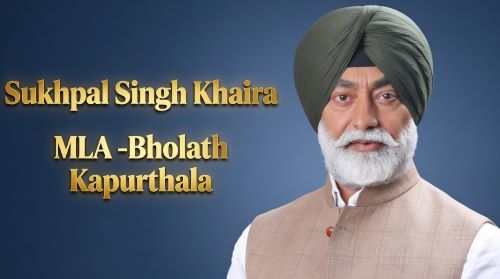
 CHANDIGARH | Senior Congress leader and Bholath MLA Sukhpal Singh Khaira has raised questions over the Punjab government’s spending priorities, arguing that public money should be directed towards education, healthcare, employment and development rather than expensive political rallies and publicity exercises.
In a post on X, Khaira said that if ₹3,000 crore were invested in Punjab’s development instead of political rallies, the state could potentially build a substantial number of new hospitals, schools and educational institutions.”Punjab needs education, healthcare, and employment—not showmanship,” Khaira observed, questioning where the priorities for public expenditure should really lie.
His remarks have brought the debate over government expenditure, political publicity and the state’s development priorities back into focus, particularly as Punjab approaches the 2027 Assembly elections.
Khaira’s central argument is that public resources should be used to address the everyday problems of ordinary people rather than being spent on large political gatherings and image-building exercises.
Punjab continues to face important challenges in strengthening its public healthcare infrastructure, improving government schools, creating employment opportunities and addressing the expectations of educated unemployed youth.
The Congress MLA’s argument raises a fundamental question about whether the government’s financial decisions are adequately reflecting the priorities of the people.
The ₹3,000-crore figure mentioned by Khaira is a hypothetical comparison in his political statement; it should not be interpreted as an independently verified account of the government’s total expenditure on rallies.
Nevertheless, the question of opportunity cost is important. Every rupee spent by the government has an alternative possible use. Investment in district hospitals, medical colleges, school infrastructure, technical education and skill-development centres could contribute to long-term economic and social progress.
Punjab’s 2026–27 Budget, for instance, provides an allocation of ₹6,879 crore for the health sector, reflecting the scale of investment required to strengthen public healthcare.
However, public expenditure on political rallies must be distinguished from legitimate government spending on public programmes, inaugurations and official events. The source of funding, purpose of expenditure and applicable government rules are important factors in assessing such spending.
Punjab is facing several interconnected challenges, including mounting public debt, unemployment, migration of young people, pressure on government healthcare facilities and the need to modernise educational institutions.
The state needs a development strategy in which education, healthcare, industrial investment, agriculture and employment creation receive sustained attention. Political gatherings may serve the purposes of democratic mobilisation and communication, but they should not become a substitute for measurable development.
Khaira’s statement has once again raised an important question for the political leadership of Punjab: should the success of a government be measured by the size of its political gatherings and publicity campaigns, or by improvements in the lives of ordinary citizens?
Ultimately, Punjab’s taxpayers deserve transparency in public expenditure, measurable results from government programmes and a clear explanation of how every major allocation contributes to the state’s future.
By Satnam Singh Chahal | Punjab Outlook — Political Analysis