
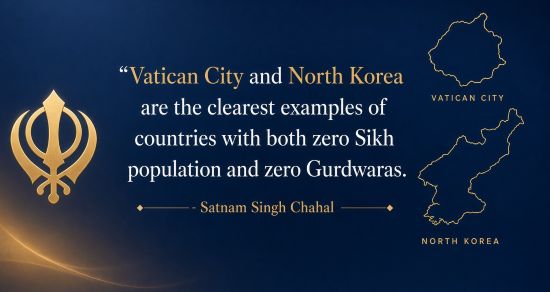
 Sikhs have migrated worldwide, many countries and U.S. states without a formal Gurdwara still have small resident Sikh families who gather in private homes or local community centers. Below is how the combination of zero/unrecorded population and no physical Gurdwara breaks down globally and in the U.S.:
• Vatican City. Residency is strictly limited to Catholic clergy, diplomats, and Swiss Guards, leaving zero Sikh residents and no non-Catholic places of worship.
• North Korea. Strict border controls and state atheism prevent foreign religious settlement or the establishment of Gurdwaras.
• Remote Pacific Microstates. Small island nations such as Tuvalu, Nauru, Kiribati, Palau, and the Pitcairn Islands have no recorded Sikh residents and no Gurdwaras.
• Certain Central & South American / African Nations. While countries like Mexico, Argentina, Brazil, Kenya, Uganda, and South Africa have active Gurdwaras, smaller nations such as Paraguay, Uruguay, Suriname, Chad, and Mali have no established Gurdwaras and virtually zero recorded Sikh population.
According to global directories like World Gurudwaras and Sikh Scholar’s Hub, the following U.S. states have no established public Gurdwara and show 0% statistically recorded Sikh population in major demographic trackers:
• North Dakota
• South Dakota
• Vermont
• Maine
(Note: Wyoming is also frequently listed with a 0% statistical population, though it has a small Gurdwara presence in Cheyenne. Other states like West Virginia, Rhode Island, New Hampshire, Nebraska, and Idaho also lack a standalone public Gurdwara in major directories, even though small numbers of Sikh families live there.)
The Sikh community has established a remarkable international presence over the past century. From Punjab to North America, Europe, Australia, Africa and Southeast Asia, Sikhs have migrated across continents while maintaining their religious identity, cultural traditions and attachment to the teachings of Sri Guru Nanak Dev Ji and the ten Sikh Gurus. Gurdwaras have played a central role in preserving this identity by providing places for worship, community gatherings, education, humanitarian service and langar.
However, the global spread of Sikhs has not resulted in the establishment of Gurdwaras in every country or territory. There are still geographical areas where no publicly established Sikh place of worship is identified in available directories. In some places, the Sikh population may be extremely small, while in others, the absence of reliable religious demographic information makes it difficult to establish whether any Sikh residents are present.
An important distinction must be made between zero recorded Sikh population, no known Gurdwara and an actual absence of Sikh residents. These are three different situations. A country that does not publish religious census figures cannot automatically be described as having zero Sikhs. Similarly, a country without a registered Gurdwara may still have Sikh individuals, families, temporary workers or visitors who practise their faith privately.
Vatican City: Vatican City is one of the most unusual examples because of its extremely small resident population and its distinctive religious and administrative character. Its population is primarily associated with the Catholic Church, the Holy See’s administration and related services. No established Sikh Gurdwara is identified in the commonly available directories. However, the absence of a published Sikh population figure should not be treated as definitive proof that no Sikh has ever resided or temporarily stayed there.
North Korea: North Korea presents a different situation. Its highly restrictive political environment, severe limitations on religious freedom and tightly controlled foreign access make the establishment of independent Sikh religious institutions extremely difficult. There is no widely documented public Gurdwara or established Sikh community there. Nevertheless, reliable population figures confirming absolutely zero Sikh residents are not available.
Small Pacific island nations: Countries and territories such as Tuvalu, Nauru, Kiribati, Palau and Pitcairn have very small populations and limited international migration. No established Sikh Gurdwara is widely documented in these locations. It is possible that individual Sikh professionals, government employees, business visitors or temporary residents may have visited or lived there without forming a permanent community.
Smaller countries in Africa and South America: Several countries have no widely documented standalone Sikh Gurdwara, even though Sikh populations exist elsewhere on both continents. Paraguay, Uruguay, Suriname, Chad and Mali are examples where the available demographic information does not establish a substantial Sikh religious community. However, these countries should not be described as having absolutely zero Sikhs without reliable population records.
It is particularly important to distinguish these countries from Kenya, Uganda and South Africa, where Sikh communities have a long history and have established religious institutions. Brazil and Argentina also have documented Sikh populations, although they are relatively small compared with the major Sikh diaspora destinations. The international Sikh community is therefore considerably more widespread than a simple list of countries with Gurdwaras might suggest.
The World Religion Database, reproduced through the Association of Religion Data Archives (ARDA), provides country-level estimates for Sikh populations. Its 2025 database contains numerical estimates for some countries but leaves many other country entries blank. A blank entry is not equivalent to a confirmed zero population.
The United States has one of the world’s most widely distributed Sikh diaspora communities. Sikh Americans live in major metropolitan areas as well as smaller towns and rural communities. California, New York, New Jersey, Washington and several other states have substantial Sikh populations and established Gurdwaras.
However, the distribution of Sikh religious institutions is uneven. Some states have only a small number of Sikh residents, while others have very limited institutional representation.An important research document, Sikhs in the United States: A Profile of Who We Are, prepared by the National Sikh Campaign, identifies Wyoming, South Dakota, Montana, Alaska and Vermont among the states with the smallest Sikh populations in its research sample. It also explains that reliable national data on Sikh religious identification has historically been limited.
The 2020 U.S. Religion Census provides another useful reference. Its American Sikh Council congregation data records one congregation in New Hampshire and one in Nebraska, demonstrating why these states should not automatically be classified as having no Sikh religious institutions.North Dakota, South Dakota, Vermont and Maine can be included in a research list of states where Sikh institutional presence appears particularly limited. However, their exact current population and Gurdwara status require individual verification. A missing entry in a directory does not establish that no Sikh family lives there.
Wyoming also deserves attention. Earlier demographic research places it among the states with the smallest Sikh populations, but it should not be described as having no Sikh religious presence without checking the current status of its local institutions.A Gurdwara is much more than a religious building. For Sikhs living outside Punjab, it is often the centre of community life. It provides an opportunity to listen to Gurbani, participate in religious services, teach children Punjabi and Gurmukhi, celebrate Gurpurabs and maintain connections with Sikh history and traditions.
The institution also serves a humanitarian purpose. Through langar, Sikhs provide free meals without discrimination based on religion, nationality, caste, race or economic background. Gurdwaras frequently support newcomers, international students, travellers and families experiencing financial difficulties.In countries without a Gurdwara, even a handful of Sikh families may face difficulties in organising religious programmes, celebrating important Sikh occasions or passing religious traditions to the next generation. Some may arrange private gatherings in homes, while others may travel to neighbouring cities or countries to participate in congregational worship.
The absence of a permanent institution does not mean the absence of Sikh identity. Sikhism is carried by its followers through their beliefs, practices, values and commitment to the teachings of the Gurus.The global Sikh community and its representative organisations should pay greater attention to Sikhs living in geographically isolated countries and regions. Most international Sikh organisations concentrate their activities in countries with large populations, established Gurdwaras and substantial financial resources. Smaller and isolated Sikh communities may consequently receive very little attention.
International Sikh institutions could undertake a systematic survey to identify countries without established Gurdwaras, locate individual Sikh families and understand their religious and cultural needs. Such an initiative could also help connect isolated Sikh residents with nearby Gurdwaras, Sikh scholars and community organisations.The exercise should not be limited to counting buildings. It should also document Sikh residents, temporary workers, students, professionals and families who may not appear in official religious statistics.
The worldwide Sikh diaspora is a reflection of the community’s migration history, economic contribution and commitment to preserving its religious identity. From large Gurdwaras in North America and Europe to small gatherings in distant countries, Sikhs have continued to maintain their connection with their faith and heritage.The real question is not simply how many countries have zero recorded Sikh population or no Gurdwara. It is whether the international Sikh community knows where its people are living and whether those living in isolated locations have access to religious guidance, community support and Sikh institutions.
No Sikh family should feel disconnected from its religious heritage simply because it lives in a country where no Gurdwara has yet been established. The responsibility of the worldwide Sikh community should extend beyond its major centres and reach even the smallest and most isolated Sikh settlements.Research note: This article distinguishes between confirmed population figures, unavailable demographic information and the absence of documented Gurdwaras. The country and state examples should be treated as a preliminary research list, not a certified worldwide census of zero Sikh populations.
Sources for further verification
ARDA – World Religion Database, Sikh population by country.
National Sikh Campaign – Sikhs in the United States.
U.S. Religion Census – American Sikh Council congregations.
Sikh Analytics – Where Sikhs Live Worldwide.
Punjab Outlook | International Sikh Affairs
Disclaimer: This article and accompanying images are for informational and illustrative purposes only. Some visuals may be AI-generated or digitally enhanced and may not depict actual events or persons.Views expressed are based on publicly available information and analysis