
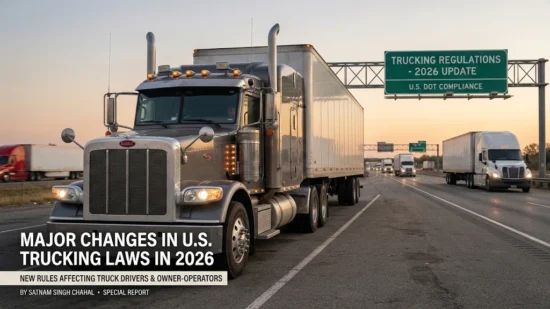
 The American trucking industry is experiencing significant regulatory changes in 2026, affecting commercial driving licences, immigration-related eligibility, employment classification, English-language proficiency, electronic logging devices and hours-of-service requirements. These developments are particularly important for immigrant communities, including thousands of Punjabi truck drivers, owner-operators and trucking business operators across the United States.
Trucking is not merely an occupation for many Punjabi families; it is a major source of household income and business investment. Many families have invested their savings in purchasing trucks, establishing transportation companies and entering lease-purchase agreements. Consequently, changes in federal and state regulations can have a direct impact on their employment, financial stability and future business opportunities.
One of the major developments concerns the classification of truck drivers as independent contractors or employees. On November 19, 2026, the U.S. Department of Labor announced a final rule replacing the 2024 classification framework with an approach substantially similar to the 2021 economic reality test. The rule was published in the Federal Register on November 23 and is scheduled to take effect on January 22, 2027.
The new framework places particular emphasis on whether a worker exercises meaningful control over the work and whether the individual has a genuine opportunity to earn profits or suffer losses through independent business decisions. Other considerations, including the skills required, the duration of the working relationship and the role of the work within the company’s business, may also be examined.
The change is especially relevant to owner-operators working under lease-purchase arrangements. Purchasing or leasing a truck does not automatically establish independent contractor status. The actual relationship between the driver and the trucking company matters, including who controls freight arrangements, negotiates rates, chooses routes and manages business expenses.
California drivers should pay particular attention because California’s AB 5 employment classification law operates independently of the federal framework. The new federal rule does not automatically override California’s separate requirements.Another important development concerns non-domiciled Commercial Driver’s Licences. The Federal Motor Carrier Safety Administration introduced tighter eligibility requirements effective March 16, 2026, limiting qualifying non-domiciled CDL and commercial learner’s permit applicants to specified immigration categories, including H-2A, H-2B and E-2 visa holders.
States are required to verify qualifying immigration status through federal systems under the applicable requirements. This development has raised important questions among immigrant truck drivers about licence renewals, eligibility and continued employment.It is important to distinguish between a standard state-domiciled CDL and a non-domiciled CDL. U.S. citizens and qualifying lawful permanent residents remain subject to the standard CDL eligibility framework. Drivers should verify their individual circumstances with their state licensing agency rather than relying on social media discussions or informal advice.
For Punjabi drivers, particularly those whose immigration status or licence category is changing, obtaining accurate information before a licence expires is essential. English-language proficiency remains an important federal qualification requirement for commercial drivers. Drivers are expected to understand relevant highway traffic signs, communicate with law enforcement officers and respond appropriately to roadside inspection instructions.
On August 10, 2026, FMCSA published a proposed rule seeking to formally incorporate English-language proficiency violations into federal out-of-service regulations. However, a proposed rule must be distinguished from a completed final regulation.This issue is particularly relevant to immigrant drivers whose first language is not English. Even experienced drivers can encounter difficulties when dealing with inspectors, understanding official instructions or responding to questions during roadside inspections. Improving practical English communication and familiarity with highway terminology can help drivers meet their responsibilities and avoid unnecessary compliance problems.
Electronic Logging Devices have become another important area of federal enforcement. During 2026, FMCSA removed several ELD products from its registered-device list because they did not satisfy applicable federal technical requirements.On February 12, FMCSA removed nine devices and instructed affected carriers to replace them by April 14. Further enforcement followed during the year. On November 12, the agency announced the removal of another 121 devices, with affected motor carriers given 60 days to replace them. FMCSA also announced the reinstatement of FORZA ELD on November 18.
These developments demonstrate why truck owners and transportation companies must regularly check the official FMCSA registered and revoked ELD lists. A device being advertised or sold commercially does not necessarily mean that it remains federally registered. Continued use of a revoked device beyond the applicable replacement deadline can expose carriers and drivers to enforcement action.
Speed limiters have been a subject of considerable discussion within the trucking industry. Proposals to require speed-limiting technology on heavy commercial vehicles generated concerns among drivers and transportation companies about operating flexibility, safety and delivery schedules.However, federal regulators withdrew the proposed nationwide speed-limiter rulemaking. Consequently, the withdrawn proposal does not create a new federal speed-limiter requirement. This does not remove existing speed limits or other state and federal road-safety obligations. Commercial drivers must continue to follow applicable speed restrictions and vehicle safety regulations.
The FMCSA has also examined possible changes to Hours-of-Service arrangements through pilot programmes. These initiatives explore whether drivers could receive greater flexibility in organizing rest periods while maintaining road safety.The Flexible Sleeper Berth programme examines alternative rest combinations, including 6/4 and 5/5 splits. Another initiative, the Split Duty Period programme, examines whether qualifying non-driving time of up to three hours could pause the 14-hour duty window.
These proposals are relevant to drivers dealing with traffic congestion, adverse weather, delays at loading facilities and unpredictable delivery schedules. However, pilot programmes should not be confused with nationwide changes to existing Hours-of-Service regulations. Drivers should continue following the rules currently applicable to them unless they are formally participating in an authorized pilot programme.
Federal regulations are only one part of the legal framework governing American trucking. Individual states can introduce additional requirements relating to employment classification, vehicle registration, insurance, cargo theft and business operations.Fraudulent freight transactions, identity theft and unauthorized changes to cargo delivery arrangements have become important concerns for transportation companies. Trucking businesses must maintain proper documentation, verify freight transactions and understand the legal requirements of the states in which they operate.
Drivers travelling across state borders should remember that federal compliance does not automatically satisfy every state requirement. California, for example, has its own employment classification rules that can affect owner-operators and transportation businesses.These regulatory developments deserve particular attention within the Punjabi-American community. Trucking has provided employment and business opportunities to generations of Punjabi immigrants, and many families depend on the industry for their financial security.
Owner-operators should carefully examine their lease-purchase agreements, business expenses and contractual relationships with transportation companies. Company drivers should understand their employment rights and responsibilities. Drivers holding non-domiciled CDLs should verify their eligibility and documentation, while all commercial drivers should maintain valid licences, medical certificates, insurance and vehicle registration records.Community organizations, trucking associations and transportation businesses can also help by sharing verified information in English and Punjabi. Accurate information is particularly important when regulatory changes are circulated through WhatsApp groups and social media, where proposed rules are sometimes incorrectly presented as final laws.
The regulatory developments of 2026 demonstrate that the American trucking industry is undergoing significant changes. Employment classification, commercial licensing, immigration eligibility, English-language proficiency, electronic logging requirements and working-hour arrangements can all influence the professional lives of truck drivers.For Punjabi immigrant families, these are not simply government policy matters. They are connected to employment, business ownership, household income and long-term financial security.
Truck drivers should not make important decisions about their licences, immigration status or business arrangements based solely on informal information. They should consult the Federal Motor Carrier Safety Administration, the Department of Labor and their respective state transportation and licensing agencies.A strong trucking industry requires informed drivers, fair enforcement, transparent regulations and respect for the rights of those who keep America’s transportation system moving.
By Satnam Singh Chahal
Punjab Outlook — Special Report
Disclaimer: This article and accompanying images are for informational and illustrative purposes only. Some visuals may be AI-generated or digitally enhanced and may not depict actual events or persons.Views expressed are based on publicly available information and analysis