
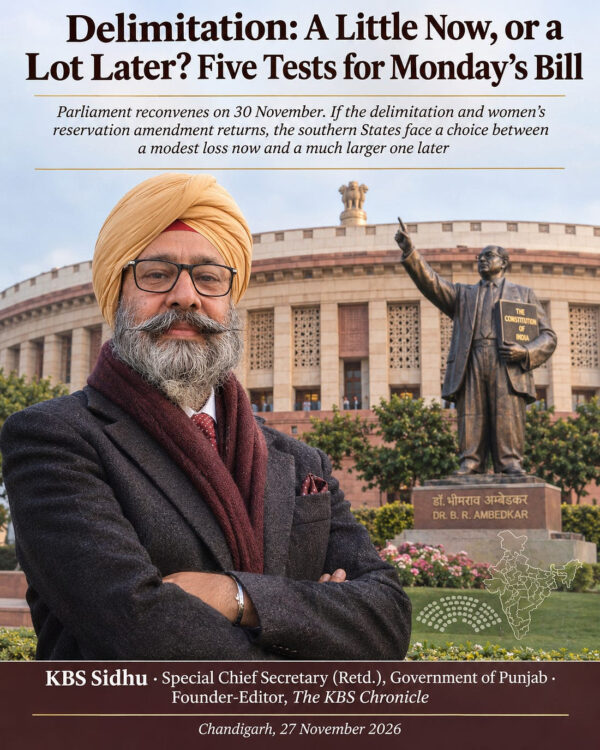
KBS Sidhu · Special Chief Secretary (Retd.), Government of Punjab · Founder-Editor, The KBS Chronicle
Chandigarh-At 7.23 on Thursday evening, the Parliamentary Affairs Minister, Kiren Rijiju, posted a three-sentence notice. The Government has asked the Speaker to reconvene the Lok Sabha on Monday, 30 November, and the Chairman to reconvene the Rajya Sabha on Wednesday, 2 December, “to transact essential Government Business”. Both Houses may rise on 3 December.
No Bill is named. Nobody in Delhi, however, is speculating about anything else. The word that matters is “reconvene”. Parliament was adjourned in August but never prorogued, so it can be called back without the fourteen days’ notice a fresh session requires. The order of sittings matters too. The Lok Sabha gets two days to itself before the Rajya Sabha joins, which is just the shape a constitutional amendment needs.
A reminder of the rules, since this is technical ground and memories are short. An amendment to the Constitution must be passed in each House separately, by a majority of its total membership and by two-thirds of the members present and voting. There is no joint sitting to fall back on if one House baulks. And because this amendment alters the representation of the States in Parliament, it will also need ratifying by the legislatures of at least half the States.
The first threshold is the Lok Sabha, where the Bill fell in April by 54 votes. If it clears that hurdle on Monday or Tuesday, every ounce of the Government’s effort will move across the corridor to the Rajya Sabha, where its margin is thinner still. I do not propose to count heads here, party by party and rebel by rebel; others are doing that, and the count will shift by the hour. What I can do is set down what to look for in the text.
Five Tests, Plainly Put
These tests come out of two earlier pieces in this Chronicle, Shah’s Gambit (16 October) and Settle at 2011, Seal for Decades (16 November). Each is a question the Bill’s own text can answer, whatever is said in the debate.
1. Proportionate, or merely “no State loses”? The two sound alike but mean different things. “No State will lose a seat” can be kept while the southern States’ share of an enlarged House shrinks steadily. “Every State keeps its proportionate share” cannot. The south will be watching for that word.
2. A schedule, or a promise? April’s Bill was defeated partly because the assurance of 50 per cent more seats for every State was given from the floor and not written into the text. A table in the Constitution, State by State, settles the matter; a speech does not.
3. Which census? Today’s shares rest on the 1971 Census, frozen since 1976. The 2001 Census only redrew boundaries within States. The Bill can keep the 1971 shares, rebase on 2011, or wait for Census 2027. Each choice moves dozens of seats between north and south.
4. A seal, and for how long? Whatever shares are fixed now, the real question is when they next open up. A 25-year freeze is what the DMK has asked for. Without one, any settlement is only a truce until the next census.
5. Does the Rajya Sabha grow in step? A Lok Sabha of about 815 beside an unchanged Rajya Sabha shrinks the voice of the States wherever the two Houses sit together. If the Council of States is to remain a council of States, it must grow in the same ratio.
A Little Now, or a Lot Later
Behind the five tests lies one hard choice, and it is the south’s to make. The five southern States (Tamil Nadu, Kerala, Andhra Pradesh, Telangana and Karnataka) hold 129 of the 543 seats today, about 23.8 per cent of the House, on shares frozen since 1971.
If they hold out and Parliament does nothing, the freeze ends of its own accord once Census 2027 is published, and the seats are shared out again on population. On my estimates from the official projections, the five would fall to about 103 seats in a House of 543. Those are fewer seats in absolute terms, with Kerala down from 20 to 14 and Tamil Nadu from 39 to 29.
If instead they accept a rebase on the 2011 Census, with every State’s seats in a schedule and the shares sealed for a generation, they would hold 167 seats in a House of 815, about 20.5 per cent. Every one of them gains seats in absolute numbers. They give up about three percentage points of the House, and in return they buy twenty-five years of certainty.
The flat 50 per cent on present shares would give them more still: 195 seats, their share intact. That is the best outcome on paper, and the DMK’s stated demand. Whether the Hindi heartland, which would have to forgo the seats its population entitles it to, can be brought to accept it in both Houses is a question no one has yet answered.
The Hardest Chair in the Room
This is easy enough to set out on paper and much harder to sell at home. No southern leader wants to be the one who agreed to a smaller share for his State, however good the arithmetic, and no southern leader wants to be the one who held out and watched the next census take a fifth or more of his seats.
The difficulty is greatest for the south’s partners in the NDA, and above all for Chandrababu Naidu. Andhra Pradesh holds 25 seats today. A flat 50 per cent would take it to about 38; a rebase on 2011 to about 33; drift into Census 2027, on my estimate, down to about 20. Supporting the Government on a 2011 rebase means defending a shrinking share in Amaravati. Opposing it means breaking ranks with the alliance on the Government’s flagship measure. Abstaining satisfies neither side.
The opposition in the south faces a mirror image of the same problem. Saying yes looks like a surrender to Delhi. Saying no, and being blamed for keeping women out of a third of the House, is no easier. Whichever way they vote, they will have to explain it, at home as well as in Delhi.
Not a Dime Either Way
So, will it pass? I am not willing to bet even a dime on the outcome, one way or the other. The Government would not be reconvening Parliament for four days unless it believed it had the numbers, or was close enough to try. It believed much the same in April.
The draft Bill may not reach members until they are in their seats on Monday, and the debate could begin within hours. When it does arrive, read the text before the speeches. Check whether it says “proportionate”, whether it carries a schedule, which census it rests on, whether it seals the shares and for how long, and whether the Rajya Sabha grows in step. Those five answers will tell us what the Government has conceded to get its numbers, and what the south has accepted in return, more reliably than any whip.
Women have waited three decades for their third of the House. Whatever happens next week, it would be a pity if they had to wait for yet another census.