
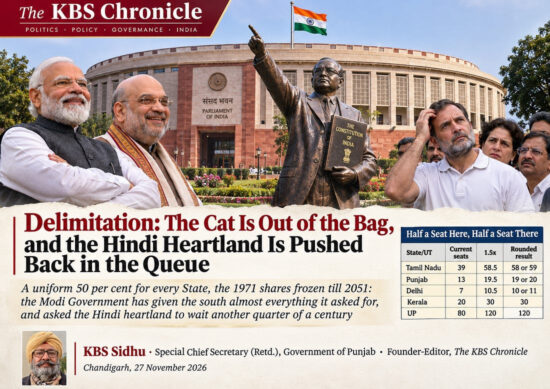
The Union Cabinet met in special session on Friday, 27 November, and cleared the revised Constitution Amendment Bill on women’s reservation and delimitation. The full text is not yet public, but its three load-bearing elements have been reported consistently. Every State’s Lok Sabha seats go up by a uniform 50 per cent. The 1971 Census stays the basis for sharing seats among States, with that freeze extended by 25 years, to 2051. And the 2011 Census will be used only to redraw constituency boundaries within each State.
In other words, the Vajpayee formula of 2001 (the Eighty-Fourth Amendment, which froze the shares and redrew the lines) has been taken off the shelf, enlarged by half, and dated forward a generation.
This is not what I expected. In Shah’s Gambit last month I made the case for exactly this formula. By 16 November, in Settle at 2011, Seal for Decades, I had talked myself out of it, reasoning that a Government whose base lies in the Hindi heartland would never ask that heartland to give up what the 2011 Census owed it. I thought the best the south could hope for was a rebase on 2011, sealed for a generation. The Government has gone further. The south loses nothing.
The Heartland’s Due, Deferred Again
The arithmetic of what the north gives up is not hard to do. Share out a House of about 815 on the 2011 Census, and Uttar Pradesh would be entitled to some 134 seats. Under the uniform 50 per cent it gets 120. Bihar would be due about 70 and gets 60. Rajasthan, about 46 against 38; Madhya Pradesh, about 49 against 43 or 44. On today’s population projections, the gap is wider still, with Uttar Pradesh nearer 139 and Bihar nearer 75.
These are seats the Constitution’s own principle of one person, one vote would assign to the heartland. Since 1976 they have stood frozen on the 1971 Census, a freeze first meant to last until 2000, then extended to 2026, and now, if this Bill passes, to 2051. That is eighty years on one headcount. If the heartland’s due has not quite been bartered away, it has certainly been pushed back to the end of the queue once again.
That the Government doing the pushing draws its majority from Lucknow and Patna is what makes the decision remarkable. In that sense, and only in that sense, the Modi Government has capitulated to the south. A Bihar voter’s ballot will continue to count for little more than half as much as a Kerala voter’s in the Lok Sabha, and will do so until the 2050s.
No Reason Left to Say No
For the five southern States the Bill now meets both of the demands they made in writing. The DMK asked for a 50 per cent increase on present shares, written into the Bill, and for the allocation to stay unchanged for 20 to 25 years. It has both. Tamil Nadu goes from 39 seats to 58 or 59, Kerala from 20 to 30, Karnataka from 28 to 42, Andhra Pradesh from 25 to 37 or 38, and Telangana from 17 to 25 or 26. Not one of them loses a percentage point of the House.
In an earlier piece, Let’s Not Push Them Towards a Federation of ‘Dakshin’ Bharat, I warned that the five southern States, already contributing more to the Union’s taxes than they get back, would see a population-based delimitation as a second blow on top of the first. To pay more and then also be heard less would have been a double whammy, and the talk of a southern federation would have stopped being talk. This Bill removes the second blow. Whatever the north has given up, the Union of India has been held together by it, and that, to my mind, is a bargain worth making.
It follows that there is now no principled ground on which any party from Tamil Nadu, Kerala, Karnataka, Telangana or Andhra Pradesh can oppose the Bill on the question of seats. They may oppose it on other grounds. On this one, the Government has met them on their own terms.
Congress’s Southern Dilemma
The one party with a reason still to vote no is the Congress, and its reason has little to do with the south. Rahul Gandhi’s line since April has been that the Congress supports women’s reservation without reservation, but that delimitation must wait for the census now under way, with its count of caste, so that the backward classes get their due; a delimitation on 2011 figures, which carry no such count, he has refused to accept. The revised Bill still uses the 2011 Census to redraw constituencies within States. On that point, his objection stands, and it may yet carry the party into the No lobby.
If it does, the strain will show on his own benches. The Congress holds Karnataka and Telangana and is the principal force in Kerala. Its MPs from those States will be asked to vote against a formula that gives their States everything their Chief Ministers and Assemblies have demanded for two years. Explaining that in Bengaluru, Hyderabad or Thiruvananthapuram will not be easy, and the Government knows it. Do not be surprised if a few southern Congress MPs find that their consciences, or their flights, keep them away on the day.
Half a Seat Here, Half a Seat There
Of the five tests set out in these columns this morning, the Cabinet’s decision meets three on paper. It is proportionate. It says which census governs which job: 1971 for the shares, 2011 for the boundaries. And it seals the shares, until 2051. Two tests remain open until the text is tabled.
The first is the schedule. Half as many seats again sounds simple, until one notices that eighteen of the thirty-six States and Union Territories have an odd number of seats today. One and a half times 39 is 58.5. Round every half down and the House comes to 805; round every half up and it comes to 824. Tamil Nadu is 58 or 59, Punjab 19 or 20, Delhi 10 or 11, and eight single-seat States and territories either get no increase at all or double their strength. Only a State-by-State table in the Constitution settles that, and in April a Government functionary said no Bill would ever carry the numbers.
The second is the Rajya Sabha. Nothing reported so far says that the Council of States will grow with the House of the People. Unless it does, the voice of the States in any joint sitting will shrink, just when their numbers in the Lok Sabha have been so carefully protected.
Punjab: In the Middle, and None the Worse
Punjab sits close to the national average, and that is its protection. It holds 13 of the 543 Lok Sabha seats today, 2.39 per cent of the House, against 2.29 per cent of India’s population in 2011. A strict population count would have given it 19 seats in a House of about 815; the uniform 50 per cent gives it 19 or 20. Whichever way the half seat falls, this formula cannot hurt Punjab.
The women’s quota then works as follows. One-third of the Lok Sabha, about 270 seats nationally, goes to women. In Punjab, that is 6 or 7 of its 19 or 20 seats. Punjab today reserves 4 of its 13 seats for Scheduled Castes. At that same ratio the enlarged delegation would have 6 SC seats, and one-third of those, 2, would be reserved for SC women.
The larger change is at home. The Punjab Vidhan Sabha, at 117 today, would go to 175 or 176. One-third of it, 58 or 59 seats, would be reserved for women. The House now reserves 34 seats for Scheduled Castes; at the same ratio that becomes 51, of which 17 would go to SC women. Since the boundaries are to be redrawn on the 2011 Census, when nearly 32 per cent of Punjab’s people were Scheduled Castes, the SC count could come out somewhat higher still. Either way, close to sixty women would sit in a Punjab Assembly that elected about a dozen in 2022.
From Not a Dime to a Fair Bet
This morning I wrote that I would not bet a dime on the outcome either way. The Cabinet’s decision changes that. With the south’s two conditions met, the southern parties outside the Congress have run out of reasons to vote no, and the Congress’s own southern MPs will be uneasy voting no. The Bill still needs two-thirds of those present and voting in each House, and nothing is certain until the votes are counted. But on these terms, I expect it to sail through.
The north has paid for it, deferring once more what the census owes it. The south has been spared a double blow. And women, who have waited three decades for a third of the House, may at last get it at the next general election. As bargains go, this is one that keeps the Union whole and wholesome.
Share The KBS Chronicle
About the author: KBS Sidhu is a retired IAS officer (1984 batch, Punjab cadre) who superannuated as Special Chief Secretary, Government of Punjab. He has discharged statutory duties under the election law at every level, from presiding officer at a polling station to District Election Officer, Amritsar, in which capacity he was also Returning Officer for the Amritsar and Tarn Taran parliamentary constituencies, and served as an election observer of the Election Commission of India in three successive Lok Sabha elections. He is the Founder-Editor of The KBS Chronicle and Convener of the Shiromani Punjab Forum.