
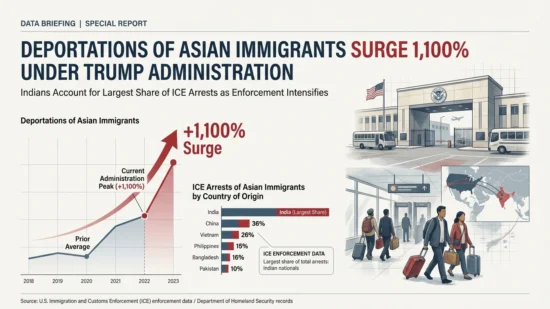
 WASHINGTON, D.C. — Deportations of Asian immigrants have surged by approximately 1,100% under U.S. President Donald Trump’s second administration, with Indian nationals accounting for the largest share of arrests and detentions among Asian immigrant communities, according to a new report released by Stop AAPI Hate.
The report, based on federal immigration enforcement data obtained through Freedom of Information Act (FOIA) requests, recorded more than 9,900 deportations of Asian migrants between January 20, 2025, and August 6, 2026. During the same period, arrests increased by 436% to at least 21,480, while detentions rose by 512% to 19,148.
The report highlighted a dramatic increase in monthly deportations. In March 2022, approximately 123 Asian immigrants were deported, compared with 1,703 in March 2026, representing an increase of 1,284.6%.
Cynthia Choi, co-founder of Stop AAPI Hate, said the experiences of Asian Americans and Pacific Islanders were frequently overlooked in the national immigration debate. She emphasized that the impact of immigration enforcement on these communities needed greater public attention and recognition.
Indian Nationals Account for Largest Share of Arrests
Indian nationals accounted for approximately 29% of all Asian immigrant arrests by Immigration and Customs Enforcement (ICE), followed by Chinese nationals at 25%. India recorded the highest number of arrests and detentions among Asian immigrant communities, while China ranked first in deportations, narrowly ahead of India.
Stephanie Chen, director of data and research at Stop AAPI Hate, said the arrest figures for Indian and Chinese nationals were broadly consistent with their respective shares of the Asian-born non-U.S. citizen population.
However, the report also identified disproportionate immigration enforcement against several refugee and Central Asian communities. Although people from Laos represent approximately 0.6% of the Asian non-citizen population in the United States, they accounted for nearly 5% of Asian immigrant arrests.
Similar disproportionate patterns were reported among immigrants from Vietnam, Cambodia and Bhutan, as well as Kyrgyzstan and Kazakhstan.
Deportations to Third Countries Raise Concerns
The report also highlighted a significant increase in the deportation of Asian immigrants to third countries. Nearly 200 Asian migrants were reportedly deported to countries other than their countries of origin, representing a 942% increase compared with the Biden administration.
Some deportees were reportedly sent to countries where they had no established connections or previous residence, raising concerns about their safety, legal protection and ability to rebuild their lives.
Cynthia Choi expressed concern that some Asian and Pacific Islander immigrants were being deported to countries where they had never lived or where they could face persecution and violence.
California Leads in Asian Immigrant Arrests
California accounted for approximately 25% of Asian immigrant arrests nationwide, making it the state with the largest share of such arrests. Texas followed with 13%, while New York accounted for approximately 9%.
Oklahoma also recorded a substantial number of arrests, with more than 2,700 Asian immigrants arrested through enforcement operations, including Operation Guardian. The operation reportedly resulted in the arrests of more than 120 commercial vehicle operators.
The report found that Oklahoma’s share of Asian immigrant arrests was approximately nine times its share of the Asian non-citizen population. Indiana, Minnesota and Pennsylvania also recorded arrest levels roughly twice their respective shares of that population.
Growing Immigration Enforcement and Its Impact on Asian Communities
The findings highlight the expanding impact of immigration enforcement on Asian immigrant communities across the United States, particularly Indian nationals, who constitute the largest share of Asian ICE arrests.
For Indian-origin communities, the figures are especially significant because they demonstrate the growing exposure of Indian immigrants to arrest, detention and deportation proceedings.
The report raises broader questions about immigration enforcement priorities, due process, detention conditions and the treatment of vulnerable immigrant communities. It also underscores the importance of transparency and accurate public reporting as immigration policies continue to affect thousands of families.
While the Trump administration has made immigration enforcement a central policy priority, the Stop AAPI Hate report provides a closer look at how these measures are affecting Asian immigrant populations, whose experiences have often received less attention in the wider national immigration debate.