
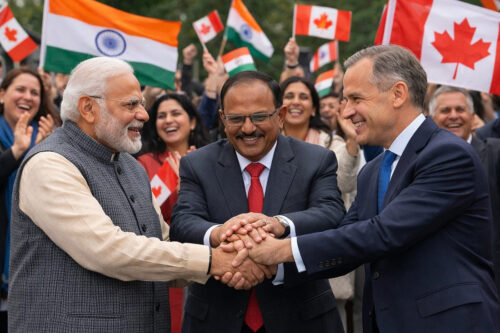
 After years of tension, distrust, and public sparring, India–Canada relations are finally showing signs of calm improvement. This shift has not come suddenly or easily. NSA Ajit Doval had a low key visit to Canada to meet his counter part in February 2026. It follows a troubled period marked by political misjudgments, loud diplomatic drama, and avoidable bitterness. What is unfolding now is not emotion or goodwill, but clear-headed realism—and that is precisely why it offers real hope for a steadier and more durable future.Ajit Doval is the man of the moment. Prime Minister Mark Carney, expected to visit India in March 2026
When Home Politics Took Over Foreign Policy
Much of the damage began under former Canadian Prime Minister Justin Trudeau, whose government allowed domestic vote-bank politics to shape foreign relations. In trying to appease certain loud and organised diaspora groups, Ottawa failed to draw a firm and necessary line between peaceful protest and dangerous extremism.Canada’s respect for free speech is genuine and valuable. But under Trudeau, this principle slid into excessive and careless tolerance. Khalistani separatist voices—some openly supporting violence, issuing threats, and encouraging intimidation—were allowed public space and political comfort. India’s repeated warnings that these groups posed a serious security threat were played down or ignored, rather than addressed with responsibility and seriousness.
The Nijjar Episode: A Serious Error in Judgment
The lowest point came in September 2023, when Trudeau made a statement in the Canadian Parliament accusing India of involvement in the killing of Hardeep Singh Nijjar.This move was shocking and deeply ill-advised. Nijjar was not an ordinary community leader. He had a highly questionable and controversial past, was listed as a terrorist by Indian authorities, and was alleged to have entered Canada using fake documents and false identities. Making such a serious allegation—against a friendly country, on the floor of Parliament, and without placing clear and verifiable public evidence—was unusual, reckless, and unnecessary.
Sensitive matters of this nature are normally handled quietly through intelligence channels and diplomatic engagement. Instead, the issue was made public, leading to predictable damage: diplomats were expelled, trade talks were halted, and trust between the two countries collapsed. A calmer, wiser, and more restrained approach could have avoided this diplomatic breakdown.
Ignoring Warnings, Empowering Extremism
This episode also exposed a deeper and systemic problem within Canada. For years, Indian agencies had issued clear warnings to Ottawa about the growing and dangerous overlap between Khalistani groups, organised crime, drug trafficking, and gang violence—especially in British Columbia and Ontario. These warnings were largely ignored or downplayed.
The consequences were severe and predictable. Criminal networks flourished under this lax political cover. Innocent, law-abiding Sikh families faced terrifying intimidation through extortion rackets, threats, and targeted shootings. The fentanyl crisis spiralled out of control, claiming countless lives. Canada’s permissive approach ultimately damaged its own social fabric and public safety.
Groups like Sikhs for Justice exploited this loose environment to push an outdated separatist agenda—one with little real support in present-day Punjab but constant disruptive impact abroad. Reports have also linked drug profits to funding pro-Khalistan rallies and legal defences, often with alleged backing from Pakistan’s ISI.
The Numbers Tell a Grim Story
Recent statistics paint a disturbing picture of rising violence and public anger.In Peel Region (near Toronto), extortion reports surged from 319 in 2023 to 490 in 2024, and stood at 436 by late 2025.In Surrey, British Columbia, more than 100 extortion cases were reported in recent months, with 132 cases in 2025 alone, including 49 involving shootings.In just the first 27 days of 2026, Surrey recorded 35 extortion-related shootings.Nationwide, such incidents—often linked to organised gangs such as the Lawrence Bishnoi network—are approaching 1,500 cases, including murders, arson attacks, and drive-by shootings.
Public resentment has grown sharply. An Abacus Data survey (September 2025) found crime and public safety to be a top concern for 20% of Canadians, up from 16% earlier. An Angus Reid poll (January 2026) showed a majority of Canadians believing that crime in their communities has increased over the past five years. This anger, fuelled by a visible breakdown in law and order linked to organised crime and extremist networks, has intensified pressure on the Canadian government to act. The international crime syndicate cannot be broken unless there is intel sharing. That is why the Liasson officers have been appointed to quickly share the crime intel of the gangsters and extremists.
A Quiet Reset Begins
The change in direction started quietly in early February 2026, when India’s National Security Advisor Ajit Doval visited Ottawa. There were no loud speeches or media theatrics—only serious and focused discussions.Doval met Canada’s National Security Advisor Nathalie Drouin. They agreed on practical steps: enhanced intelligence sharing, closer coordination between agencies, and joint action against extremism, cybercrime, and drug networks. Canada also made it clear that violent Khalistani groups do not enjoy government support, marking an important and overdue correction of earlier excesses.
Why Canada Is Now Willing to Improve Ties
Canada’s change in approach is driven by reality, not sentiment.
First, law and order has become a major political issue. Gang violence, extortion, and drug crimes linked to extremist networks are now widely recognised as a Canadian problem, not an Indian one.Second, economic stress is biting hard. Indian students once contributed massively to Canada’s economy—up to CA$22 billion annually through tuition fees, housing, and local spending. After relations deteriorated, student arrivals reportedly fell by 67.5% from 2023 levels, resulting in an estimated CA$10.5 billion shortfall. Universities have faced deficits, job losses have crossed 5,000, and sectors such as retail and housing have suffered. With caps on study permits extended into 2026, repairing ties with India has become an economic necessity, not a diplomatic luxury.
Thirdly, growing tensions of Canada with USA is also another reason for Canada to reset its international relations with an old ally, India, which has one of the largest diaspora and contributing hugely to Canadian economy.Fourthly, another reason for growing unease locally is the mounting feeling of intimidation by religious groups during their religious functions.
A New and Practical Tone in Ottawa
Political change has also helped steady the atmosphere. Prime Minister Mark Carney, expected to visit India in March 2026, brings a more practical, business-like, and unsentimental approach. Unlike his predecessor, Carney appears focused on economic recovery, internal security, and rebuilding damaged relationships.Challenges remain. Khalistani groups continue to be loud and confrontational, staging protests and issuing threats. But the difference now lies in official thinking: tolerating extremism does not strengthen democracy—it weakens the state.
Looking Ahead: Common Sense Over Drama
The India–Canada reset is not about apologies or emotions. It is about learning from mistakes. The lesson is clear and unavoidable: using extremist politics for short-term political gain leads to long-term diplomatic damage and internal disorder.
If this sensible course correction continues, both countries can benefit—from renewed trade and education ties to stronger security cooperation. Most importantly, it sends a clear message that foreign policy cannot be driven by diaspora politics and encouraging intimidation of the localites.After a bitter and dark period, a calmer and more constructive future now looks possible. From here only onwards, the future looks promising. The worst seems to be over.