
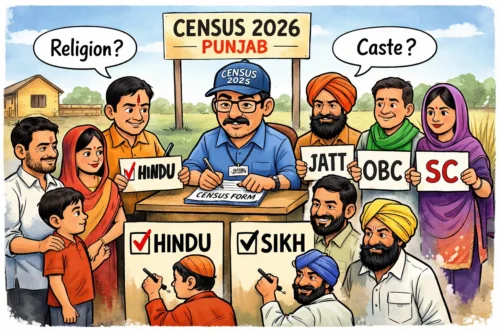
 The last comprehensive census of Punjab was published in 2011. Now, as the next Census is set to be conducted in two phases along with enumeration of castes, as announced by the Ministry of Home Affairs, the state has undergone significant demographic, social, and political transformations. According to the press release, “It has been decided to conduct Population Census-2027 in two phases along with enumeration of castes,“ with the reference date being 00:00 hours of March 1, 2027 (or October 1, 2026, for certain snow-bound areas). The first phase (houselisting and housing) is expected to align with historical patterns, potentially from April to September 2026, followed by population enumeration around February 2027.
This Census will do far more than refresh population totals. It will test entrenched assumptions about caste structure, migration, religious change, and political power—assumptions that have shaped Punjab’s governance since Independence.
Between 2011 and 2026, Punjab has lived through sustained emigration, deepening dependence on migrant labour, declining fertility, and increasingly charged debates around caste and religion. The forthcoming data will demand calm, evidence-based interpretation—not political sensationalism. Punjab’s population stood at 27.74 million in the 2011 Census. By the time population enumeration is completed in early 2027, official projections suggest the state’s population will have crossed 32 million, adding roughly four to five million people in fifteen years. Importantly, this growth has occurred in a context of low fertility and ageing—meaning that migration, not natural increase, has been the principal driver of demographic change.

What the 2011 Census Established
The Census of India 2011 recorded Punjab’s population at 27.74 million. Sikhs constituted 57.69 per cent, Hindus 38.49 per cent, Muslims 1.93 per cent, Christians 1.26 per cent, with other religions together accounting for less than one per cent.
Scheduled Castes (SCs) made up 31.9 per cent of the population—the highest proportion among all Indian states. This single statistic places Punjab in a unique social category nationally.
What is equally important—and often overlooked—is that India has not published comprehensive caste-wise population data since the 1931 Census. Post-Independence censuses enumerate and publish data only for Scheduled Castes and Scheduled Tribes. Detailed figures for OBCs, Jatts, and forward castes are not released in the public domain.
Thus, while Punjab’s religious composition in 2011 is firmly documented, caste distributions beyond SCs have had to be reconstructed through indirect but credible sources.
Caste Data: Collected, Withheld, Yet Widely Used
It would be misleading to suggest that caste data ceased to exist after 1931. What changed was publication, not collection.
In 2011, alongside the Census, the Government of India conducted the Socio-Economic and Caste Census (SECC), which recorded caste identities across the country. Subsequently, the Union Government decided not to publish the caste tables, officially citing data-quality and verification concerns, and stating that there was “no proposal to release the caste data.”
Yet, the data itself:
· Exists within government systems,
· Is accessed in aggregated or indirect form by political parties and administrations,
· Informs welfare design, reservation debates, and electoral strategy,
· Has been extensively used in academic research, National Sample Survey–based studies, and policy papers.
In effect, caste data in India has remained politically available but publicly unaccountable.
A Critical Shift: Census-2027 Will Enumerate Castes
This long ambiguity is now formally acknowledged.
In an official press release dated 16 June 2025, issued by the Ministry of Home Affairs, the Government of India notified that the Population Census-2027 will be conducted in two phases and will include the enumeration of castes, under the provisions of the Census Act, 1948. The release also specifies March 1, 2027 as the reference date for most of the country.
This is a crucial institutional admission. It confirms what has long been informally true: caste information is integral to governance—and cannot remain indefinitely unpublished without consequence.
Whether and how the caste data collected in Census-2027 is ultimately released will therefore be as important as the enumeration itself.
Punjab’s Broad Caste Composition (Best Available Estimates)
(Derived from Census 2011 SC data, SECC-2011, NSS rounds, and academic consensus)
· Scheduled Castes (SC): ~31.9% (official Census figure)
· Other Backward Classes (OBC): ~30–32%
(Saini, Kamboj, Tarkhan/Ramgarhia, Kumhar, Lohar, Gujjar, etc.)
· Jatts (Sikh + Hindu): ~20–21%
o Jat Sikh: ~18–20%
o Hindu Jat: ~1–3%
· Upper/Forward Castes (Brahmin, Khatri, Arora, Bania, etc.): ~12–15%
· Scheduled Tribes (ST): negligible
Two structural truths stand out.
First, Scheduled Castes numerically exceed Jatts by a wide margin.
Second, Jatts—despite being a demographic minority—continue to dominate land ownership, political leadership, and key religious institutions.
This gap between numbers and power lies at the heart of Punjab’s political economy.
What Changed Between 2011 and 2026
International Emigration
Punjab has witnessed sustained overseas migration, particularly to Canada, where India has emerged as the largest source of permanent residents. Scholarly studies consistently show that rural, land-owning, general-category households—especially Jat Sikhs—are disproportionately represented in long-term emigration.
The demographic consequence is visible: a relative decline in the Jat Sikh share of Punjab’s resident population, especially among the working-age cohort.
Internal In-Migration
Punjab’s agriculture and construction sectors now depend structurally on migrant labour from Uttar Pradesh, Bihar, Jharkhand, and Odisha. These workers are predominantly Hindu and largely from OBC and Scheduled Caste backgrounds. Though much of this migration is seasonal, a growing portion is semi-permanent and likely to be reflected in Census counts.
Conversion Debates
Religious conversions—particularly to Christianity—have become politically charged. Academic research confirms localised conversions, often linked to social vulnerability and institutional outreach. However, claims of dramatic statewide shifts lack verified evidence and must await Census confirmation.
Low Fertility and Ageing
Punjab’s fertility rate has fallen below replacement level. Natural population growth is limited; migration—not fertility—is now the principal driver of demographic change.
What the 2027 Census May Reveal: Three Analytical Scenarios
These are stress-tested projections, not predictions.
Scenario One: Low Change
Sikhs ~56–57%, Hindus ~38%, Christians ~1.5%, SCs ~31%, Jat Sikhs ~19–20%.
Scenario Two: Moderate Change (Most Likely)
Sikhs ~55–56%, Christians ~2% (district variation), SC share stable, OBC share marginally higher, Jat Sikhs ~18–19%.
Scenario Three: High Change (Stress Test)
Sikhs below ~54%, Christians above 5%, Jat Sikhs in mid-teens—possible only under accelerated migration or conversion dynamics.
Why This Census Matters
Punjab has often equated cultural dominance with numerical strength. The 2027 Census may expose that gap more starkly than ever: a Sikh-majority state that is SC-heavy and increasingly shaped by migrant labour, with political power concentrated in a community that is not demographically dominant.
Handled responsibly, Census data can inform welfare design, labour policy, and representation. Mishandled, it risks fuelling fear, distortion and social anxiety.
A Necessary Note of Restraint
Until official figures are released—and especially until clarity emerges on the publication of caste data—sweeping claims about demographic “replacement” should be treated with scepticism.
The 2027 Census will not transform Punjab overnight. But it will force the state to confront fifteen years of accumulated demographic change. The real test is whether Punjab’s politics can accept demographic truth without panic—or prejudice.