
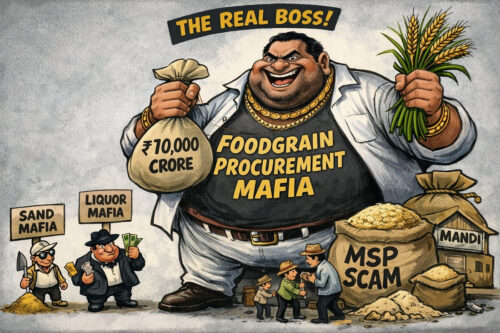
 In Haryana, a massive paddy procurement scam has already been exposed. This is no longer a matter of allegation or suspicion. Multiple arrests have been made, FIRs registered, officials suspended, and Special Investigation Teams (SITs) constituted. In districts like Karnal, investigations uncovered what the police themselves called “ghost procurement” — paddy shown as procured in official records even though it never physically arrived at the mandi.
The modus operandi was simple and brazen. Fake gate passes were generated, procurement entries were made without grain movement, and payments were released on paper stocks. Physical verification later revealed large mismatches between records and actual stocks. Those arrested include mandi officials, procurement agency staff, arhtiyas and rice millers. Farmers in Haryana have protested openly, demanding a CBI probe, alleging that losses run into thousands of crores and that the scam is being underplayed.
This background matters. Because when such a scam is proven in Haryana, with arrests and FIRs, it becomes impossible to treat similar allegations in Punjab as mere speculation or political noise.
Now Come to Punjab
The biggest mafia is not the sand mafia or the liquor mafia. We hear about those because they are visible. Trucks can be stopped. Mines can be sealed. Liquor vends can be raided. They make for dramatic headlines and television debates.
But there is a much larger, quieter, and far more dangerous mafia operating in Punjab — the foodgrain procurement mafia.

It works inside mandis, rice mills, warehouses, transport networks and procurement offices. It handles money meant for farmers. And it hides theft behind files, forms and computer entries.
Why This Is Not Rumour
The Central Government has officially asked the Punjab Government to investigate a major paddy procurement scam during the 2025–26 season. The suspected loss is estimated between ₹6,000 crore and ₹10,000 crore.
This direction did not come casually. It came from the Department of Revenue, Ministry of Finance, instructing Punjab’s Food and Civil Supplies Department to examine the complaint and submit a report by 13 February 2026.
What the Complaint Alleges
According to reports, the complaint was filed by a commission agent / rice mill owner from Sangrur. The allegations are serious and detailed:
1. Bogus paddy purchases were shown through fake J-Forms, triggering MSP payments directly into farmers’ bank accounts even though no paddy was actually sold.
2. The money released through these fake purchases was allegedly shared among farmers, arhtiyas, rice millers and procurement officials.
3. Cheaper paddy from outside Punjab, often around ₹600 per quintal cheaper than MSP, was passed off as Punjab-grown paddy to claim higher MSP, artificially inflating procurement figures.
4. Fake gate passes and miller receipts were generated for grain that never physically entered mandis or mills.
5. Procurement staff and mandi officials allegedly took kickbacks for “verifying” fake stocks.
Punjab officials have responded by saying that the allegations are yet unsubstantiated and that records are being verified. That may be so. But the scale of the alleged fraud and the Centre’s intervention cannot be brushed aside.
How Farmers Are Actually Looted
There is a dangerous myth that farmers benefit from the procurement system. They don’t.
At the mandi, the farmer has no holding power and no resisting power. He cannot take his produce back. He cannot wait indefinitely. He faces a cartel sitting across the table.
Under the garb of:
· excess moisture,
· discoloration,
· or “wrong variety”,
· % of recovery
his produce is rejected or delayed. Pressured and helpless, he sells. Often below MSP, even though MSP exists on paper.
Ironically, repeated purchases below MSP create fear in farmers’ minds. They then demand a legal guarantee of MSP, without realising that the real problem is not the absence of law, but the presence of loot inside procurement.
This Rot Is Not New: The ₹31,000-Crore Warning
To understand how deep this runs, one must look back.