
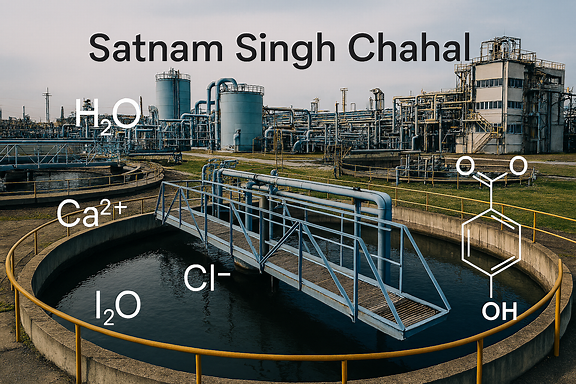
 Industrial water treatment plants are critical facilities that ensure water quality meets specific operational requirements while protecting equipment, maintaining product quality, and complying with environmental regulations. The chemical composition of water in these plants varies significantly throughout the treatment process, involving numerous chemical additives, reactions, and transformations.
Before treatment begins, raw water contains various naturally occurring substances that must be understood and managed. Dissolved minerals such as calcium and magnesium ions are the primary contributors to water hardness, typically ranging from 50 to 300 milligrams per liter in groundwater sources. Sodium and potassium ions are also present at concentrations of 10 to 100 milligrams per liter depending on geological sources. Bicarbonates, carbonates, and hydroxides contribute to alkalinity, while sulfates may be present at 10 to 500 milligrams per liter and chlorides at 10 to 250 milligrams per liter in freshwater sources. Nitrates and phosphates serve as nutrient compounds that can support biological growth.
Dissolved gases play a crucial role in water chemistry. Oxygen is typically present at 5 to 10 milligrams per liter in surface water, while carbon dioxide at 2 to 10 milligrams per liter affects pH balance. Hydrogen sulfide may be found in anaerobic groundwater, along with nitrogen and other atmospheric gases. Suspended and colloidal materials include clay particles composed of aluminum silicates, silt and sand, organic matter such as humic and fulvic acids, and various microorganisms including bacteria, algae, and protozoa. Turbidity is typically measured at 1 to 1000 nephelometric turbidity units depending on the water source.
Iron-based coagulants offer an alternative to aluminum compounds. Ferric sulfate and ferric chloride both react with natural alkalinity to form ferric hydroxide precipitates. These iron coagulants are effective across a wider pH range of 4 to 11 and are often preferred in certain applications. Ferric chloride, though more corrosive, is highly effective with dosages ranging from 5 to 150 milligrams per liter. Coagulant aids such as polyelectrolytes are synthetic polymers that enhance the coagulation process. These include cationic polymers that are positively charged, anionic polymers used for floc strengthening, and non-ionic polymers that work through bridging mechanisms. Typical polyelectrolyte dosages are only 0.5 to 5 milligrams per liter, demonstrating their powerful effect at low concentrations.
pH adjustment is essential for optimizing coagulation and protecting equipment throughout the treatment plant. Alkali addition using lime (calcium hydroxide), caustic soda (sodium hydroxide), or soda ash (sodium carbonate) increases pH and can provide additional benefits such as hardness precipitation. Typical alkali dosages range from 10 to 100 milligrams per liter. Conversely, acid addition using sulfuric acid or hydrochloric acid reduces pH when necessary, while carbon dioxide offers a gentler approach for final pH adjustment before distribution.
Ion exchange softening provides an alternative method that uses synthetic resin beads to exchange sodium ions for calcium and magnesium ions. This process can produce water with hardness below 1 milligram per liter as calcium carbonate. The resin is periodically regenerated using sodium chloride solution, consuming 120 to 400 grams of salt per liter of resin. This regeneration produces a concentrated brine waste stream that must be properly disposed of according to environmental regulations.
Filtration removes remaining suspended particles using various media including silica sand with particle sizes of 0.5 to 1.2 millimeters, anthracite coal with lighter, larger particles of 1.0 to 2.0 millimeters, garnet as a heavy mineral with density of 3.5 to 4.2 grams per cubic centimeter, and activated carbon that removes organic compounds and chlorine. Filters require periodic backwashing using clean water, and chlorine at 5 to 10 milligrams per liter or caustic washes at pH 11 to 12 help control biological growth on the filter media.
Reverse osmosis represents an advanced treatment process that removes dissolved solids through semi-permeable membranes. Pre-treatment chemicals are critical for RO success, including scale inhibitors such as phosphonates at 2 to 5 milligrams per liter or polycarboxylic acids at 3 to 8 milligrams per liter to prevent mineral precipitation on membrane surfaces. Sodium bisulfite dechlorinates the feed water at dosages 2 to 3 times the chlorine concentration to protect the polyamide membrane material.
Ultrafiltration and microfiltration membranes made from materials such as polyvinylidene fluoride, polyethersulfone, or cellulose acetate remove particles, colloids, and microorganisms. These membranes require regular cleaning using alkaline cleaners such as sodium hydroxide at pH 11 to 12 or sodium hypochlorite at 200 to 500 milligrams per liter, acidic cleaners including citric acid or hydrochloric acid at pH 2 to 3, and enzymatic cleaners for biological fouling.
Dealkalization removes alkalinity while maintaining some mineral content using weak acid cation resins that exchange hydrogen ions for calcium, magnesium, and sodium ions. The bicarbonate ions convert to carbon dioxide which is then removed through degassing. This process requires no salt for regeneration, instead using sulfuric acid or hydrochloric acid. Demineralization provides complete removal of dissolved ions to produce ultrapure water for demanding industrial applications.
The demineralization process uses strong acid cation resin regenerated with sulfuric acid at 4 to 10 percent solution concentration and strong base anion resin regenerated with sodium hydroxide at 4 to 10 percent solution. Mixed bed polishing units combine both resins to produce water with resistivity greater than 10 megohm-centimeters, conductivity less than 0.1 microsiemens per centimeter, silica below 10 parts per billion, and total organic carbon below 10 parts per billion. This ultrapure water is essential for high-pressure boilers, electronics manufacturing, and pharmaceutical applications.
Chlorination remains the most common industrial disinfectant due to its effectiveness and economy. When gaseous chlorine dissolves in water, it forms hypochlorous acid and hydrochloric acid. Sodium hypochlorite, the liquid alternative, also produces hypochlorous acid when added to water. Hypochlorous acid is the primary disinfectant species and is most effective at pH below 7.5. At higher pH, it converts to hypochlorite ion which is less effective. Free chlorine residual is typically maintained at 0.5 to 2.0 milligrams per liter in distribution systems to ensure continuous disinfection.
Combined chlorine in the form of chloramines provides longer-lasting but weaker disinfection compared to free chlorine. Breakpoint chlorination requires 7.6 to 10 milligrams of chlorine per milligram of ammonia-nitrogen to destroy chloramines completely. Chlorine dioxide represents an advanced alternative generated on-site from sodium chlorite with chlorine or hydrochloric acid. It is more effective than chlorine against biofilms and does not form trihalomethanes, with typical dosages of 0.1 to 2.0 milligrams per liter.
Ozone is a powerful oxidant and disinfectant generated by electrical discharge through oxygen or air. Dosages of 1 to 5 milligrams per liter are used for disinfection, while 2 to 10 milligrams per liter are applied for oxidation of organic compounds. Ozone decomposes relatively quickly with a half-life of 10 to 30 minutes at 20 degrees Celsius, producing hydroxyl radicals that provide advanced oxidation capabilities. Ultraviolet disinfection, while not chemical in nature, uses wavelengths of 254 nanometers at doses of 40 to 100 millijoules per square centimeter to inactivate microorganisms without leaving any chemical residual.
Corrosion inhibitors protect metal surfaces throughout water systems. Phosphate-based inhibitors including orthophosphates form protective iron phosphate films, while polyphosphates sequester metals and prevent red water problems. Zinc orthophosphate provides dual protection mechanisms with typical dosages of 1 to 3 milligrams per liter as phosphate. Silicate inhibitors using sodium silicate at 2 to 10 milligrams per liter as silica form protective silicate films on metal surfaces. Organic inhibitors such as phosphonates, polyaspartic acid, and molybdate offer alternatives, with molybdate being particularly effective for copper corrosion control.
pH control is critical for corrosion prevention. The Langelier Saturation Index is typically targeted at 0 to positive 0.5, while the Ryznar Stability Index should be maintained between 6.5 and 7.5 for optimal stability. Scale inhibitors prevent precipitation of sparingly soluble salts that can foul equipment. For calcium carbonate scale, threshold inhibitors prevent crystal nucleation at dosages below 10 milligrams per liter using polyacrylates or phosphonates that work through crystal distortion and dispersion mechanisms. Calcium sulfate scale is more challenging and requires 3 to 8 milligrams per liter of inhibitor in high-sulfate waters. Silica scale requires specialized inhibitors such as polyamines or cationic polymers, and when prevention fails, alkaline cleaning becomes necessary.
Non-oxidizing biocides provide biological control where oxidizing biocides are unsuitable due to material compatibility or process requirements. Isothiazolinones offer broad-spectrum activity at 10 to 50 milligrams per liter, while quaternary ammonium compounds functioning as cationic surfactants are applied at 20 to 100 milligrams per liter. Glutaraldehyde cross-links proteins at 10 to 50 milligrams per liter, and brominated compounds such as DBNPA are used at 5 to 25 milligrams per liter for rapid microbial control.
Open recirculating cooling systems concentrate dissolved solids as water evaporates. Cycles of concentration typically range from 3 to 6, meaning all dissolved solids concentrate by this factor. This requires comprehensive chemical programs to manage scale, corrosion, and biological growth. Calcium hardness is maintained at 200 to 800 milligrams per liter as calcium carbonate, alkalinity at 200 to 500 milligrams per liter as calcium carbonate, and pH in the range of 7.5 to 9.0.
Corrosion control in cooling systems now uses chromate-free programs due to environmental and health concerns. Common programs include phosphate or phosphonate combined with zinc at 4 to 8 milligrams per liter total, along with azoles such as tolyltriazole or benzotriazole at 1 to 5 milligrams per liter for copper corrosion protection. Biological control employs oxidizing biocides such as chlorine, bromine, or chlorine dioxide for continuous or intermittent feed, alternating non-oxidizing biocides applied weekly, and biodispersants for biofilm control. Once-through cooling systems have simpler chemistry due to the absence of concentration effects, requiring only 2 to 5 milligrams per liter of corrosion inhibitors with minimal biocide requirements.
Oxygen scavengers such as sodium sulfite are maintained at 5 to 10 milligrams per liter excess to eliminate dissolved oxygen that causes pitting corrosion. Catalyzed sulfite formulations provide rapid reaction rates. Alkalinity builders including caustic soda maintain pH while sodium carbonate provides reserve alkalinity to handle acid excursions.
High-pressure boilers operating above 300 pounds per square inch gauge require more sophisticated treatment. All-volatile treatment uses ammonia at 0.5 to 2.0 milligrams per liter for pH control, hydrazine or alternatives for oxygen scavenging, and neutralizing amines for condensate protection. Different amines have different distribution ratios between steam and water: cyclohexylamine at 0.5, morpholine at 1.0, and diethylaminoethanol at 5.0. Coordinated phosphate treatment maintains pH at 9.0 to 9.6 in boiler water using congruent phosphate control to prevent caustic hideout, with trisodium phosphate at 2 to 5 milligrams per liter.
Ultrapure feedwater is essential for high-pressure boilers with conductivity below 0.2 microsiemens per centimeter, silica below 20 parts per billion, sodium below 5 parts per billion, and total organic carbon below 200 parts per billion. These stringent requirements prevent deposition on heat transfer surfaces and turbine blades where even trace contaminants can cause significant damage.
Neutralization of acidic or alkaline wastes uses lime for acid wastes as a very cost-effective option, caustic soda for rapid response when needed, sulfuric acid for alkaline wastes, and carbon dioxide for gentle final pH adjustment before discharge. Chemical oxidation destroys organic contaminants using hydrogen peroxide at 50 to 200 milligrams per liter, Fenton’s reagent combining hydrogen peroxide with ferrous iron catalyst, or potassium permanganate for cyanide and phenol oxidation.
Advanced oxidation processes generate hydroxyl radicals, extremely powerful oxidants with an oxidation potential of 2.8 volts. These processes include ultraviolet light combined with hydrogen peroxide, ozone combined with hydrogen peroxide known as the peroxone process, and other combinations that produce hydroxyl radicals capable of destroying even recalcitrant organic compounds that resist conventional treatment.
Chemical storage requires careful attention to material compatibility and safety. Concentrated acids including sulfuric acid at 93 to 98 percent and hydrochloric acid at 30 to 37 percent are highly corrosive and require storage in polyethylene or fiberglass tanks. Caustics such as sodium hydroxide at 25 to 50 percent undergo exothermic dissolution and require temperature-controlled storage above 60 degrees Fahrenheit to prevent crystallization.
Power generation requires demineralized water for steam generation with conductivity below 0.1 microsiemens per centimeter and silica below 10 parts per billion to prevent turbine deposits. Pharmaceutical applications need Water for Injection produced by distillation or reverse osmosis followed by distillation, with bacterial endotoxin below 0.25 endotoxin units per milliliter and total organic carbon below 500 parts per billion. Electronics and semiconductor manufacturing demand ultrapure water with 18 megohm-centimeter resistivity, particles below 1 per milliliter at sizes greater than 0.05 micrometers, bacteria below 0.1 colony forming units per milliliter, and metals below 1 part per trillion for each element.
Green chemistry initiatives promote sustainable alternatives including bio-based polymers replacing synthetic coagulants, enzymatic treatments for organic degradation, and natural chelants. Advanced materials under development include graphene-based membranes for enhanced rejection and ceramic membranes for harsh chemical environments. Process intensification strategies aim to reduce equipment footprint through forward osmosis, capacitive deionization, and hybrid processes.
The chemical composition of industrial water treatment plants represents a complex interplay of compounds carefully balanced to achieve specific water quality objectives. Understanding the fundamental chemistry enables optimization of treatment efficiency, minimization of chemical consumption, and ensures consistent water quality for critical industrial applications.