
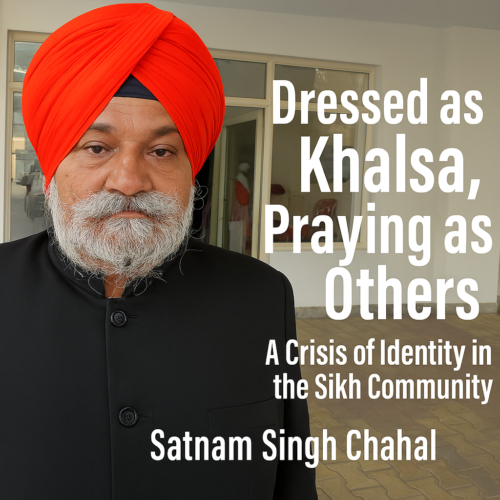
 In Sikh communities across the world, a growing and often quietly discussed concern has emerged: a significant number of individuals who outwardly adopt traditional Sikh dress, the dastar (turban), the five Kakars, and other visible markers of the faith do not necessarily follow Sikh traditions in their practice, music, or spiritual life. Instead, many are observed participating in non-Sikh rituals, reciting prayers rooted in other traditions, and listening to or performing music that contradicts the core teachings of Sikhi. This is not simply a matter of fashion or cultural identity. It raises profound questions about the authenticity of faith, the meaning of the Khalsa identity, and the future direction of the Sikh Panth.
The Visible Symbol vs. The Lived Practice
The turban, the uncut hair (kesh), and the other articles of faith are not mere cultural accessories in Sikhism. According to the Rehat Maryada, the official Sikh code of conduct, these symbols represent a complete commitment to the Guru’s path. A baptised Sikh (Amritdhari) is expected to maintain these symbols while living strictly by the principles of Gurbani, the sacred scripture enshrined in the Sri Guru Granth Sahib Ji.
However, observers within the Sikh community have noted that a significant portion of those who don the traditional appearance participate in Hindu rituals such as idol worship, astrology-based ceremonies, or visits to deras, unauthorised spiritual camps that operate outside mainstream Sikh teachings. Many recite prayers and mantras from non-Sikh traditions, blending them with Gurbani in a manner inconsistent with the Guru’s teachings. Others follow self-styled godmen or babas who claim spiritual authority outside the Sri Guru Granth Sahib Ji, the living and eternal Guru of the Sikhs.
The Music Question: Kirtan vs. Non-Sikh Traditions
One of the most visible areas of divergence is in the realm of music and devotional singing. Sikhi has a rich and disciplined musical tradition rooted in Gurbani Kirtan, the singing of sacred hymns composed by the Sikh Gurus and other saints included in the Sri Guru Granth Sahib Ji. Classical ragas form the backbone of this tradition, and for centuries, Sikh households echoed with the pure and sacred sounds of authentic Kirtan.
Yet in many Sikh households and gatherings today, a very different musical culture has taken root. Many people who identify visually as Sikhs listen to and recite bhajans, chants, and devotional music rooted in Hindu or syncretic traditions, which are not part of the Sikh scriptural canon. Some influential deras have produced their own devotional music glorifying their own leaders, which millions of turban-wearing individuals follow fervently often in preference to classical Gurbani Kirtan. Furthermore, the rise of popular, entertainment-style Kirtan set to Bollywood beats and composed with non-Gurbani lyrics has blurred the line between sacred devotion and cultural performance.
Sikh scholars and theologians argue that this represents a departure not just from tradition, but from the theological core of the faith itself, which commands that only the Guru Granth Sahib Ji be recognised as the supreme spiritual authority. When music becomes a vehicle for devotion to human figures or blended traditions, it dilutes the sanctity that Gurbani Kirtan is meant to carry.
Why Does This Happen?
Understanding why traditionally dressed Sikhs may follow non-Sikh practices requires looking at several social and historical factors. Many Sikhs inherit external markers of the faith from their families without receiving deep theological education. The turban becomes a cultural symbol of Punjabi identity rather than an expression of committed faith. In such cases, the form is preserved while the substance gradually erodes across generations.
Punjab and the diaspora are also home to dozens of influential spiritual movements that blend Sikh imagery with other traditions. Leaders of these movements often dress in a manner resembling Sikh saints, attracting followers who may not distinguish between authentic Sikh teaching and syncretic practice. The absence of widespread, rigorous teaching of Sikh theology gurmat means that many practicing Sikhs lack the scriptural knowledge to differentiate authentic Sikh practice from traditions that have gradually blended into Sikh community life over centuries.
In many Punjabi families, wearing the turban is also a family expectation tied to caste, clan, or regional identity. Individuals may comply outwardly while privately holding beliefs and practices shaped by a wider religious landscape. Social and family pressure can keep the external appearance intact long after the inner spiritual commitment has weakened or shifted toward other traditions entirely.
The Sikh Community’s Response
Sikh scholars, institutions, and the Akal Takht Sahib the highest temporal seat of Sikh authority have periodically addressed the issue of deviation from the Rehat Maryada. Preachers, kathavachaks (spiritual orators), and various Sikh organizations have called for a return to the Sri Guru Granth Sahib Ji as the sole spiritual authority, the promotion of authentic Gurbani Kirtan in its classical raga tradition, widespread parchar (outreach and education) to bring Sikhs back to gurmat, and accountability for those who outwardly represent the Sikh identity while promoting practices contrary to Sikh teachings.
A Call for Reflection
The outward symbols of Sikhism carry tremendous spiritual and historical weight. They represent the courage of the Khalsa, the egalitarian spirit of the Gurus, and a commitment to living in service to Waheguru (God) and humanity. When these symbols are worn without a corresponding inner commitment expressed through authentic prayer, Gurbani recitation, and adherence to Sikh values it creates a disconnect that can mislead others and dilute the integrity of the faith.
This is not a call for judgment of individuals, who are often navigating complex cultural and social landscapes. Rather, it is an invitation to the broader Sikh community to engage in honest dialogue about what it means to truly live the Guru’s teachings not just in appearance, but in every dimension of life, including the music we recite, the prayers we offer, and the spiritual paths we follow.
Sikhism is a faith of depth, discipline, and devotion. The traditional dress that many wear with pride is meant to be an outward declaration of an inward commitment. When a majority of those dressed in this manner are found reciting music and prayers rooted in traditions outside of Sikhi, it raises a fundamental question that the community must address with love, education, and transparency: Are we wearing the Guru’s form or truly walking the Guru’s path? The answer, Sikh tradition teaches, must come from within from the daily reading of Gurbani, the practice of Simran, and a life lived in sincere service to all.
Written for educational and community reflection purposes