
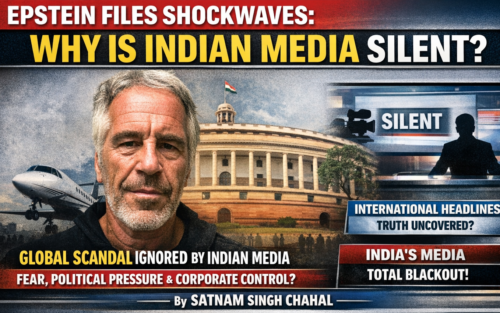
 The release of the “Epstein Files,” a large collection of court documents from the Jeffrey Epstein–Ghislaine Maxwell case, has shaken political and social systems across the world. These documents include witness statements, depositions, emails, travel logs, and references to many influential individuals. International media houses have been covering the matter with intensity, analysis, and debate. Yet, the Indian mainstream media has chosen a path of complete silence.
It is important to clarify that the appearance of any individual’s name in these documents does not automatically signal criminal wrongdoing. Many names appear simply because they were mentioned in travel logs, contact lists, or emails. In a case as massive and complicated as Epstein’s, the range of associations is extremely wide. However, what people expect is transparent reporting—not conclusions, not allegations, just facts.
Despite this basic expectation, Indian television channels, newspapers, and digital outlets have shown almost zero interest in the subject. While social media in India is buzzing with questions about certain business and political personalities possibly appearing in the broader context of Epstein’s network, mainstream outlets are maintaining an unusual silence. This blackout raises serious questions about the independence and courage of the Indian press.
Many observers believe that the silence stems from the fear of legal action, political retaliation, or pressure from corporate owners who have relationships with those in power. In India, the line between political power, big business, and media ownership has become thin. When powerful figures may be even loosely connected to a global scandal, the newsrooms suddenly become cautious, nervous, and extremely selective.
The irony is striking. The same media that spends hours sensationalising minor controversies suddenly becomes disciplined and quiet when the story involves the elite. It exposes the double standards of Indian journalism—aggressive when it is safe, but silent when the powerful are involved. This is not the role of a free press in a democracy.
The Epstein Files should have sparked thoughtful reporting, investigative journalism, and public conversation about global elite networks and exploitation. Instead, the Indian media appears more interested in distracting the public with trivial debates. Whether anyone from India is actually guilty or innocent is something that should be determined through evidence and investigation—not by social media gossip or media silence.
This silence is not just about one story. It reflects the deeper crisis facing Indian journalism: the weakening of editorial independence, the dominance of political pressure, and the erosion of moral courage. India proudly calls itself the world’s largest democracy, yet its media today looks fearful, compromised, and controlled.
The Epstein scandal is a global reminder that power protects itself across borders. But it is also a reminder that societies rely on brave journalism to confront uncomfortable truths. India urgently needs a stronger, more ethical, and fearless press—one that serves the public interest instead of the powerful.