
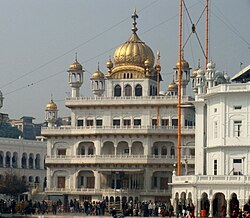
 The recent interaction between Punjab Chief Minister Bhagwant Mann and the Jathedar of Sri Akal Takht Sahib marks a consequential moment in Punjab’s public life, where faith, governance, and institutional authority intersect. The decision of the Akal Takht to summon a sitting Chief Minister is rare and symbolically significant, drawing attention not only to the immediate controversy but also to the broader question of how political leadership should engage with Sikh religious institutions.
From the Akal Takht’s standpoint, the summons was issued in response to concerns that certain remarks, representations, or conduct had hurt Sikh sentiments and challenged established traditions. As the highest temporal authority of Sikhism, the Akal Takht has historically acted as the guardian of the collective Sikh conscience, stepping in when it perceives moral or institutional boundaries being crossed. In this context, the action was presented as an assertion of responsibility rather than confrontation.
Bhagwant Mann, in his response, emphasised humility and respect, stating that he appeared before the Akal Takht as a Sikh, not merely as a Chief Minister. He denied any deliberate intent to insult Sikh institutions and argued that some of the controversy stemmed from misrepresentation or manipulation of content. His submission of extensive material related to long-pending religious and institutional concerns signalled an attempt to broaden the discussion from personal accountability to systemic reform and transparency.
Reactions within the Sikh community have reflected a spectrum of views. Some have welcomed the Akal Takht’s intervention as a necessary reminder that political authority must remain sensitive to religious sentiments. Others have expressed unease, cautioning that repeated intersections between politics and panthic institutions risk blurring sacred boundaries and inviting politicization of religious authority. These differing responses underscore the pluralism of opinion within the Sikh community rather than a unified stance.
Beyond the immediate personalities involved, the episode raises enduring questions for Punjab’s civic and religious life. How can political leaders engage respectfully with faith-based institutions without instrumentalising them? How can religious bodies uphold moral authority while remaining above partisan conflict? Addressing these questions with restraint and dialogue is essential to preserving both democratic norms and the sanctity of Sikh institutions.
In the end, the Mann–Akal Takht episode should be viewed less as a clash and more as an opportunity for reflection. It offers Punjab a moment to recalibrate the relationship between faith and power one grounded in mutual respect, institutional clarity, and a shared commitment to the public good.