
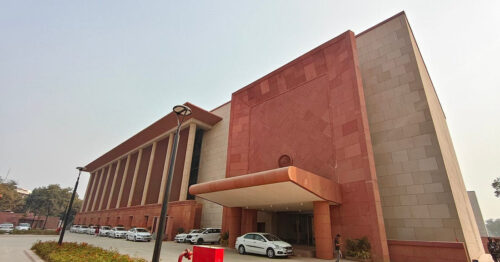
 Heartiest congratulations to the government on the inauguration of the new complex that will house the Prime Minister’s Office and other institutions of governance. Apart from the obvious gains in operational efficiency and enhanced security—both physical and cyber—the relocation from the colonial-era South Block to a purpose-built campus is not a trivial matter of brick and mortar. It signals a desire to mark a psychological and political break with the symbols of British rule and to embed the Union government in spaces designed by independent India, for independent India. That intent deserves acknowledgement.
The date, and the symbolism of remembrance
There is nothing inappropriate about the selection of the date, and the symbolism is, if anything, apt. Incidentally, on this very day—13 February 1931—the British declared New Delhi the capital of colonial India. To inaugurate a purpose-built complex for a sovereign republic on that anniversary can be read as a quiet act of historical reversal: a reclaiming of space, narrative, and authority from the architecture of empire.
The name that invites a deeper question
Yet, even as we celebrate this transition, the chosen name for the complex—“Seva Teerth”—raises a deeper question about the language through which a republic describes its highest public offices. The shift is being projected as part of a larger attempt to shed colonial nomenclature and foreground seva, or service, as the organising principle of governance. Few would quarrel with the aspiration that the Prime Minister and the executive should see themselves as sevaks of the people. The difficulty lies in the second half of the phrase: teerth.
Why teerth is not a neutral civic word
In our civilisational vocabulary, teerth is not a neutral word. It is steeped in religious meaning. A teerth is a sacred place—a site of pilgrimage—where devotees go in a spirit of reverence, supplication, and faith. The relationship it encodes is that of worshipper to the divine, of the seeker to the sanctified. Transposing this idiom onto the physical location of the Prime Minister’s Office subtly alters how we imagine that institution, and how citizens are supposed to relate to it.
Citizens are not pilgrims; the state is not a shrine
Unlike a temple or shrine, the PMO is not a place of worship. It is an administrative office created by the Constitution and accountable, through Parliament, to the people of India. Citizens who approach it—whether in person or metaphorically—are not pilgrims. They are rights-bearing members of a sovereign people, whose consent and whose taxes sustain the state. When we describe the PMO complex as a teerth, the citizen is gently recast as a bhakt visiting a sacred precinct, rather than as an equal stakeholder engaging an institution that exists to serve them as a matter of right, not grace.
Metaphor cannot erase history
Some may argue that language evolves, that teerth here is being used metaphorically to signify a place dedicated to the noble ideal of service, not to any specific deity or religious practice. But words carry the weight of history. In a country where religious identity is deeply felt and often politically mobilised, it is naïve to pretend that a term so clearly anchored in one cultural-religious tradition can instantly be stripped of its devotional overtones and converted into a purely civic signifier. The risk is not merely semantic. Once we accept that a core institution of the state can be framed as a teerth, it becomes easier to normalise a broader devotional vocabulary around governance: leaders as mahants, policies as offerings, political disagreements as heresy.
The constitutional stakes: popular sovereignty and secularism
This is where the issue touches the foundations of our constitutional order. The Indian republic, however noisy and imperfect, rests on two interlinked ideas: popular sovereignty and secularism. Popular sovereignty means that ultimate authority resides in the people, from whom all organs of the state derive their powers. Secularism, in the Indian sense, does not demand hostility to religion; but it does require that the state maintain a principled distance from all faiths and avoid presenting itself in the colours of any particular religious idiom. Both ideas are strained when state institutions begin to describe themselves through terms that belong so clearly to the vocabulary of organised religion.
Personal faith versus official naming
To be sure, India’s public life has never been hermetically sealed from religion. Our leaders have drawn on religious metaphors since the freedom movement. Parliament opens with devotional invocations; public functions often feature religious ceremonies. But there is a difference between personal belief or cultural reference, and the official naming of institutions. The former can be inclusive and plural; the latter, once inscribed on signboards, letterheads, and official communications, acquires a more permanent—and potentially exclusive—character. A term like “Seva Sadan” or “Lok Seva Bhavan” would have conveyed the message of service while remaining within a civic, secular register. “Seva Teerth” crosses that line.
The democratic cost of sacralising power
There is another, more subtle, concern. The language of pilgrimage implies that the teerth itself is inherently sacred, deserving reverence regardless of what happens within its walls. In a democracy, no institution is above critique. The PMO is a crucial node of power and must be subject to scrutiny, debate, and demands for transparency. To place it in a quasi-sacral frame risks discouraging precisely the robust, critical engagement that keeps power accountable. Citizens may be hesitant, even unconsciously, to question what they have been taught to regard as a holy site of “seva”.
Symbols shape citizens over time
Some might dismiss these anxieties as over-sensitive, insisting that the ordinary citizen is unlikely to parse the name so finely. Perhaps. But symbolic politics is not an innocent game. Governments invest enormous energy in names, ceremonies, and visual imagery because they know that symbols shape attitudes over time. If the state repeatedly presents itself through a religious or devotional lens, it nudges citizens towards seeing political authority as something to be revered rather than interrogated—followed rather than challenged.
Decolonisation should not become sacralisation
None of this is to deny the genuine desire to move away from colonial architecture and nomenclature. The old power centres of Lutyens’ Delhi were unmistakably products of an imperial mindset. Reimagining them for a self-respecting, post-colonial republic is a worthy project. But decolonisation of symbols should not become a pretext for their sacralisation. Replacing the imagery of the British Raj with the imagery of a majoritarian religious tradition is not a step towards a more equal, confident India; it is a lateral move from one hierarchy to another.
Keeping the Republic legible to all
The republic’s strength lies in a simple but profound proposition: that every citizen, regardless of faith, gender, caste, or region, can approach the state as an equal. The architecture and naming of public offices should reinforce, not dilute, that proposition. The Prime Minister’s Office, perhaps more than any other institution, must remain visibly and linguistically a space of public service, not public worship.
The question that deserves democratic debate
That is why, even while offering heartiest congratulations on the new complex and welcoming the emphasis on seva, one is uneasy with the use of the word teerth for a public office. It creates an impression—intended or otherwise—that citizens approaching it are devotees or pilgrims, not co-owners of the Republic. The question, then, is a straightforward one: in a constitutional democracy that prides itself on being secular and republican, is it acceptable for the nerve-centre of executive power to describe itself in language that casts the citizen as a supplicant at a shrine?
A name that will echo every day
The new complex will, inevitably, become a major node of governance and a prominent landmark in the capital. Its name will be repeated daily in official communication, media reports, and political rhetoric. Precisely for that reason, it is worth pausing at this moment of celebration to reflect on what that name conveys. Nations are shaped not just by policies and projects, but by the words they choose for their institutions. Seva is an inspiring aspiration. Whether teerth belongs alongside it, in the address of the Prime Minister’s Office of a secular republic, remains open to democratic debate.