
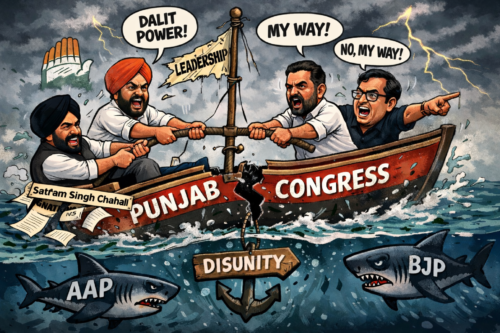
 The Punjab Pradesh Congress Committee (PPCC) has for several years been plagued by internal groupism and factional politics, which have weakened the party both organizationally and electorally. Instead of functioning as a united opposition force, the party has often appeared divided into competing camps driven by personal ambitions, leadership rivalries, caste equations, and strategic disagreements. This internal discord has significantly damaged the Congress’s credibility at a time when Punjab faces serious governance challenges.
The roots of factionalism in Punjab Congress lie deep in its leadership culture, where strong individual leaders command personal followings rather than strengthening institutional discipline. While this model once helped the party dominate state politics, it gradually turned into a liability as internal rivalries intensified. Differences were often suppressed during election cycles but resurfaced sharply once power was secured or lost.
The problem became highly visible during the 2017–2022 Congress government, when infighting among senior leaders frequently overshadowed governance. Power struggles within the cabinet and the party leadership created confusion, delayed decision-making, and weakened public confidence. These internal battles ultimately contributed to the party’s humiliating defeat in the 2022 Assembly elections, when voters punished what they perceived as chaos and disunity.
After losing power, instead of introspection and unity, groupism deepened further. The party split into informal camps around key leaders, each blaming the other for electoral failures. The leadership of the state unit itself became a point of contention, with allegations of exclusion, favoritism, and lack of consultation becoming common within party forums.
One of the most sensitive flashpoints has been Dalit representation and leadership space. Former Chief Minister Charanjit Singh Channi raised concerns that Dalit leaders were not being given proportionate representation in party organization and decision-making. While the issue itself is politically and socially significant in Punjab, the manner in which it surfaced exposed underlying factional rivalries rather than a collective ideological debate.
At the same time, questions were raised about the style of functioning of the state leadership, with critics accusing the party president and Leader of Opposition of running the organisation in a centralized and closed manner. Several leaders felt sidelined, leading to resignations from party posts and open expressions of dissatisfaction. These public disagreements further reinforced the image of a divided party.
Repeated interventions by the Congress high command have so far failed to permanently resolve the crisis. While central leaders have appealed for unity and discipline, factional alignments remain intact at the ground level. The lack of a clear, collective vision for Punjab has allowed internal rivalries to dominate political discourse instead of public issues like unemployment, drugs, agrarian distress, and law and order.
As Punjab moves toward the next Assembly elections, internal groupism remains one of the biggest challenges for the Congress. Unless the party succeeds in reconciling factions, empowering grassroots workers, and presenting a united leadership, it risks remaining trapped in internal battles while political opponents consolidate their position.
Timeline: Internal Groupism in Punjab Congress
2017
• Congress returns to power in Punjab after Assembly elections.
• Early signs of internal rivalry emerge within the government and party leadership.
2019–2020
• Differences between senior leaders intensify.
• Public statements and internal complaints indicate growing factionalism.
2021
• Leadership crisis escalates; power struggle dominates state politics.
• Governance takes a backseat as internal battles gain prominence.
2022
• Congress suffers a massive defeat in Punjab Assembly elections.
• Loss widely attributed to infighting, poor coordination, and public perception of chaos.
2022–2023
• Party moves into opposition but fails to unite.
• Formation of informal camps around senior leaders continues.
2024
• Questions raised about leadership style and effectiveness of state unit.
• Internal dissatisfaction becomes more vocal.
2025
• Dalit representation debate surfaces strongly within the party.
• Resignations from organizational posts expose deep internal rifts.
• High command intervenes repeatedly, urging unity.
Present
• Groupism remains unresolved.
• Congress struggles to project itself as a strong, united alternative in Punjab.