
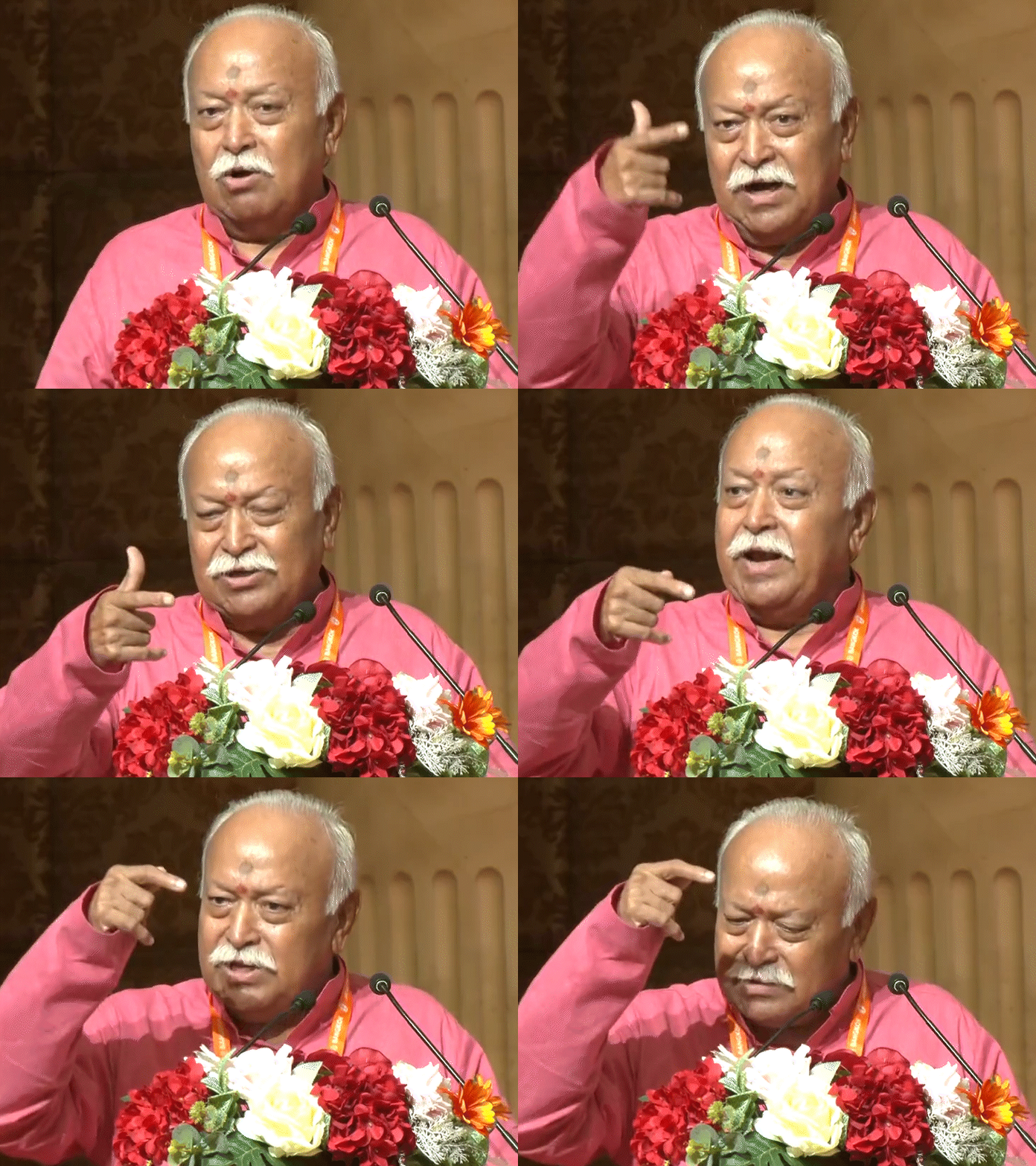
 Mohan Bhagwat, the RSS Chief, chose an unusually calibrated setting for an unusually calibrated message. Speaking at the Nehru Centre Auditorium, Worli (Mumbai), on 7 February 2026—during a two-day lecture series marking the RSS centenary, titled “100 years of Sangh Journey – New Horizons”—the RSS Sarsanghchalak began by lowering the temperature. He said he was not delivering a “speech”, but offering “information” and a conversation. Even the staging reinforced the intent: less rally, more seminar; less mobilisation, more explanation.
For observers in Punjab, and particularly for Sikhs and Muslims in North India, such tonal shifts matter. The RSS has long exercised political influence while insisting it is not a political party. It shapes vocabulary, frames national identity, and supplies social muscle to the ecosystem of electoral power. When its sarsanghchalak softens words and posture, the question is unavoidable: is this a point of inflexion—or simply a more polished way of staying the course?
The evidence suggests a measured answer. The address signals a softening of language and presentation, but not necessarily a softening of ideological intent; tactical moderation, not yet a paradigm shift.
A Centenary Reset in Tone
Bhagwat’s initial argument was definitional: the RSS is best understood by clearing away misconceptions. He insisted it is not a paramilitary force despite drills; not an अखाड़ा despite lathi training; not a music school despite the disciplined “ghosh”; not a political party despite the presence of swayamsevaks in politics. Judging the organisation by externals, he argued, produces misunderstanding. The only reliable way to grasp it is to see it from within—especially by observing its central method: the shakha.
This is a familiar RSS self-description, but delivered in a noticeably less combative idiom. A homely analogy—“sugar” cannot be understood by lectures alone, it must be tasted—was used to imply that criticism is largely a product of distance, and that proximity would dissolve suspicion.
To many audiences, this invitation will sound reassuring. Yet Punjab’s history encourages a more demanding standard: proximity to the Sangh ecosystem has not consistently delivered reassurance, especially when questions of minority identity and political power are involved.
“We Don’t Want Power”: A Claim That Requires Testing
Bhagwat stated explicitly that the RSS does not seek popularity or power. The claim is best treated as a thesis to be evaluated rather than accepted at face value. Organisations can shape power without contesting elections, influence governments without entering cabinet, and function in form like an NGO while operating in effect like a political machine.
Indeed, Bhagwat’s own description strengthens the political implication. He presented the RSS as a long-term project to “organise society” and produce an all-India cadre of disciplined exemplars who become models in each locality, thereby shaping social “fashion”. If that project succeeds, it does not yield the absence of power; it yields the deepest kind of power—the ability to define a nation’s moral common sense.
Punjab understands this instinctively. In North Indian politics, those who define community boundaries—who is “inside”, who is “other”, who is “native”, who is “suspect”—rarely remain mere social reformers. They become decisive actors in how legitimacy and coercion are distributed.
So, the RSS may not seek power in the narrow sense of holding office. But the pursuit of cultural and social hegemony is, in practice, a pursuit of power.
The Most Significant Line: “Hindu” as Adjective, Not Noun
The address’s most consequential conceptual move was Bhagwat’s insistence that “Hindu” should not be treated as a noun naming a single religious community defined by ritual or dogma. Instead, he argued, “Hindu” is an adjective—a civilisational descriptor, a cultural temperament, an integrative ethos. Properly understood, he suggested, it is inclusive rather than exclusionary.
This formulation matters because it attempts to answer an old critique: that Hindutva politics reduces India to a majoritarian religious state. Bhagwat’s reply is that “Hindu” is not a religion-marker at all; it is a broad identity that can encompass multiple sects, traditions, and paths.
If this idea were applied consistently, it could indeed lower communal temperature. A civic adjective is looser than a religious noun. It can accommodate internal diversity. It can create rhetorical space for plural belonging without forcing everyone into a single liturgical mould.
But Punjab’s scepticism begins with a basic question: who defines the adjective? Adjectives can be instruments of inclusion—or instruments of assimilation.
When “Hindu” becomes a civilisational adjective applied to all Indians, minorities are offered a subtle choice: accept the adjective and be counted as properly national, or resist it and risk being painted as foreign, disloyal, or separatist. That is not pluralism in the constitutional sense; it is a sophisticated form of majoritarian normalisation.
The Sikh Question: Distinct Faith or Absorbed Identity?
For Sikhs, the “adjective” framing carries a specific anxiety. Sikhi is not merely a cultural variant within a larger continuum. It is a revealed tradition with its own scripture, metaphysics, discipline, and historical community forged through sacrifice and sovereignty. Sikh identity cannot be reduced to a subset of someone else’s umbrella without distorting its core self-understanding.
In the excerpted address, there is no clear, explicit affirmation that Sikhism is a separate religion in the modern sense. The discussion instead leans heavily on the “Hindu-as-adjective” framework and on an ambiguous distinction between “religion” and “dharma”. Bhagwat argued that “dharma” is a universal principle—duty, ethical order, and the sustaining law of existence—whereas “religion” is a narrower category. He criticised the popular formulation of “dharmanirapekshata” as conceptually mistaken, implying that what is meant is neutrality among sects or panths, since nobody can be free of dharma.
Philosophically, this may be framed as a universalist ethic. Politically, the distinction is far from neutral. In Indian public life, when “dharma” is elevated and “religion” is reduced, minorities often fear being told: distinctiveness may be tolerated as private ritual, but public identity must submit to a majoritarian civilisational grammar.
A genuine inflexion point would have included an unambiguous line: Sikhism is a distinct faith, equal in dignity, not a subset, not a synonym, not a footnote. That line does not appear in the material shared from this address.
A Muslim and North Indian Reading: Inclusion by Embrace—or Absorption?
For India’s Muslims, especially in North India where political rhetoric is frequently polarised, the “adjective” framing may appear conciliatory. Bhagwat suggested that Indian Muslims and Christians are not the same as Muslims and Christians elsewhere because India’s civilisational ethos shapes everyone here. This too can be read in two ways.
The optimistic reading is that it acknowledges the cultural rootedness of Indian Muslims and Christians and pushes back against the trope that they are perpetual outsiders. The sceptical reading is that minority legitimacy is made conditional: acceptable if “Indian enough” as defined by the umbrella, suspect if it insists on its own autonomous grammar of dignity.
North India has repeatedly witnessed how the umbrella can become a sieve: those who conform pass through; those who dissent are labelled problematic. The proof of inclusion lies not in conceptual generosity, but in everyday equality and institutional restraint.
The RSS as Method and the Constitutional Problem
Bhagwat returned repeatedly to the claim that the RSS is essentially a methodology—the shakha as a daily discipline that builds character and social cohesion. He presented social change as driven by society rather than by parties, policies, or governments. Systems follow habits; traffic lights do not create discipline, disciplined people make traffic lights meaningful.
This “society-first” theory can sound civic-minded. But it also risks sidelining constitutionalism. India is not merely a cultural society; it is a constitutional order designed precisely to protect individuals and minorities against the tyranny of majorities—whether cultural or political.
Punjab has lived through moments when “society” was invoked against law, when mass sentiment was weaponised, and when identity became a justification for punishment rather than a fact to be respected. A healthy society is desirable. But a society organised around a single cultural adjective can harden into moral policing when backed by electoral power, administrative influence, and street mobilisation.
If the RSS seeks to be seen as a constructive civic organisation rather than a political engine, it must demonstrate—not merely declare—its distance from coercive identity politics.
Not Yet a Paradigm Shift—But a Window Opens
The Mumbai address is best read as a deliberate centenary-era recalibration in tone. It is intellectually packaged, strategically softened, and designed to appear civilisational rather than sectarian. The “Hindu as adjective” line will be quoted often and deployed widely.
Yet a change in vocabulary is not, by itself, a change in paradigm. Paradigms change when power behaves differently, not merely when power speaks more gently.
For Punjab and North India, the test is practical. Will the “adjective” be used to widen equal citizenship—or to compress distinct identities into a civilisational hierarchy? Will Sikh distinctiveness be honoured as fully autonomous—or treated as a cultural variant expected to downplay its separateness? Will Muslims be embraced as equal co-owners of the Republic—or praised conditionally, so long as they accept the umbrella on the umbrella’s terms?
What Cautious Optimism Can Look Like
Cautious optimism is not naïveté. It is the willingness to recognise that rhetoric can open doors while insisting that doors must lead somewhere real. If Bhagwat’s framing reflects genuine intent, it creates an opportunity for dialogue anchored in three non-negotiables:
Equal dignity of faiths as faiths
Not merely “paths” under an adjective, but distinct religious traditions with full public legitimacy.
Constitutional primacy over cultural primacy
The Constitution is the shared civic scripture of the Republic; cultural adjectives must never override equal rights.
Repudiation of coercive identity politics
Not abstractly, but through sustained denunciation of vigilantism, hate campaigns, and majoritarian intimidation.
If the RSS wishes to be believed when it says it does not seek power, the most persuasive evidence would be restraint when it stands closest to power. That is the hardest test—and the only one that counts.
The Punjab Lens: Memory, Realism, and the Demand for Clarity
Punjab’s political memory is long, and Sikh history is a disciplined teacher. The language of national unity has alternated between inclusion and betrayal; the rhetoric of harmony has often coexisted with administrative hardness. Punjab therefore values clarity over comfort.
Bhagwat’s address offers civility, and civility is welcome. It offers softer words, and softer words are welcome. But it does not yet offer the one clarity that would signal a genuine turning point: an explicit, unambiguous acceptance of Sikhism’s separateness as a faith—and a clear assurance that “dharma” will not become a civilisational instrument for absorbing minorities into a majoritarian template.
For now, the Sangh may be polishing its language for its centenary. It is not yet evident that it is rewriting its ideological operating system. If such a change comes, it will be known not from metaphors and definitions, but from the lived taste of equal citizenship—quietly, consistently, in everyday life.
Share