
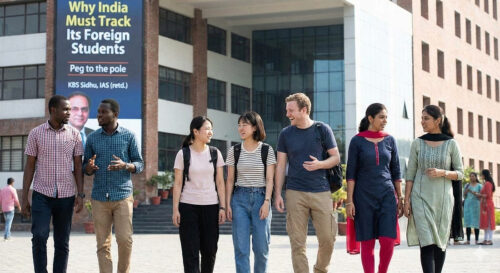
 The Union Government’s recent decision to require all educational institutions in India to promptly register and report admissions of foreign nationals — a category that will clearly sweep in Overseas Citizens of India (OCI) as well — has triggered familiar anxieties about xenophobia, “closing” Indian campuses, and driving away talent. Much of this unease is misplaced. Properly understood, the move is both justifiable and overdue.
In a written reply to the Rajya Sabha in December 2025, the government disclosed that there are 72,218 foreign students currently in India, drawn from about 200 countries — a small city’s worth of young people embedded in campuses, hostels and neighbourhoods at any given time. This is no longer a marginal phenomenon; it is a system‑wide reality that any serious policy must take into account. The question is not whether India should host foreign students, but how intelligently it manages the risks that inevitably accompany such numbers.
Why tighter registration is justified
Foreign nationals, including OCIs, enjoy the privilege of extended physical presence on Indian soil when they join universities, colleges and even schools. A multi‑year student visa is, for all practical purposes, a long‑term residency permit. Any state serious about security, public order and migration management will want to know who is entering on this basis, where they are enrolled, whether they are actually studying, and whether they remain in lawful status.
India already expects hotels and guest houses to report foreign guests. Extending a similar logic to institutions where foreigners may stay for three to five years is common sense, not paranoia. Under the new directions, schools, colleges and universities must inform the competent registration authorities within 24 hours of admitting any foreign national, uploading details through a designated digital platform. The format seeks information not only on identity and visa status, but also on attendance, academic performance and conduct — whether the student is fit to continue in the course.
USA’s SEVIS, after the 9/11 shock
After the shocks of 9/11, the United States created SEVIS (Student and Exchange Visitors Information System), a centralised system that tracks foreign students and exchange visitors and requires institutions to report key changes in a student’s academic “career”: non‑enrolment, probation, withdrawal, change of course, and more. India is, in effect, moving toward a lighter Indian SEVIS. Including OCIs is consistent with this rationale. An OCI card does not make its holder an Indian citizen; it grants a generous, residency‑like status. That creates the same concerns: a potentially long‑term physical presence and, in a small but real number of cases, the possibility of being used as a bridgehead for external agendas. To exempt OCIs simply because they are “our diaspora” would be sentiment trumping prudence.
Not to shun foreign students, but to filter risks
The objective of this regime is not to drive away foreign students. India needs them for diversity, academic internationalisation and fee income, and our “World Class Institutions” and Institutions of Eminence schemes explicitly assume globally connected campuses. But confidence cannot be blind. Any open system attracts three types of entrants: genuine students, non‑serious “visa students” buying time onshore, and a tiny minority acting as agents or facilitators of foreign state or non‑state interests.
These latter categories can do real damage if they remain for years under the comfortable cover of “pursuing education” — through calibrated campus agitation, recruitment and fund‑raising, or digital operations aligned with hostile narratives. A robust registration and tracking system is therefore not about treating every foreigner as a suspect, but about giving the state the information it needs to distinguish: to welcome the genuine scholar, ease out the visa‑shopper, and detect early the rare but dangerous outlier who comes with a different mission. Without such a system, enforcement agencies operate in the dark, while institutions bear no real consequence for indifference or complicity.
Existing provisions of the FCRA are not sufficient
Where India risks stopping half‑way is in failing to align this new “savvy” registration regime with an equally intelligent financial‑transparency framework. The Foreign Contribution (Regulation) Act (FCRA) contains a revealing loophole: “fees” charged by an Indian educational institution to foreign students, and payments treated as normal commercial consideration, are excluded from the definition of “foreign contribution”. On paper, this prevents genuine fee income from being strangled by red tape. In practice, it opens the door to large flows that can be structured and labelled as “fees”, “donations linked to enrolment”, “service charges” or “collaborative programme payments”, and thus escape the heightened scrutiny applied to NGOs or advocacy groups.
In an era of intense geopolitical competition, universities and colleges are attractive platforms for shaping narratives, accessing research, cultivating future elites, or laundering influence under the benign label of “international collaboration”. If we are serious enough to track the attendance, behaviour and academic performance of individual foreign students, it is incoherent to remain incurious about who is paying their way and on what terms institutions are accepting overseas money. Surveillance of bodies without transparency of flows is a lopsided architecture.
A more coherent model would do three things. First, retain the basic FCRA exemption for genuine tuition, but introduce a threshold: once an institution’s aggregate receipts from foreign sources cross a specified ceiling, enhanced disclosure and light‑touch registration should kick in. Second, mandate granular public reporting of the origin, magnitude and purpose of foreign inflows into educational institutions, including whether any donor or sponsor is linked to a foreign government or its fronts. Third, integrate this data with the foreign‑student registration system, so that the state can see whether clusters of students from particular jurisdictions are associated with unusual funding patterns or politically sensitive areas of study.

Filling the lacuna, strengthening the welcome
Critics will argue that such frameworks will “scare away” foreign students. That fear is overstated. Countries that operate tight reporting and compliance regimes for foreign students and for foreign funding of universities remain magnets for global talent. Students who are genuinely committed to study, and institutions committed to teaching and research, adapt to rules that are clear, even if demanding. It is only those who prefer to operate in the penumbra — non‑serious students and covert actors — who find such systems uncomfortable.
The right way to frame India’s current shift is not as a retreat from internationalisation, but as adult supervision of it. The state has both the right and the responsibility to know who walks onto its campuses and who wires money into them. The new directives on registering foreign nationals, including OCIs, are a necessary move in that direction. But unless we also repair the FCRA lacuna and build a coherent financial spine under this emerging “savvy” system, the architecture will remain unbalanced.
Welcoming foreign students and protecting the Republic are not opposing goals. They are complementary. We can only sustain an open, attractive academic ecosystem if the security risks are intelligently managed. Genuine students — those who come to learn, research and engage in good faith — should find India an easier and more predictable destination as the rules become clearer and the filters more rational. Non‑serious entrants and those who mistake our hospitality for weakness will, rightly, discover that the pole of scrutiny is now much closer than before.