
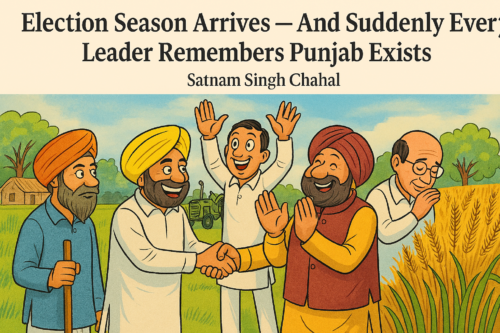
 The season of the Punjab Assembly election is approaching, and with it comes the grand annual migration of leaders back to their constituencies. For five years, many of them were invisible, busy, unavailable, or “working silently,” but now they are suddenly everywhere — in villages, in markets, in gurdwaras, and even in those remote corners where the mobile network disappears but the vote count does not. Their return is almost poetic, like watching migratory birds come home, except these birds arrive with media teams, loudspeakers, and promises that could power a rocket to Mars.
As the election breeze begins to blow, Punjab witnesses a magical transformation. Roads that were crying for repair suddenly get patched overnight. Streetlights that were dead for years start glowing as if they’ve been reborn. Water supply becomes the top priority, and every leader begins addressing every voter as “brother,” “uncle,” “auntie,” or “my dear youth,” depending on the age and potential vote value. Problems that were ignored for half a decade are now treated with dramatic shock, as if the leaders are discovering them for the first time in human history.
The field visits are a spectacle of their own. Leaders walk through muddy streets wearing spotless white clothes, trying to look humble while praying that their shoes survive the journey. They take a single heroic bite of a paratha for the camera, nod with exaggerated appreciation, and declare, “This is the real taste of Punjab,” before quietly handing the rest back to the plate. In farms, they touch wheat crops with the seriousness of a doctor checking a patient’s pulse, sit on tractors for exactly fourteen seconds, and deliver speeches about agriculture that make farmers wonder whether the leader even knows the difference between wheat and mustard.
Meanwhile, the manifesto race is in full swing. Parties are printing promises faster than wedding cards. One promises free electricity, another promises free water, and a third promises free everything except oxygen — though they hint that even that might be negotiable. Some promises are so grand that even the voters look up at the sky and whisper, “God, is this even possible?” God, wisely, remains silent.
Through all this, the voters watch with a calm, knowing smile. They listen to speeches, shake hands, and nod politely, but inside they carry the same timeless question: “Where were all these people for the last five years?” Election season has arrived, leaders are in the field, and Punjab — as always — is observing everything with humour, patience, and a memory sharper than any manifesto.