
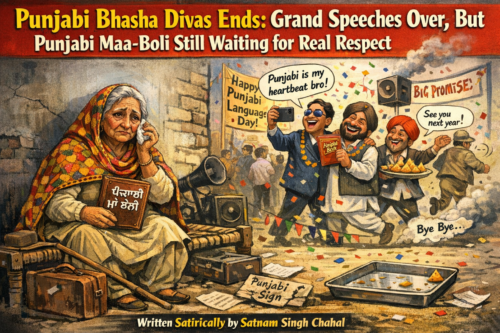
 The Annual Punjabi Bhasha Divas celebrations are over once again, and like every year, the noise, speeches, and slogans have faded faster than a political promise after elections. For twenty-four hours, the entire state suddenly remembers that Punjabi is not just a language, but supposedly their pride, heritage, and beating heart. Schools rehearse the same old speeches downloaded from last year’s WhatsApp messages, offices hang banners written in huge English fonts boldly wishing everyone “Happy Punjabi Language Day,” and political leaders—who otherwise mix Hindi, English, and confusion in every sentence—start speaking such heavy Punjabi that even folk singers feel insecure.
But the next morning, everything returns to normal. The microphones go silent, the samosa plates vanish, and Punjabi Maa-Boli quietly slips back into the same dusty corner where she spends the rest of the year. Her condition remains unchanged—ignored, undervalued, and treated like an old family member whom everyone loves only on special occasions but forgets the moment the celebration ends. The day ends with praise, but the year ends with neglect.
What did we gain? We gained long speeches no one wrote themselves. We gained hundreds of selfies where people proudly held Punjabi books they didn’t bother to open after the photo session. We gained promises from leaders—from making Punjabi compulsory to promoting it globally—that were immediately buried under government files the moment the event ended. A full truck of commitments was unloaded onto the stage, but not a single commitment travelled beyond the gate of the venue.
And what did we lose? We lost yet another precious year in which Punjabi could have become the natural administrative language of government offices. We lost the chance to revive fading Punjabi signboards that are being replaced by English-only boards faster than climate change. We lost another opportunity to ensure our children speak Punjabi proudly instead of treating it like an optional ringtone. And, of course, the most tragic loss of the entire celebration: the samosas finished before half the audience could reach the table.
Meanwhile, Punjabi Maa-Boli stands in the background, wearing her phulkari dupatta, clearing her throat softly, hoping someone will notice her. She keeps asking, “Will someone remember me tomorrow, too?” But everyone is busy making Instagram reels titled “Punjabi is my heartbeat bro,” using filters that look more Korean than Punjabi. The situation is comic yet painful, funny yet frightening. The celebrations come every year, but Punjabi Maa-Boli continues to wait—hoping someone will love her more than just one day out of three-hundred-and-sixty-five.
Satire Written by Satnam Singh Chahal