
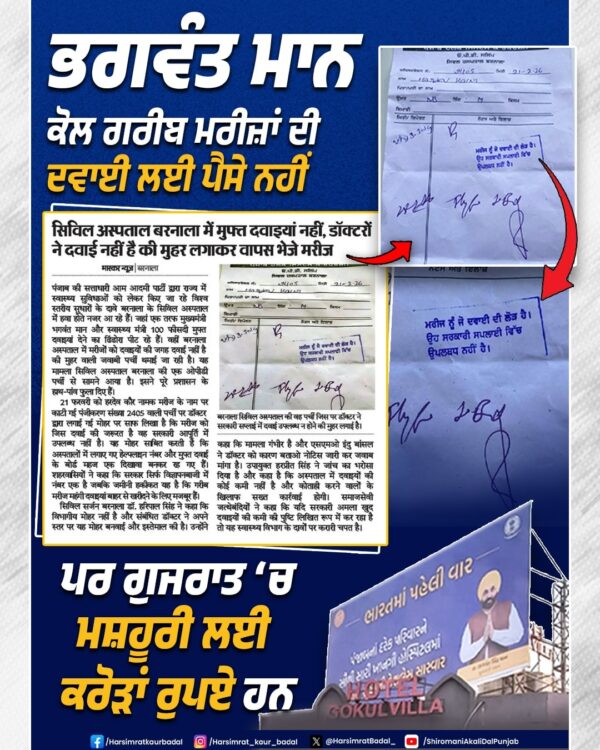
 As doctors sign prescriptions and administrators issue seals, sick patients in Barnala are left to buy medicines out of their own pockets — defeating the entire purpose of public healthcare
There is a cruel irony playing out inside the government hospital in Barnala, Punjab. A patient walks in, unwell and trusting that the state will care for them. A doctor examines them. A prescription is written. An official government stamp is pressed onto the paper — a mark of institutional authority, a symbol of the state’s promise. And then the patient is turned away, told the medicine is not available. The stamp meant nothing. The prescription was theatre. The patient, often poor and with nowhere else to turn, must now either go without treatment or find money they do not have to buy medicine from a private pharmacy. This is not an isolated incident. It is a systemic failure — one that exposes the yawning gap between Punjab’s stated commitment to public health and the daily reality faced by ordinary citizens who depend on government facilities. The Aam Aadmi Party government came to power on promises of free, quality healthcare for all. The “Health Helpline” number 73472-00994 is printed on pamphlets and broadcast on television. But when patients dial that number or walk through those hospital doors, they are met not with medicine but with apologies, redirections, and an empty shelf.
What makes the Barnala case particularly damning is the detail at its centre: the official government seal. A stamp on a document carries the weight of the state. It signals that the machinery of government has reviewed, approved, and stands behind what the paper says. In this case, the stamp is being used to certify prescriptions for medicines that the hospital cannot or will not provide. It lends legitimacy to a process that ultimately fails patients. It is bureaucratic performance masquerading as healthcare delivery.
The hospital’s own records reportedly show that a patient with Registration No. 2406 was prescribed medicines that never materialised. Reports indicate that 100% of the prescribed drugs were to be dispensed free of charge inside the hospital, yet patients are routinely told to go elsewhere. No satisfactory explanation has been given. No accountability has been assigned. The stamp remains on the paper; the medicine remains unavailable.
The Deputy Commissioner said, “I will personally follow up on this matter.” The Civil Surgeon has reportedly promised swift action. These statements are welcome — but they are not enough. Officials in Punjab have a troubling habit of responding to public embarrassment with reassurances that quietly dissolve once media attention fades. What is needed is not a press statement but a structural solution: a fully funded, regularly audited, and adequately stocked medicine supply chain in every government hospital.
The Punjab Health Department must publicly explain why medicines prescribed under its own hospital’s letterhead are unavailable within that same hospital. It must disclose procurement records, distribution data, and stock reports for Barnala Civil Hospital. It must investigate whether negligence, corruption, or sheer administrative incompetence is responsible for this failure — and it must do so transparently, with findings made public.
Among those affected are patients suffering from jaundice — a condition that, while treatable, can become life-threatening when care is delayed or incomplete. That jaundice patients are among those left without medicines in a government hospital is not a footnote. It is an indictment. These are vulnerable individuals who cannot afford private care. They placed their trust — and their health — in the hands of the state. The state issued them a stamp. It did not issue them medicine.
Punjab’s healthcare crisis is not new, but each new revelation — each patient turned away, each stamped prescription that leads nowhere — makes it harder to accept official reassurances that things are improving. If the government is serious about universal healthcare, it must ensure that what is written on a prescription can actually be dispensed at the pharmacy window. Anything less is not healthcare. It is a bureaucratic insult to the sick.
This editorial calls for urgent, concrete action on the following fronts:
1. An immediate audit of medicine procurement and distribution at Barnala Civil Hospital, with results published within 30 days.
2. Accountability for officials responsible for stock shortages, including the Medical Officer and pharmacy in-charge.
3. Emergency restocking of essential medicines across all government hospitals in Punjab, not only those under media scrutiny.
4. A public-facing real-time medicine availability dashboard for all district hospitals, so patients know before arriving what is and is not in stock.
5. A formal apology and compensation mechanism for patients who incurred out-of-pocket costs for medicines that should have been provided free of charge.
A government that cannot stock the shelves of its hospitals has forfeited the right to put its seal on prescriptions. Until medicines are consistently, reliably, and freely available to every patient who walks through those doors, that stamp is not a mark of care — it is a mark of shame.
This editorial is based on reporting by Jasvinder Singh Dhull, Punjabi Jagrat. The editorial board of this publication stands in full solidarity with the patients of Barnala Civil Hospital.