
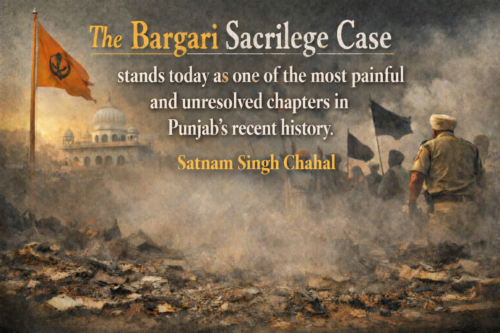
 The Bargari sacrilege case stands today as one of the most painful and unresolved chapters in Punjab’s recent history. Ten years have passed since the first shocking incident, yet justice remains elusive, promises remain unfulfilled, and the Sikh community continues to wait for closure. What began in 2015 as a moment of deep spiritual violation has stretched into a decade-long struggle marked by political assurances, stalled investigations, shifting narratives, and a growing sense of betrayal among the people.
The chain of events began in June 2015, when the sacred saroop of Sri Guru Granth Sahib Ji was stolen from Burj Jawahar Singh Wala. The incident shook the conscience of the Sikh community. Four months later, in October, 110 torn pages of Sri Guru Granth Sahib Ji were found scattered in Bargari, triggering widespread outrage and peaceful protests across Punjab. On October 14, 2015, police opened fire on the protestors in Behbal Kalan, killing two Sikhs and injuring many others. These events marked the beginning of a long and painful journey for justice.
Between 2016 and 2017, multiple SITs and CBI investigations were launched, yet none succeeded in identifying or arresting the main culprits. The Punjab Assembly formed its own committee, but even that effort produced no meaningful progress. Families of the victims, Sikh organisations, and civil society groups repeatedly demanded accountability, but the case remained stuck in bureaucratic and political deadlock.
In 2018, the CBI withdrew from the case, raising further questions about the seriousness of the investigation. By 2020, Dera Sacha Sauda chief Gurmeet Ram Rahim was officially named as a conspirator, but even this development did not accelerate the legal process. The case continued to move slowly, weighed down by legal challenges, political pressures, and administrative delays.
The years 2021 and 2022 brought more complications. The case was shifted to a Chandigarh court, adding another layer of procedural delay. In November 2022, Dera follower Pradeep Singh, who was linked to the sacrilege cases, was shot dead, further intensifying tensions and raising concerns about witness safety and the integrity of the investigation.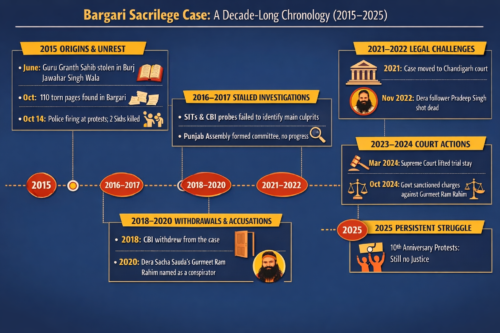
In 2023 and 2024, the legal landscape shifted again. In March 2024, the Supreme Court lifted the stay on the trial, clearing the way for proceedings to resume. In October 2024, the Punjab government sanctioned charges against Gurmeet Ram Rahim, a move that was seen as a long-awaited step forward. Yet, despite these developments, the pace of justice remained painfully slow.
By 2025, the tenth anniversary of the sacrilege, frustration had reached its peak. The Aam Aadmi Party, which came to power promising swift action, had assured the people that the accused would be arrested within fifteen days of forming the government. Senior leaders Kultar Singh Sandhwan and Kuldeep Singh Dhaliwal publicly promised that arrests would be made within a week. These commitments raised hopes across Punjab, but none of the promises materialised. The accused remain unpunished, and the community continues to wait.
Adding to the disappointment, several Babas and religious leaders launched a morcha after performing ardas before Sri Guru Granth Sahib Ji, vowing not to end their protest until justice was delivered. Yet the morcha was eventually concluded without any concrete progress, leaving many to question why the movement ended when justice had not been achieved.
Today, the Sikh community stands at a painful crossroads. Ten years have passed, but the wounds remain fresh. The questions remain unanswered. The promises remain unfulfilled. The families of the victims, the panthic organizations, and the wider Sikh sangat continue to demand accountability, transparency, and closure. The Bargari sacrilege case is no longer just a legal matter — it has become a symbol of the state’s failure to deliver justice, a reminder of broken promises, and a test of political integrity.
As Punjab marks a decade since the sacrilege, the demand is simple and unchanged: justice must be delivered, and those responsible must be held accountable. Until that happens, the struggle will continue, and the memory of Bargari will remain a powerful reminder of a community’s resilience and its unwavering commitment to truth.