
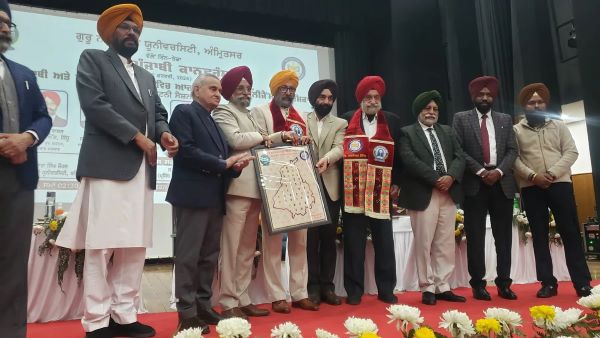
 It was my privilege to deliver the keynote address at the inaugural session of the three-day World Punjabi Conference at Guru Nanak Dev University, Amritsar, on Februray 20, 2026, on the theme, “The Role of Artificial Intelligence in Punjab, Punjabi and Punjabiyat.”
The subject could not have been more timely.
Artificial Intelligence is no longer a futuristic abstraction. It is not a matter for engineers alone. It represents a structural shift in how knowledge is produced, how economies function, how governance is conducted, and how cultures remain visible in an increasingly algorithm-driven world.
Every linguistic community today faces a quiet but consequential question: will it remain digitally relevant, or will it gradually slip into algorithmic invisibility?
Punjab must confront this question honestly.
I also wish to record my sincere appreciation for the Chief Guest, Sardar Tarlochan Singh, former Member of Parliament, whose address placed the very idea of Punjab, Punjabi and Punjabiyat in a wider historical continuum—tracing its civilisational depth from the pre-Christian era through successive political and cultural phases to modern times. His framing offered both perspective and balance, reminding us that technology must be understood within the longer arc of history.
A Civilisational Shift, Not Just a Technological One
In my address, I argued that Artificial Intelligence is not merely a technological transition; it is a civilisational one. The printing press reshaped religious authority. The industrial revolution redrew economic hierarchies. The Green Revolution transformed Punjab’s agricultural landscape. Artificial Intelligence belongs in that category of change — deep, systemic and irreversible.
The issue before us is not whether AI will influence Punjab. It already does. The real question is whether Punjab will shape its engagement with AI thoughtfully and strategically — or remain a passive consumer of technologies designed elsewhere.

Punjabi in the Age of Datasets
Languages now survive not only in classrooms and homes, but in datasets.
AI systems learn from digital corpora. If Punjabi is underrepresented in structured, high-quality digital datasets, it will inevitably be underrepresented in global AI systems — in search results, translation tools, academic research engines, and knowledge platforms.
I emphasised the urgent need for a comprehensive Punjabi digital corpus: linguistically rich, academically vetted and technologically usable. This must include not only contemporary literature but also digitised, searchable access to our literary and scriptural heritage, including Sri Guru Granth Sahib and related scholarship.
For the first time in history, technology makes it possible for thematic queries, contextual cross-referencing and real-time multilingual explanations to be available to anyone, anywhere. Such tools can extend access without diluting authenticity.
Equally significant is the ability of Artificial Intelligence to bridge script divides. Real-time transliteration between Gurmukhi and Shahmukhi can ensure that Punjabi speakers across borders and in the global diaspora engage with shared heritage in the script most natural to them. When technology removes barriers rather than erects them, it strengthens civilisational continuity.
Employment, Adaptation and the Algorithmic Economy
Artificial Intelligence is also reshaping employment patterns. It will replace repetitive tasks long before it replaces entire professions. Clerical work, routine drafting, basic translation and predictable cognitive functions are already being automated.
But the deeper truth is this: jobs will increasingly be taken not by machines alone, but by individuals who use machines more effectively than others.
Punjab’s universities must therefore integrate AI literacy across disciplines — not confine it to engineering departments. The algorithmic economy will require administrators, lawyers, journalists, agriculturists and scholars who are conversant with AI tools, data structures and digital reasoning.
Punjab once led the Green Revolution. It must not remain absent from the Algorithmic Revolution.
Agriculture, Governance and Digital Sovereignty
AI-driven precision farming, water modelling and crop analytics hold immense potential for Punjab’s agricultural sustainability. Similarly, predictive governance and data-informed policy can improve public service delivery.
Yet these opportunities come with important questions: Who owns agricultural data? Where is citizen data stored? Who designs the algorithms that influence public decision-making?
Digital transformation without digital sovereignty risks creating new forms of dependency. Punjab must be an informed participant in the design and governance of AI systems, not merely a source of raw data.
Institutionalising the Vision
In my remarks, I suggested that Guru Nanak Dev University consider institutionalising research in Artificial Intelligence within a dedicated interdisciplinary framework — bringing together computer science, linguistics, history, public policy and agriculture.
A Centre for Artificial Intelligence and Civilisational Studies, or a similar structured initiative, could anchor sustained scholarship on Punjabi language digitisation, AI ethics, agricultural analytics and digital governance. Universities must not simply host conferences on AI; they must create durable research platforms that engage with it systematically.
I was heartened to note that Member of Parliament Vikramjit Singh Sani announced a contribution of Rupees One Crore from his MP Local Area Development Fund to support this initiative. Such financial backing gives substance to intellectual intent. It signals that the conversation must translate into infrastructure.
Punjabiyat in the Digital Age
Punjabiyat has historically represented resilience, enterprise and adaptability. In the digital era, it must also represent technological confidence.
Cultural identity that is not digitised does not vanish immediately, but it risks becoming peripheral in global knowledge systems. At the same time, AI can preserve oral histories, archive folklore, expand global access to Punjabi literature and strengthen educational outreach to the diaspora.
The challenge is not whether machines will become intelligent. The challenge is whether we will deploy that intelligence wisely.
Artificial Intelligence possesses computational power. It does not possess conscience. It does not possess judgment. Those remain human responsibilities.
A Note of Gratitude
I remain grateful to Dr Karamjeet Singh, Vice-Chancellor, and the faculty and organisers of Guru Nanak Dev University for hosting a conference that addressed a subject of contemporary urgency with seriousness and foresight.
The conversation initiated in Amritsar must now continue in research laboratories, policy forums, classrooms and public discourse.
The question before us is simple: will Artificial Intelligence speak Punjabi, understand Punjabiyat, and reflect the aspirations of Punjab?
The answer depends not on technology alone, but on the clarity of our intent and the strength of our institutions.