
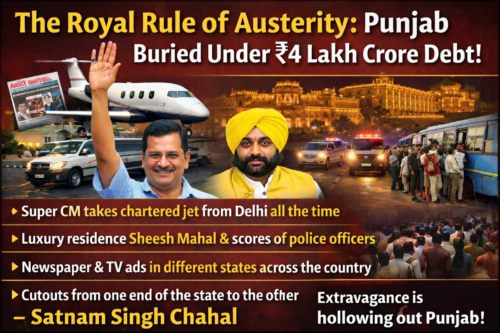
 Punjab today finds itself at a strange crossroads—caught between towering promises of change and the suffocating reality of a governance model powered more by spectacle than substance. At the center of this growing debate is the ruling Aam Aadmi Party (AAP) and its national convenor Arvind Kejriwal, who has increasingly been portrayed as the de-facto “Super CM” of Punjab. Chief Minister Bhagwant Mann may occupy the office, but the reins of power, perception, and projection appear firmly in Kejriwal’s hands.
What has disturbed many Punjabis is the extravagance that accompanies even the smallest official event. Whether it is the inauguration of a minor project or a modest political rally, the script remains the same: a rented luxury chartered jet first takes off from Punjab, flies to Delhi, picks up the “Super CM,” and then returns to Punjab burning crores in the process. A state neck-deep in debt behaves like a kingdom preparing for the arrival of royalty.
Once on the ground, the optics only grow grander. The CM’s residence at Sheesh Mahal already infamous for its cost now serves as a symbol of governance built more on show than service. Hundreds of police officers are deployed, convoy routes are sanitized, and public resources are diverted all to maintain an image of power that grows more expensive by the day.
The propaganda machinery runs at full throttle. Front-page advertisements in newspapers across the country promote the “Punjab Model,” at a cost that Punjab’s treasury can hardly afford. Television commercials, YouTube push ads, sponsored social-media campaigns, and brightly lit bus-stand billboards in states far from Punjab continue to amplify a narrative that has little connection with the state’s crumbling finances. The highway from Chandigarh to Amritsar is lined with giant cutouts and hoardings of the CM and Super CM, turning the route into a corridor of political self-promotion.
On the day of rallies, crowds are stuffed into buses, often brought from distant districts, to create the illusion of mass enthusiasm. But behind the orchestrated excitement lies a quieter, more troubling truth: Punjab is financially exhausted. With a public debt crossing ₹4 lakh crore, experts warn that the state is approaching an unsustainable economic cliff. Revenue has not increased, industries are struggling, farmers are under pressure, and yet the government continues to spend extravagantly on optics and promotions.
Critics argue that this culture of spectacle is hollowing out the state from within. Instead of addressing the real issues of drug abuse, unemployment, agrarian distress, fiscal crisis, and declining law and order, the government seems more focused on image-building and nationwide publicity. Punjab’s governance has shifted from problem-solving to public-relations theatre, and the cost is being paid by ordinary citizens.
The ruling party came to power promising transparency, simplicity, and honesty. But the contrast between those promises and today’s royal-style functioning is stark. When a state drowning in debt behaves like it is hosting a king, it raises serious questions about priorities, economic prudence, and political integrity.
Punjab deserves leadership that treats public money as a sacred trust, not a tool for projection. The growing disconnect between grand political shows and the grim financial reality on the ground is becoming impossible to ignore.Unless governance returns to humility, accountability, and genuine public service, the burden of this extravagance will keep pushing Punjab deeper into crisis—while the “Super CM” continues to fly in and out on chartered jets,untouched by the struggles of the common Punjabi.