
 For many years, Punjab witnessed a long pause in visible development work. Roads remained unrepaired, infrastructure projects moved slowly, and public facilities showed signs of neglect. Only recently has the ruling party accelerated construction, beautification, and repair work across the state. This sudden shift has led many observers to question why development began so late. Analysts often point to financial limitations, administrative delays, and shifting political priorities as major reasons. Punjab’s treasury has been under pressure for years, leaving little room for large-scale development. Bureaucratic procedures, tender processes, and departmental coordination also slowed progress. Some experts note that in many Indian states, development activity tends to intensify closer to election cycles, when visibility becomes a political necessity rather than a long-term plan.
Punjab’s economic situation adds another layer to this discussion. Once considered one of India’s strongest state economies, Punjab now faces structural challenges that have weakened its financial stability. Agriculture, the backbone of the state, is struggling due to rising input costs, stagnant crop diversification, and severe groundwater depletion. Industrial growth has not kept pace with other states, limiting job creation and tax revenue. A significant portion of the state budget is consumed by salaries, pensions, and interest payments, leaving limited funds for development. Economists often describe Punjab’s financial model as one where expenditure grows faster than income, creating long-term stress on the state’s economy.
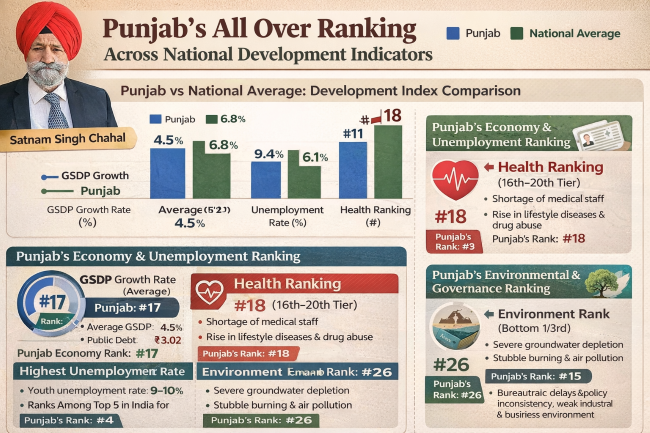
Punjab’s ranking in various national indicators reflects this decline. In education, the state has slipped from its earlier leadership position and now stands in the middle range. Health indicators remain better than many states but no longer reflect the dominance Punjab once enjoyed. Industrial investment rankings show Punjab trailing behind states that have aggressively reformed their business environments. Even in agricultural sustainability, Punjab ranks low due to environmental pressures and unsustainable farming patterns. These rankings collectively highlight a state with potential but struggling to maintain its earlier momentum.
The issue of debt is perhaps the most worrying aspect of Punjab’s economic landscape. Reports indicate that Punjab carries one of the highest per‑capita debt burdens in India. A large share of the annual budget goes toward paying interest on old loans, leaving little room for new initiatives. In some years, the state has had to borrow even for routine expenses rather than development. This creates a cycle where debt continues to rise while revenue remains stagnant. Economists warn that without structural reforms, Punjab may find it increasingly difficult to manage its financial obligations.
The question of who will repay this growing debt remains central. Ultimately, the burden falls on future generations through higher taxes, reduced public services, or slower development. Unless Punjab expands its economic base through industrial growth, agricultural reform, and improved revenue systems, the debt will continue to grow. The concern is not only the size of the debt but the absence of a clear roadmap for repayment. Punjab’s recent burst of development activity may be visible on the surface, but the deeper economic challenges require long-term solutions rather than short-term announcements.
In the end, the real issue is not why development started late, but whether Punjab can sustain it without sinking deeper into financial difficulty. The state stands at a critical moment where decisions made today will shape the economic future of the next generation.