
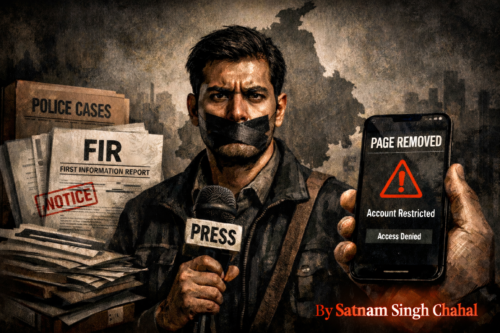
 In recent months, serious concerns have emerged over the Punjab government’s approach toward independent journalists and digital media platforms. From registering police cases against reporters to influencing the shutdown or restriction of social-media pages, the government is increasingly being accused of attempting to silence critical voices. These actions raise an important question: Is the government gaining anything from suppressing the media, or is it damaging democratic foundations in Punjab?
Multiple incidents suggest a troubling pattern where journalists critical of the government face legal notices, FIRs, or administrative actions. Social-media pages of news portals and individual journalists have reportedly been taken down or restricted following complaints routed through official channels. Such actions are often justified under vague claims of misinformation or law-and-order concerns, but critics argue that they selectively target voices questioning government performance.
The frequent registration of cases against media persons sends a chilling message across the journalistic community. Even when cases do not lead to convictions, the legal harassment itself becomes punishment. This environment creates fear, self-censorship, and hesitation among journalists who might otherwise investigate corruption, policy failures, or misuse of public resources.
With traditional media already under pressure, social media has become a powerful tool for independent journalism. The cancellation or blocking of Facebook pages, YouTube channels, and X (Twitter) accounts has therefore become a major concern. Digital platforms allow journalists to reach people directly, bypassing government advertising control. Silencing these platforms appears to be an attempt to control narratives rather than correct genuine misinformation.
In the short term, restricting the media may help the government reduce criticism and manage public perception. Fewer critical stories mean less immediate political discomfort. However, these gains are temporary and superficial. Suppressing media does not solve governance problems—it only hides them.
In the long run, targeting the media damages the government’s credibility. Public trust erodes when citizens feel information is being controlled. Courts often intervene in such cases, embarrassing the administration further. International human-rights and press-freedom organizations also take note, harming the state’s democratic image.
A free press is not the enemy of governance—it is a pillar of democracy. When journalists are intimidated, citizens lose access to unbiased information. Punjab, with its strong democratic and reformist traditions, risks sliding toward an atmosphere where power goes unquestioned and accountability weakSilencing journalists and restricting media platforms may offer momentary relief from criticism, but it comes at a heavy cost. The Punjab government gains little and loses much—public trust, democratic legitimacy, and moral authority. True strength in governance lies not in suppressing dissent, but in addressing criticism with transparency, accountability, and reform.