
 AAP Leads in Punjab’s Rural Power Battle as Zila Parishad and Block Samiti Results Redraw Local Politics.The political landscape surrounding Punjab’s latest Zila Parishad and Block Samiti elections reflects both the changing nature of rural power and the persistent role of grassroots networks. Polling took place on December 14, 2025, and counting began on December 17 under heavy security arrangements. These elections covered 347 Zila Parishad zones across 22 districts and more than 2,800 Block Samiti constituencies spread over 153 bodies, representing roughly 1.36 crore eligible voters. Yet turnout hovered around only 48 percent, signalling a notable degree of apathy or fatigue within the rural electorate. The scale of the exercise and the muted voter response suggest that, for many villagers, these polls remain driven more by local personalities, family networks, and the promise of direct benefits than by broad ideological commitments or state-level political rhetoric.
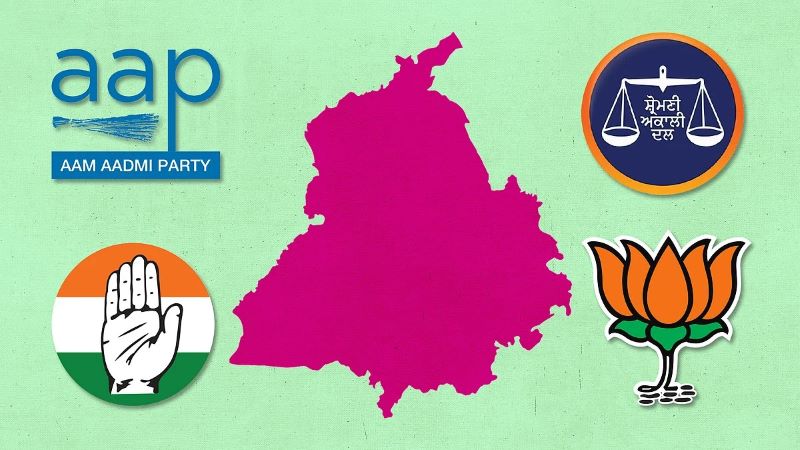
Early counting trends consistently indicated that the Aam Aadmi Party emerged as the dominant force in many districts, leading a significant share of Block Samiti positions and making inroads across the Zila Parishad landscape. This reflected the ruling party’s organisational strength in rural areas, where it has expanded welfare messaging and attempted to translate its administrative access into village-level mobilisation. Even so, the performance was uneven, and the picture that emerged was not one of absolute dominance. The Congress and Shiromani Akali Dal mounted strong resistance where traditional loyalties still matter, while the Bharatiya Janata Party and smaller factions used limited pockets of support to maintain relevance. In several places, independent candidates, local pressure groups, and influential village figures secured victories that broke the formal party pattern, underlining how powerful clan influence, caste dynamics, and village leadership remain in determining political outcomes.
Opposition parties attempted to blunt the ruling party’s advantage through a dual approach: electoral competition on the ground and a narrative of alleged irregularities. As polling unfolded, Congress and SAD leaders publicised claims of booth-capturing, administrative interference, and intimidation. These accusations became central to their post-poll messaging, and demands for repolling or official inquiry appeared in specific booths in parts of Malwa and other competitive pockets. While some of these incidents were investigated, others became political ammunition designed to delegitimise the ruling party’s organisational gains and cast doubt upon the credibility of the State Election Commission’s conduct. The allegations also drew attention to the larger issue of security deployment, which saw substantial police presence, repeated law-and-order reviews, and strict oversight during counting.
Despite the partisan contest, the stakes in these elections are fundamentally administrative. Zila Parishads and Block Samitis control important levers of rural development: local roads, water supply implementation, health sub-centre monitoring, primary school oversight, and allocation of funds under national and state development schemes. Political gains at this level translate to direct control over patronage—decisions about labour hiring for development works, prioritising link roads or drainage, and channelling welfare beneficiaries. If the Aam Aadmi Party consolidates its early leads into district-level control, it will gain a strategic demonstration platform ahead of the next assembly cycle, allowing it to claim that it can deliver governance not just in theory but through decentralised administration. However, the presence of independents in several wards means that coalition-style bargaining may determine chairpersonships, giving non-party actors a surprising amount of leverage.
Viewed politically, the elections also exposed several vulnerabilities. The low turnout indicates that mass enthusiasm is far lower than the intensity projected in state-level battles. Rural voters may see limited stakes or may distrust political promises altogether. In some districts, election duty controversies—such as the deaths of teachers in road accidents while on assignment—sparked protests and further criticism of administrative planning. Such episodes feed opposition narratives that governance systems are overstretched and insensitive. Conversely, they put pressure on the ruling party to respond quickly and show compassion, as public sentiment can turn sharply in local contexts where families expect immediate support.
The regional picture was highly differentiated. In Malwa, where recent elections have produced sharp political competition, allegations of malpractice and fractious contesting indicated that political stakes remain high. In central Punjab and parts of Doaba, strong village-based networks shaped outcomes regardless of party labels, demonstrating that electoral machinery still competes with deeply entrenched social organisation. Taken together, these patterns prove that rural Punjab cannot be treated as a monolith—fragmentation, personality politics, caste considerations, and local opportunity structures shape every outcome.
For AAP, the opportunity lies in turning these results into governance credibility. If the party can channel funds transparently, avoid administrative heavy-handedness, and show quick improvement in local services, it may convert limited rural scepticism into political advantage. For the Congress, SAD, and BJP, the path forward lies in combining litigation, public protest, and recruitment of influential local intermediaries. Their ability to transform allegations into sustained mobilisation may determine their rural recovery. Independents, meanwhile, now hold bargaining power because district-level coalitions cannot be formed without them in closely divided bodies. The coming weeks will therefore be defined not just by final tally announcements, but by negotiations over chairpersonships and committee control—positions that are far more powerful than their low public profile suggests.
Ultimately, the 2025 Zila Parishad and Block Samiti elections provide a revealing snapshot of Punjab’s political mood: competitive but tired, decentralised rather than ideological, still driven by the arithmetic of local influence rather than a sweeping wave for or against any single party. They confirm that while ruling parties hold advantages, they cannot escape the constraints of ground-level legitimacy, nor the bargaining power of rural actors who operate outside formal partisan lines. The true consequences of these results will unfold not in counting halls but in the implementation of development schemes, the settlement of local disputes, and the everyday experience of governance in the state’s villages.