
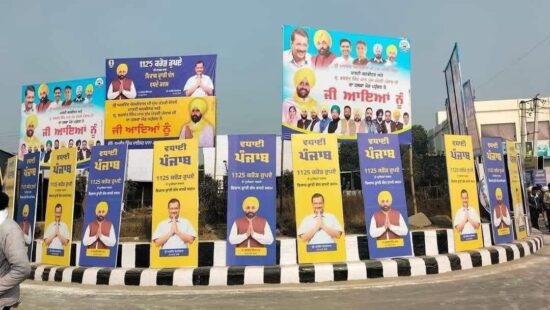
 From the very first day of assuming power, the Punjab government has relied more on publicity slogans than on policy substance. Several thousand crore rupees of public money have allegedly been spent on aggressive advertisements, self-congratulatory campaigns, and image-building exercises, while the core issues of Punjab industrial stagnation, unemployment, agrarian distress, and youth migration remain unresolved. What was promised as a new era of governance has, in practice, turned into an era of loud claims with little to show on the ground.
A major pillar of the government’s narrative has been the repeated assertion by the Chief Minister that “big industries are coming to Punjab.” These claims were amplified through advertisements, social media blitzes, hoardings, and sponsored media content across India and abroad. However, despite these tall promises, there is no visible industrial wave in Punjab. No major multinational manufacturing unit, no transformative industrial corridor, and no large-scale job-creating investment has materialised. Industrial estates remain underutilised, and existing units continue to struggle with high power costs, regulatory uncertainty, and law and order concerns.
The irony is that while crores are being poured into publicity, Punjab’s traditional industries textiles, bicycle manufacturing, sports goods, small and medium enterprises, are crying for support. Entrepreneurs repeatedly raise concerns about bureaucratic hurdles, lack of incentives, and an unstable policy environment. Instead of addressing these structural problems, the government appears more focused on selling an illusion of success. Public relations has replaced public policy.
Even investment summits and roadshows announced with much fanfare have produced little concrete outcome. Memorandums of Understanding (MoUs), often showcased as proof of success, rarely translate into actual projects on the ground. MoUs do not create jobs; factories do. Press conferences do not revive the economy; sustained industrial policy does. Unfortunately, the gap between announcements and execution continues to widen.
The financial burden of this so-called “fake publicity” ultimately falls on the people of Punjab. At a time when the state is drowning in debt, struggling to pay salaries, pensions, and meet welfare commitments, spending thousands of crores on advertisements is not just irresponsible it is an insult to taxpayers. Money that could have been invested in skill development, industrial infrastructure, power subsidies for manufacturers, or incentives for startups has instead been diverted to polishing the government’s image.
Unemployment among youth remains alarmingly high, forcing thousands to migrate abroad every year. If industries were truly coming to Punjab as claimed, this exodus would have slowed. The reality on the ground tells a different story—one of broken promises and shattered hopes. The government’s constant self-praise cannot hide the fact that Punjab has failed to attract meaningful new investment under the current regime.
In conclusion, the Punjab government’s approach from the beginning appears to be built on optics rather than outcomes. Governing through advertisements may create headlines, but it does not create factories, jobs, or prosperity. The people of Punjab are no longer impressed by slogans and staged announcements. They are demanding accountability, transparency, and real development. Continuing to make a fool of the public with fake publicity may serve short-term political interests, but it is pushing Punjab further away from economic recovery and long-term stability.