
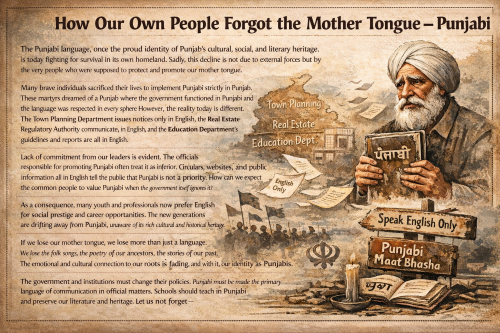
 The Punjabi language, once the proud identity of Punjab’s cultural, social, and literary heritage, is today fighting for survival in its own homeland. What makes this crisis even more painful is that outsiders have not weakened Punjabi, but by the very people who were supposed to protect, promote, and implement it. The decline of Punjabi is not accidental—it is the result of decades of negligence by political leaders, bureaucrats, and government institutions who failed to honour their responsibility toward the mother tongue.
Many people have sacrificed their lives in the struggle to ensure the strict implementation of Punjabi in Punjab. From student movements to cultural activists, numerous individuals stood up against injustice, discrimination, and anti-Punjabi policies. They imagined a Punjab where government offices communicated in Punjabi, schools taught in Punjabi, and every citizen took pride in the language. However, despite their martyrdom and sacrifices, the reality today stands in sharp contrast. Those who carry the responsibility on paper have rarely shown sincerity in practice.
The departments of the Punjab Government, which should have been the guardians of Punjabi, have instead become the biggest violators. The Town Planning Department of Punjab routinely issues notifications and circulars only in English. The Real Estate Regulatory Authority (RERA Punjab), which directly deals with the public, prefers English in its communication, making it difficult for ordinary Punjabis to understand important legal and property-related information. Even more disappointing is the Education Department itself—an institution expected to promote language and culture that continues to issue guidelines, websites, and reports mainly in English rather than Punjabi.
This behaviour sends a clear message: the administration treats Punjabi as a secondary or optional language, not as the mother tongue of the state. When government officers and departments do not respect the language, how can we expect the common people to uphold it? As a result, many individuals are gradually drifting toward English for status, employment, or social pressure, forgetting that Punjabi is not just a language—it is our identity, our history, our roots.
If Punjabi is weakened in its own soil, the loss will not be linguistic alone. It will be cultural, emotional, and generational. The language in which our ancestors wrote poetry, sang folk songs, narrated stories, and lived their everyday lives is slowly disappearing from our official spaces. It is time for the Punjab Government, institutions, and society to wake up. The revival of Punjabi requires honest commitment, strict policy enforcement, and above all, pride in our mother tongue.
Punjabi will survive only when its people decide that they will no longer ignore it. The responsibility lies on all of us—students, parents, government officials, teachers, and the community at large. A nation that forgets its mother tongue ultimately forgets its identity. And Punjab must not allow that to happen.